
How to Pay Commissions
Once commissions are calculated and approved, the final step is paying your partners.
For most portals, PartnerPortal is where commissions are calculated, reviewed, and exported. The actual payment is then handled in the company’s own AP, finance, or bill-pay systems.
Choose Your Payment Workflow
Section titled “Choose Your Payment Workflow”Most customers use one of these two payout approaches:
| Workflow | Best for | What PartnerPortal does |
|---|---|---|
| Export and pay outside PartnerPortal | Most companies | PartnerPortal tracks commissions, your finance team pays them in its own systems |
| PayPal autopay | Older legacy workflows | PartnerPortal schedules and sends PayPal payouts automatically |
Pay Commissions Outside PartnerPortal
Section titled “Pay Commissions Outside PartnerPortal”This is the most common workflow.
In this setup:
- PartnerPortal calculates and tracks commissions
- your team reviews and approves the records inside PartnerPortal
- your finance or AP team exports those commissions into its own payment systems
- after the payment is complete, your team marks the commission records as Paid in PartnerPortal
Export commissions from the main Commissions page
Section titled “Export commissions from the main Commissions page”Open the main Commissions page.
Filter to the commissions you are ready to pay.
Click Export Commissions.
Choose the format you need.
Export the file and complete the payment in your AP, accounting, or payment system.
Update the commission records in PartnerPortal so they reflect the final paid state.
Choose the right export format
Section titled “Choose the right export format”PartnerPortal supports two commission export formats:
| Format | Best for | What it includes |
|---|---|---|
| AP-Ready | Importing into AP or bill-pay systems like Ramp, QuickBooks, or BILL | Vendor fields, invoice-style fields, amount, currency, and AP export defaults |
| Full Detail | Internal reporting, audits, or deeper analysis | More PartnerPortal-specific commission details |
For most payout operations, AP-Ready is the better starting point.
Use status and date filters
Section titled “Use status and date filters”The export modal supports:
- status filtering
- issue date range filtering
This is useful when you want to export only:
- commissions that still need approval
- commissions already approved for payment
- commissions from a specific month or quarter
- only paid history for reconciliation
If you have chosen a period in the Payout Summary card above the table, the export is limited to that period’s commissions as well, so the file matches what is on screen. For period and per-partner totals rather than row-level records, see How to Use Payout Reports.
Prepare AP-ready exports
Section titled “Prepare AP-ready exports”AP-ready exports are designed for teams that pay partners outside PartnerPortal through AP or finance systems.
Those exports can include:
- Vendor Name
- Vendor Email
- Vendor ID
- Invoice Number
- Invoice Date
- Due Date
- Amount
- Currency
- Description
- Expense Account
- Tax Code
- Class
- Location
- Department
- Tracking Categories
Add vendor details for better matching
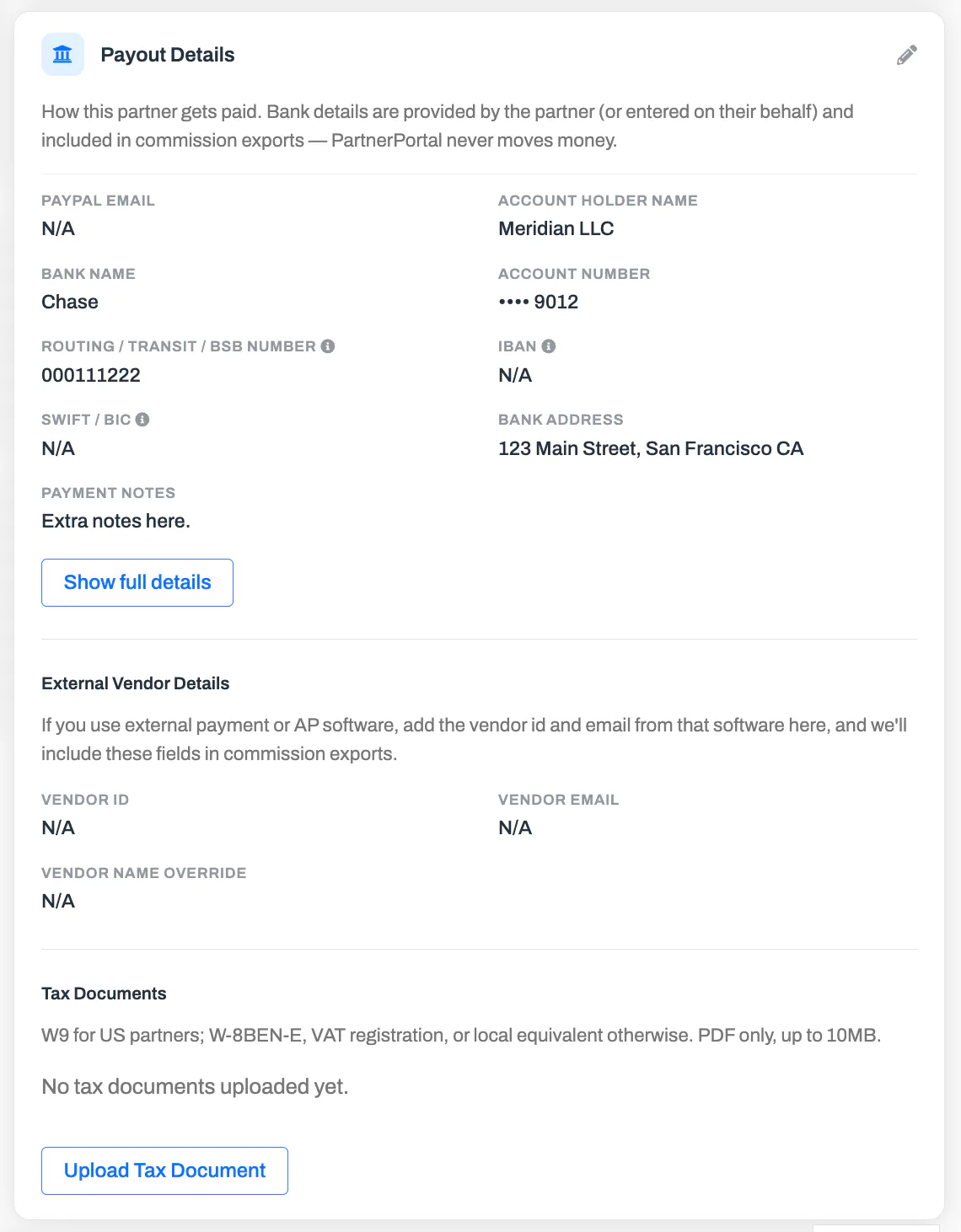
Section titled “Add vendor details for better matching”If your AP system uses vendor identifiers that do not exactly match the partner’s name in PartnerPortal, fill in the partner’s external vendor details first. They live in the External Vendor Details section of the Payout Details card on the partner record.
That usually means adding:
- Vendor ID
- Vendor Email
- optionally a dedicated Vendor Name
These values improve matching in external systems and reduce manual cleanup after export.
Set AP export defaults once
Section titled “Set AP export defaults once”If your team uses AP-ready exports regularly, set your accounting defaults in Payment Settings first.
The most important defaults are often:
- Expense Account
- Tax Code
- Class
- Location
- Department
- Tracking Category fields
Collect Partner Payment Details and Tax Documents
Section titled “Collect Partner Payment Details and Tax Documents”To pay partners through your own bank or AP systems, you need their payment details — and for US programs, usually a W9. Partners can provide both directly in PartnerPortal, so your team no longer has to collect bank details and tax forms over email.
PartnerPortal stores these details for your finance workflow only. It never uses them to move money.
How partners provide their details
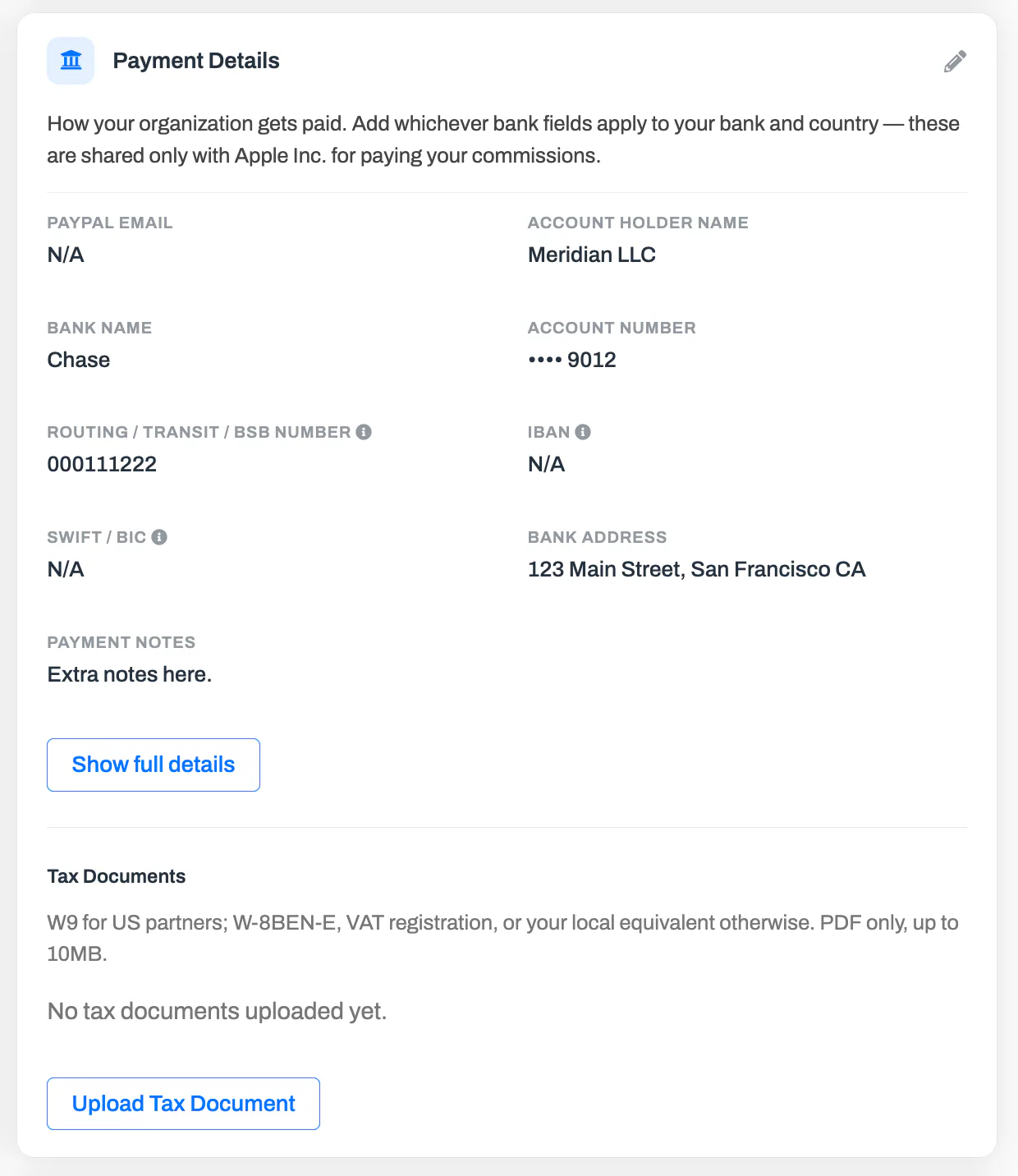
Section titled “How partners provide their details”Partner owners add their own payment details from their Account page, in the Payment Details card. They can enter:
- a PayPal Email (if your portal pays through PayPal)
- bank details: Account Holder Name, Bank Name, Account Number, Routing / Transit / BSB Number, IBAN, SWIFT / BIC, and Bank Address
- Payment Notes for anything else your finance team needs, such as an intermediary bank or a payment reference
Every field is optional, and all fields are always shown — partners fill in whichever apply to their bank and country. A US partner typically provides a routing and account number, while a European partner provides an IBAN.
Partners can also upload tax documents in the same card: a W9 for US partners, or a W-8BEN-E, VAT registration, or local equivalent for international partners. Uploads are PDF only, up to 10MB.
How admins view and manage them
Section titled “How admins view and manage them”On the admin side, the same information appears in the Payout Details card on each partner record. Portal owners and admins can also enter or update details on a partner’s behalf — useful when a partner sends their information by email.
A few things to know about how this data is protected:
- The account number and IBAN display masked, showing only the last four characters.
- Portal owners and admins can click Show full details to reveal the full values, and editing reveals them automatically. Each reveal is recorded for auditing.
- Portal team members see masked values and tax-document names only — they cannot reveal bank numbers or open tax documents.
- Tax documents are stored privately and open through secure, expiring links.
Pay through PayPal
Section titled “Pay through PayPal”PartnerPortal also supports an older automated payout workflow through PayPal.
In that setup:
- commission records follow the legacy status workflow
- the schedule’s Payment Type is set to PayPal
- scheduled commissions are typically sent automatically on the next nightly payment run once their issue date is reached
For the full PayPal setup, partner PayPal email requirements, and integration steps, see PayPal.
Troubleshooting
Section titled “Troubleshooting”The AP file is missing accounting fields
Section titled “The AP file is missing accounting fields”Set or update the AP Export Defaults in Payment Settings before exporting again.
The wrong commissions are included
Section titled “The wrong commissions are included”Check the selected statuses and issue-date range in the export modal.
The vendor does not match in the AP system
Section titled “The vendor does not match in the AP system”Update the partner’s external vendor details so the export uses the correct vendor name, email, or ID.
A commission was paid, but PartnerPortal does not reflect it yet
Section titled “A commission was paid, but PartnerPortal does not reflect it yet”If you paid the commission outside PartnerPortal, update the commission record so its status reflects the completed payout in the app.
If you need to configure the upstream commission workflow first, see How to Manage Commissions and Payment Settings.