
Partner Enablement: What It Is and How to Do It Well
Partner enablement is the training, content, tools, and support that let partners sell, implement, and support your product. What it covers, how to build and run an enablement program, how to measure it, and the software behind it.
Written by the team at PartnerPortal — PRM software used to run B2B partner and channel programs.
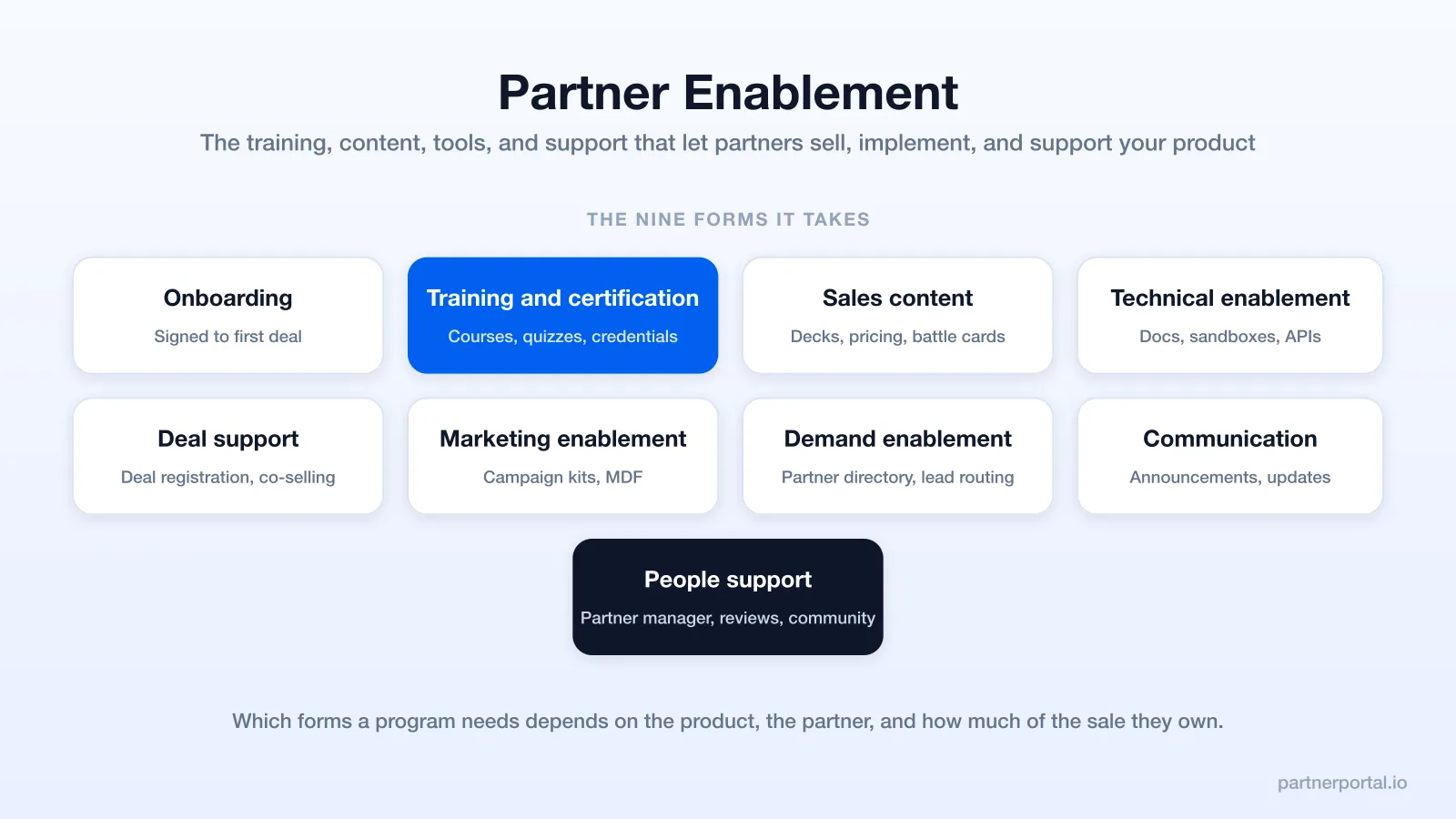
Partner enablement is the training, content, tools, and support a company provides so its partners can sell, implement, and support its product. The partners are outside businesses: resellers, referral partners, agencies, distributors, managed service providers, and technology partners. Enablement is what they need to know, what they can hand a customer, how they register and work a deal, and how they stay current as the product changes.
Enablement is continuous. Onboarding gets a partner to a first deal and then ends. Enablement is what gets them to the tenth deal, and the hundredth, as your product, pricing, and competitors change. It’s also broader than sales content. Training, technical documentation, deal support, co-marketing, a partner directory, and a steady flow of updates all count as enablement too. Few programs need all of these, and the real work is choosing which ones you need.
This guide covers what partner enablement is, the different approaches to it, which approaches each kind of partner needs, a framework for building an enablement program, how to run and measure it, and the software that delivers it. Each one links to a dedicated guide where one exists.
Full disclosure: PartnerPortal publishes this page. PartnerPortal is PRM software with built-in enablement features, so the software section includes our own product. We say so where it comes up.
TL;DR:
- Partner enablement is continuous, and broader than training. It’s the content, tools, and support — not just courses — that let partners sell, implement, and support your product. Onboarding gets a partner started, but enablement continues for as long as they sell for you.
- There are many approaches. The common ones are onboarding, training and certification, sales content, technical enablement, deal support, marketing enablement, demand enablement, communication, and people support.
- No program needs all of them. Which approaches matter depends on your product, how much of the sale the partner owns, and how the partner works.
- It belongs in one place. The partner portal — courses and content next to deal registration, not a separate system partners rarely visit.
- Measure results, not reach. Compare enabled partners with un-enabled ones on deal outcomes. Completion rates alone show who turned up, not who sold more.
What is partner enablement?
Partner enablement is the set of things a company gives its partners so they can do their part of the work well, and what that involves depends on the partner. A reseller has to sell and often implement the product. A referral partner only needs to recognize a good-fit customer and make the introduction. A technology partner is building and maintaining an integration, while a services partner implements and supports the product for the customer. The specifics change from one partner to the next, but the goal is always the same: a partner who can act without calling you first.
The term has several near-synonyms. Channel enablement and channel partner enablement usually mean enablement for reselling partners in a channel program. Partner sales enablement narrows it to the selling part. Partner readiness is sometimes used for the certification piece. This page uses partner enablement for all of it.
Four related terms are easy to confuse.
| What it is | How long it lasts | What it is measured by | |
|---|---|---|---|
| Sales enablement | Equipping your own sales team | Continuous | Rep productivity, win rate |
| Partner onboarding | Getting a new partner from signed to first deal | First 30–90 days | Time to first deal |
| Partner enablement | Equipping partners to sell, implement, and support, after onboarding and for as long as they are a partner | Continuous | Whether enabled partners produce more than un-enabled ones |
| Partner engagement | Whether partners stay active: logging in, registering deals, completing training | Continuous | Active-partner rate |
Sales enablement and partner enablement differ mainly in control. You can require your reps to complete training and use the approved deck. You cannot require that of someone who works for another company. Partner enablement has to earn its use.
Onboarding is a project with a clear end, while enablement is an ongoing program you keep running. See channel partner onboarding for the first 90 days.
Engagement is the outcome enablement is trying to produce — whether partners actually log in, register deals, and work with you once they have what they need. See partner engagement.
What partner enablement is not. It isn’t a folder of decks — a folder has no structure, no tracking, and no way to tell what’s current. It isn’t onboarding done a second time, and it isn’t incentives. Commissions, SPIFFs, and tiers give partners a reason to act, but enablement is what makes them able to act well. The two work together, even though you design them separately. See partner incentives.
Why it matters, and when less is more
A partner you can’t manage has to be able to sell without you, which is the whole case for enablement. A partner’s rep will be in front of a customer when you’re not in the room. What they say about your product, how they handle the competitor, whether they quote the right price, and whether they register the deal all depend on what you gave them beforehand.
The costs of weak enablement are specific. A partner trained a year ago is still selling last year’s product. When a rep can’t find the current deck, they send an old one. A partner who was never shown how to register a deal simply doesn’t, and the deal later turns into a dispute. One who doesn’t know what a good-fit customer looks like sends bad leads, or none at all. None of this is a motivation problem — it’s an information problem, and enablement is how you fix it.
Vendor-published guides claim large effects from enablement: faster time to first deal, higher partner-sourced pipeline, better win rates. The mechanism is sound. The specific figures are usually unsourced, so we do not repeat them here. The useful test is your own: compare partners who completed your onboarding course with partners who did not, on registered deals in the next quarter. That comparison is covered under measurement.
When less is more. Enablement has a cost on both sides — the work of building and maintaining it for you, and the attention it asks of your partners. For some programs, the right amount is small. A referral partner who sends two introductions a year may need only a description of a good-fit customer, a lead form, and a note about what they earn. An affiliate may need only links, a few assets, and a dashboard. Whether that is enough depends on the product and the partner. A referral partner for a complex product may need real product training to recognize a fit.
The question that decides most of this: how much of the sale, the implementation, and the customer relationship does the partner own? The more they own, the more they need from you. That is a starting point for the choices below, not a formula.
The approaches to partner enablement
Enablement is a category, not one thing, and there are many approaches to it. The ones below are the most common. They overlap, you could group them differently, and almost no program uses all of them. Each section says what the approach is, who needs it, what a good version looks like, and the minimum version for a small program. Where a dedicated guide exists, it’s linked. Several of these also overlap with the components of a partner program, and this page covers the enablement side of each.
Onboarding enablement
What it is. Everything a partner needs in the first 30 to 90 days: the agreement, portal access, first training, how to register a deal, the first resources, and a first opportunity to work.
Who needs it. Every partner type. The depth varies with how much the partner will do. A reseller’s onboarding is often a structured path. A referral partner’s may be a short course and a lead form, or more if the product takes real understanding to refer well.
What good looks like. Access the day the agreement is signed. A first course under 30 minutes. Deal registration set up before the first opportunity. A check-in at 30 days. A target of a first registered deal in the first month.
Minimum version. One course, one deck, deal registration, one call.
Full guide: channel partner onboarding.
Product and sales training, and certification
What it is. Courses that teach partners to position, demo, price, and sell the product, and to implement and support it where that is their role. Certification turns completion into a credential.
Who needs it. Resellers, services partners, and technology partners, usually in depth. Referral partners, to whatever degree the product requires. A simple product may need none at all, while a complex one may need a real course so partners can recognize a fit and describe it accurately.
What good looks like. Short lessons organized into courses. A quiz with a pass mark, so completion means something. Certifications that are awarded automatically and unlock a benefit: a tier, a rate, a listing. Completion tracked per partner company and per person. Refreshed with each major release.
Minimum version. One onboarding course with a quiz, and one certification that unlocks a benefit.
Full guides: partner training software for what to teach and how to organize it, and partner LMS for the system that delivers and tracks it.
Sales content and the resource center
What it is. The assets a partner’s rep uses in a deal: pitch decks, one-pagers, case studies, competitive comparisons, pricing and packaging guides, demo scripts, proposal templates, and ROI calculators. The resource center is where they live.
Who needs it. Any partner who sells or advises a customer during an evaluation. That is often resellers and agencies, and it can include referral partners who stay involved after the introduction.
What good looks like. One library, inside the partner portal, organized by what the partner is trying to do, not by your internal team structure. Every asset dated and versioned. Access by partner group, so each type sees what applies to it. Usage tracked, so you can see what is opened and what is ignored. A refresh owner.
Minimum version. One current deck, one pricing page, one case study, one competitive one-pager. A few assets partners trust are worth more than forty they’ll never open.
Full guide: Partner Resource Center (coming soon). Until then, the resources documentation covers how resource libraries work in PartnerPortal.
Technical enablement
What it is. Documentation, sandboxes, APIs, integration guides, architecture references, and technical certification. The enablement an engineer needs rather than a salesperson.
Who needs it. Services partners and systems integrators who implement the product. Technology partners who build on it. Managed service providers who run it.
What good looks like. Public or partner-gated documentation that is kept current. A sandbox environment partners can use without asking. A technical certification distinct from the sales one. A technical contact who answers.
Minimum version. Current docs and a named technical contact.
Full guide: Technical Partner Enablement (coming soon).
Deal support and co-selling
What it is. The help a partner gets on a specific deal: deal registration, lead and opportunity sharing, joint calls, access to your sales engineers, pricing approvals, and the rules of engagement that keep your direct team and partners from colliding.
Who needs it. Any partner who sells. Deal registration also matters to referral partners, because it is how their introduction is credited.
What good looks like. Deal registration that is quick to submit and answered within a day. Leads passed to partners with context and a follow-up window. A way for a partner to ask for help on a live deal and get it. Written rules for who pursues what.
Minimum version. Deal registration with a one-day response, and a named person partners can ask.
Full guides: channel conflict for deal registration and rules of engagement. Co-Selling with Partners (coming soon). In PartnerPortal, opportunities is the feature for sending leads to partners.
Marketing enablement
What it is. The assets and support that let partners generate demand: co-branded templates, campaign kits, email sequences, event support, through-partner marketing automation, and market development funds.
Who needs it. Partners who market to their own customers, which is often resellers and agencies. Technology and alliance partners for joint campaigns. Referral partners, when the program expects them to generate demand rather than only make introductions.
What good looks like. A small set of campaigns a partner can run with minimal customization. Clear rules for logo and brand use. MDF with pre-approval and proof of performance, once the program is mature enough to administer it.
Minimum version. One co-brandable one-pager and a brand-use guideline.
Full guides: channel partner marketing and market development funds.
Demand enablement: the partner directory
What it is. Making partners findable to your customers. A public partner directory lists partners by service, region, and specialty. Lead routing sends inbound customers to the right partner.
Who needs it. Services partners and resellers who want customers to find them. Technology partners through a marketplace or integration listing.
What good looks like. A directory your customers actually use, with profiles partners maintain themselves and filters that match how buyers search. A listing that partners have to earn, so it stays a benefit.
Minimum version. A partner page on your site that lists certified partners.
Full guide: partner directory.
Communication and updates
What it is. The flow of information that keeps partners current: release notes, announcements, newsletters, pricing changes, competitive updates, and direct messages.
Who needs it. Every partner type. A partner working from stale information sends the wrong leads and quotes the wrong price, whatever their type.
What good looks like. Announcements in the portal, targeted by partner group, with an email notification partners can rely on. A predictable cadence, such as a monthly update. Release notes written for partners, not copied from internal ones. A way to message a partner privately about their account.
Minimum version. A monthly email with what shipped and what it means for partners.
Full guide: Partner Communications (coming soon). In PartnerPortal, announcements and messages and files cover this.
People support
What it is. The humans behind the program: a partner manager who knows the partner’s business, office hours, quarterly business reviews, a community of partners, and events.
Who needs it. Every partner needs someone to ask. How much time each partner gets is a program decision, usually weighted toward the partners that matter most to it.
What good looks like. A named contact for every partner. A review cadence scaled to the partner’s importance. A partner manager who follows up personally when a partner goes quiet.
Minimum version. A named contact and a 30-day check-in.
Full guide: channel partner management.
What sits next to enablement
Two things are often grouped with enablement and are better designed separately.
Incentives are about motivation. Commissions, margin, SPIFFs, and tiers give partners a reason to act, while enablement gives them the ability to. A certification that unlocks a tier is where the two meet. See partner incentives and channel partner incentives.
Engagement is the result. Whether partners log in, register deals, and complete training is the outcome enablement and incentives together produce. See partner engagement.
Enablement by partner type
The approaches above are a menu. Which ones a program needs is not fixed by partner type. Two referral programs can need very different enablement. One sells a simple product where a referral partner only needs to recognize a fit. The other sells a complex product where the partner advises the customer through the evaluation. The second program may need training, content, and deal support that the first would never use.
Five questions do more to decide the right set than the partner’s label:
- How much of the sale does the partner own? Introducing a lead, running the evaluation, closing, or billing. More ownership calls for more sales content and deal support.
- Does the partner implement or support the product? If so, technical enablement and a technical certification are in scope.
- How complex is the product to position? A simple product needs a one-pager. A product with several use cases, integrations, and pricing options needs training even for partners who only refer.
- Does the partner market to its own customers? If so, marketing enablement and a directory listing matter. If not, they do not.
- How often does the product change? Fast-moving products need a steady flow of updates and recertification. Stable products can go longer between refreshes.
Partner type is a useful shortcut because it correlates with these answers. Resellers usually own more of the sale than referral partners, services partners usually implement, and technology partners usually need documentation more than decks. The table shows the approaches that often matter for each type, as a place to start. Your program’s answers to the five questions decide what you actually build.
| Approach | Referral / affiliate | Reseller / VAR | Services / SI | Technology / ISV | Strategic alliance |
|---|---|---|---|---|---|
| Onboarding | Often short | Often substantial | Often substantial | Often substantial | Often substantial |
| Training and certification | Depends on product complexity | Often central | Often central, with a technical track | Often technical rather than sales | Varies |
| Sales content and resource center | Depends on how much the partner advises | Often central | Often useful | Often light | Often useful |
| Technical enablement | Often light | Depends on whether they implement | Often central | Often central | Varies |
| Deal support and co-selling | Deal registration at least | Often central | Often useful | Often useful | Often central |
| Marketing enablement | Depends on whether they generate demand | Often central | Often useful | Often useful | Often central |
| Demand enablement (directory) | Often light | Often useful | Often central | Often central, via marketplace | Varies |
| Communication and updates | Needed | Needed | Needed | Needed | Needed |
| People support | Often light | Often substantial | Often substantial | Often useful | Often substantial |
See the types of channel partners for who these partners are and what motivates them.
A partner enablement framework
Two failure patterns come up often. Nothing gets built because the full list looks overwhelming. Or everything gets built at once and nothing is maintained. The framework below is designed to avoid both. It is scaled for a program of tens to a few hundred partners with one owner.
Step 1: Audit what partners get today
List what a new partner receives now, from signing to their first deal. Then ask five partners where they got stuck. The answers are usually specific: they could not find the current pricing, they did not know how to register a deal, the deck was out of date. Those are your first fixes.
Step 2: Segment partners by type and stage
Group partners by type, using the matrix above, and by stage: new, ramping, established. A new reseller and an established referral partner need almost nothing in common. Enablement that treats them the same serves neither.
Step 3: Choose the approaches each segment needs
For each segment, pick the essential approaches from the matrix and ignore the rest for now. Write down what you are not building and why. That list is as useful as the one you are building. It stops the program from sprawling.
Step 4: Build one home
Put everything in the partner portal: content, training, deal registration, updates, and the partner’s own record of what they have earned. One login. Partners who have to go to a second system for training, or email you for the current deck, are less likely to do either. See what is a partner portal.
Step 5: Launch to a pilot, then the segment
Pick five to ten engaged partners. Give them the first version. Watch where they hesitate and fix it. Then open it to the segment it was built for, with one message about what is there and what the certification unlocks.
Step 6: Measure, then add the next approach
After 90 days, look at completion, content use, and registered deals for the partners who went through the program against those who did not. Then add one more approach, the one the data or the partner interviews point to. One addition per quarter, measured, keeps the program maintained.
The minimum viable enablement program
For a ten-partner referral or agency program, the whole thing fits in a week:
- One onboarding course, under 30 minutes, with a quiz and a certification that unlocks something.
- One current deck.
- One pricing page.
- Deal registration with a one-day response.
- A monthly update email.
- A named contact.
That is a complete enablement program. Everything else on this page is what you add when partners ask for it or the data shows a gap.
The operating model
Enablement decays unless someone is responsible for it. The parts of the operating model:
An owner. In small programs, the person who runs the partner program, part-time. In larger programs, a partner enablement manager. The owner doesn’t produce everything. They decide what gets built, who builds it, and when it gets refreshed.
Named contributors. Product marketing owns the deck and the competitive comparisons. Product owns release notes for partners. Sales or sales engineering owns deal support. Without named contributors, every refresh lands on the owner, and refreshes slip.
A refresh cadence. Release-driven for product content: when something ships, the course and the deck change. Quarterly for competitive and pricing content. Annually for the full library, with a review of what partners opened and what they did not. Archive what nobody used.
A content calendar. A simple one. What is being refreshed this month, who owns it, and when partners will hear about it.
A feedback loop. A question in every quarterly business review: what could you not find? A short survey once or twice a year. In larger programs, a partner advisory council. The answers often point to problems that usage data does not show.
Measuring partner enablement
Enablement is measured in three layers. The first two are easy and tell you less than they appear to. The third takes some work and is the one that matters.
Leading indicators: did partners use it? Training and certification completion, per partner company and per person. Content opened and downloaded. Portal logins. Time from activation to first registered deal. These show whether the enablement is reaching partners. A low number here is a findability or relevance problem, and it is fixable quickly.
Lagging outcomes: did the channel produce? Partner-sourced pipeline and revenue. Partner win rate. Average deal size. Partner retention. These are the numbers the program is judged by. They move slowly, and by the time they drop the cause is a quarter old.
The joined comparison: did enabled partners produce more? Partners with a certified rep against partners without, on registered deals, win rate, and time to first deal. Partners who opened the competitive one-pager against partners who did not, on deals where that competitor appeared. This is the comparison that justifies the program and tells you which approaches are working. It requires enablement data and deal data to live in the same system, or to sync between the partner portal and the CRM. If they live apart, you will be exporting two spreadsheets and matching by partner name.
The full metric set and the partner scorecard are in channel performance metrics. Training completion is also one of the earliest signals of partner engagement.
Partner enablement best practices and common mistakes
Practices that tend to hold up.
- One login. Enablement lives in the partner portal, next to deal registration and commissions.
- Short pieces. A ten-minute lesson beats an hour-long webinar recording. A one-page competitive comparison beats a forty-slide deck.
- Lead with the moment. Organize content by what a partner is trying to do this week: handle a competitor, quote a price, answer a security question.
- Date and version everything. Partners cannot tell what is current without it, and undated content invites doubt.
- Tie certification to a benefit. A credential that unlocks nothing gives partners little reason to earn it.
- Ask partners. What did you use? What could you not find? What did a customer ask that you could not answer?
Mistakes that recur.
- Treating enablement as onboarding. A partner trained once sells last year’s product.
- The content dump. Forty assets in a flat folder is storage, not enablement.
- The same kit for every type. Referral partners drown in it, while resellers don’t get enough.
- No owner, or an owner with no contributors. Nobody is responsible for refreshing the library, so it drifts out of date.
- Measuring only completion. Completion shows reach. It does not show whether partners sold more.
- Buying the enterprise stack for a twenty-partner program. A through-channel marketing platform and a standalone LMS solve problems a small program does not have, and they add logins.
- Enablement without deal support. A trained partner who cannot get a quick answer on a live deal is still stuck on that deal.
Partner enablement software
Enablement can start in a shared folder and an email list. It stops working there at a predictable point: partners can’t find the current version, you can’t see who completed what, training goes untracked, and deal registration lives in an email thread. For many programs, that point arrives somewhere past ten to twenty active partners.
Four categories of software deliver partner enablement. Many programs need only one of them. Larger programs combine two or more.
| Category | What it covers | Best fit |
|---|---|---|
| PRM with built-in enablement | Partner portal, resource library, courses and certifications, deal registration, announcements, directory, commissions, reporting, in one login | Programs of tens to a few hundred partners that want one system |
| Standalone partner LMS | Deep training: learning paths, graded and proctored assessments, SCORM, recertification | Programs certifying many partners to a formal standard, or selling training |
| Sales-enablement content platforms | Content management, search, and usage analytics for sales assets — built for internal reps, with partner access as an extension | Large companies already running one for direct sales |
| Through-channel marketing automation (TCMA) | Co-branded campaign kits partners run themselves, plus MDF management | Mature channels with partners who market to their own customers |
Within the PRM category, enablement depth varies. Some PRMs offer a resource library only. Others include courses, certifications, announcements, and a directory. Check what is included and what is an add-on. Our best PRM software comparison covers the options. For training specifically, the partner LMS guide compares PRM-built training with standalone learning platforms.
PartnerPortal is a PRM with enablement built in. On every plan, including the free tier, it provides a resource library with access by partner group, courses with quiz lessons and certifications, announcements targeted by group with email notification, customizable partner emails, private messages and file sharing per partner, opportunities for sending leads to partners, a public partner directory, and SPIFF campaigns, alongside deal registration synced to the CRM and commission payouts. It’s built for the programs this guide is written for: tens to hundreds of partners, run by a small team, in one system. It doesn’t include SCORM import, proctored assessments, or through-channel marketing automation. Programs that need those add a dedicated tool from the categories above.
Related reading
- Channel Partner Enablement — the Enable stage of channel management, for reselling partners: sales content, training, tools, and co-marketing.
- Channel Partner Onboarding — the first 30 to 90 days, from signed to first deal.
- Partner Training Software and Partner LMS — what to teach partners and the system that delivers it.
- Partner Directory — making partners findable to your customers.
- Channel Partner Marketing and Market Development Funds — helping partners generate demand.
- Partner Engagement — keeping partners active after onboarding.
- Channel Partner Programs — the program enablement sits inside: types, components, tiers, and how to build one.
- Best PRM Software in 2026 — the platforms that deliver enablement, compared.
Frequently asked questions
What is partner enablement?
Partner enablement is the training, content, tools, and support a company provides so its partners can sell, implement, and support its product. Partners are outside businesses: resellers, referral partners, agencies, distributors, and technology partners. Enablement covers what they need to know, what they can hand a customer, how they register and work a deal, and how they stay current as the product changes. It is continuous. Onboarding finishes once a partner reaches a first deal, but enablement carries on for as long as they stay a partner.
What's the difference between partner enablement and sales enablement?
Sales enablement equips your own sales team. Partner enablement equips people who work for other companies. The difference is control. You can require your reps to complete training and use the approved deck. You cannot require that of a partner. Partner enablement has to be short, findable, and worth the partner’s time, and it has to live where partners already go. The content also differs. Partners need to know how to position your product next to the others they sell, and how to register a deal with you.
What's the difference between partner enablement and partner onboarding?
Onboarding is the first 30 to 90 days after a partner signs: the agreement, portal access, first training, deal-registration setup, and a first deal. It has an end. Enablement is everything that keeps a partner effective after that: new-release training, refreshed content, competitive updates, co-marketing support, and recertification. Onboarding is a project. Enablement is a program.
What does a partner enablement program include?
It depends on the partner type, but the main approaches include onboarding, product and sales training with certification, sales content in a resource center, technical enablement like docs and sandboxes, deal support and co-selling, marketing enablement like co-branded assets and MDF, demand enablement like a partner directory, communication and updates, and people support from a partner manager. Which of these a given program needs depends on the product, how much of the sale the partner owns, and how the partner works. There is no fixed set per partner type.
What is a partner enablement framework?
A repeatable way to decide what to build and in what order. A workable one has six steps: audit what partners get today and where they get stuck, segment partners by type and stage, choose the approaches each segment needs, build one home for it in the partner portal, launch to a pilot group and then the full segment, then measure and add the next one. The framework matters less than the discipline of building one thing, measuring it, and then building the next.
How do you measure partner enablement?
With leading indicators first: training and certification completion, content use, portal activity, and time to first deal. Then lagging outcomes: partner-sourced pipeline and revenue, win rate, and partner retention. The most useful measurement compares enabled partners with un-enabled ones on deal outcomes. That comparison is only possible when enablement data and deal data live in the same system or sync between systems.
What is partner enablement software?
Software that delivers and tracks enablement for external partners. The main categories are partner relationship management (PRM) platforms with built-in enablement features such as a portal, resources, courses, deal registration, and announcements, then standalone partner learning management systems, sales-enablement content platforms, and through-channel marketing automation. For programs of tens to a few hundred partners, a PRM with built-in enablement usually covers the need. Larger or more specialized programs add the others.
How much enablement does a referral partner need?
It depends on the program. A referral partner introduces leads rather than selling or implementing, so the baseline is a clear description of a good-fit customer, a way to register a lead, an explanation of what they earn, and updates when things change. Beyond that, the product and the partner decide. A referral partner for a complex product may need real product training to recognize a fit. A referral partner who also advises the customer may want the same content a reseller uses. Ask the partners what they need, and build from the baseline up.
Who owns partner enablement?
In small programs, the person who owns the partner program, part-time. In larger programs, a partner enablement manager, sometimes inside a channel or partnerships team and sometimes inside a wider enablement function. Whoever owns it also needs named contributors: product marketing for content, product for release updates, sales for deal support. Without an owner, nobody is responsible for keeping it current.
How do you get partners to actually use enablement content?
Put it where they already are, which is the partner portal, not a separate system. Keep each piece short and tied to a moment in a deal. Lead with what the partner needs this week, such as a competitive comparison or a pricing answer, rather than a general overview. Date and version everything so partners trust it is current. Tie training to a credential that unlocks something. And ask partners what they used and what they could not find.