
Channel Partner Enablement: How to Equip Partners to Sell
A practical channel partner enablement strategy — the content, training, tools, and co-marketing partners need to sell your product, how it differs from onboarding, and how to measure whether enablement is actually working.
Written by the team at PartnerPortal — PRM software used to run B2B partner and channel programs.
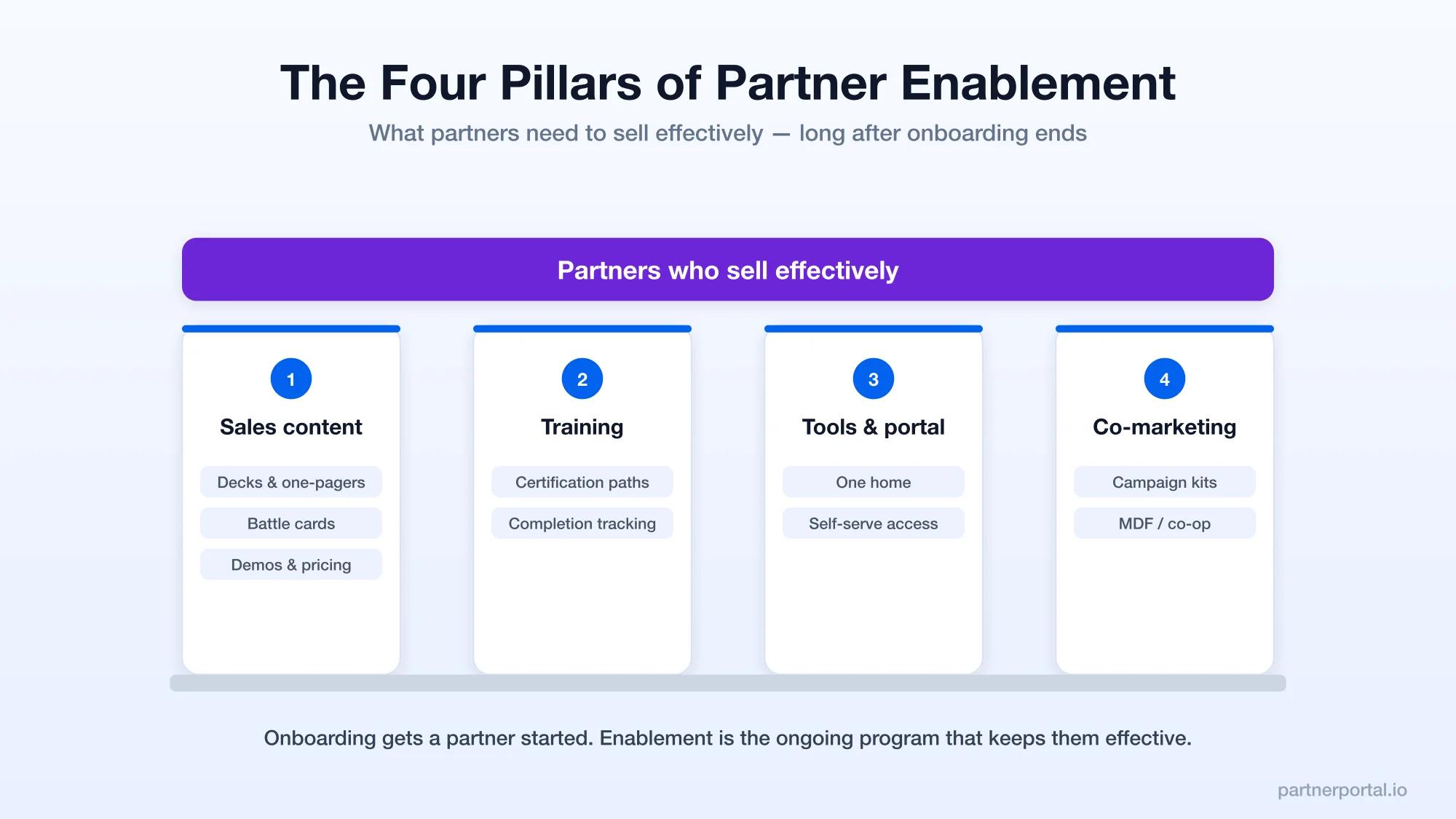
Recruiting and onboarding a partner gets them to their first deal. Enablement is what gets them to their tenth. It’s the least glamorous stage of channel management and the one most programs quietly underinvest in — which is exactly why “partners as an extension of your sales team” so often stays a slogan instead of becoming real.
TL;DR: A channel partner enablement strategy is the ongoing supply of what partners need to sell your product effectively:
- Sales content — decks, demos, battle cards, and competitive intelligence, kept current.
- Training and certification — with visibility into who’s actually completed it.
- Tools and self-serve access — everything findable in one portal, not a shared drive.
- Co-marketing support — so partners generate their own demand, not just consume leads.
- Measured by engagement, not volume produced — usage and completion predict revenue.
This piece is the “Enable” stage of channel management, covered in depth.
Enablement vs. onboarding
The two get conflated constantly, and the distinction matters because it changes how you resource each one.
Onboarding is finite. It’s the first 30–90 days: execute the agreement, provision portal access, deliver initial product and sales training, teach deal-registration mechanics, and get the partner to a first win. It has a clear beginning and end.
Enablement is continuous. It’s everything that keeps a partner effective after onboarding — new-release training, refreshed pitch assets, competitive intelligence for the deal they’re in this week, recertification, and marketing support for the campaign they’re running next quarter. A partner who was well-onboarded a year ago but hasn’t been enabled since is running on stale knowledge and old collateral.
The practical implication: onboarding is a project you can “finish,” but enablement is a program you staff and sustain. Treating enablement as a one-time onboarding event is the single most common reason partners plateau.
The four pillars of partner enablement
A complete enablement strategy supplies four things. Weakness in any one shows up as partners who can’t sell effectively.
1. Sales content
The assets a partner’s reps use to move a deal: pitch decks, one-pagers, demo environments or scripts, ROI calculators, case studies, pricing and packaging guidance, and battle cards for the competitors they’ll run into. The test isn’t whether the content exists — it’s whether a partner rep can find the right asset in under a minute and trust that it’s current.
2. Training and certification
Structured paths that build and verify partner competence: product training, sales training, and — for technical partners — implementation and integration certification. The key word is verify. Certification you can’t track tells you nothing; you want visibility into who has completed what, so you know which partners are actually equipped and which are selling from memory. The software category for delivering and tracking this is partner training software.
3. Tools and self-serve access
Enablement only works if partners can reach it without emailing you. That means a partner portal where content, training, deal registration, and resources live in one place, organized so partners can self-serve. The friction of “where do I find the latest deck?” is a silent tax on every partner-led deal.
4. Co-marketing and demand support
The most mature enablement doesn’t just help partners close demand — it helps them create it: co-branded campaign kits, through-partner marketing automation, MDF or co-op funds, and event support. This is where enablement overlaps with channel partner marketing, and it’s what separates partners who wait for leads from partners who generate their own.
Enable by partner type
Enabling every partner with the same generic kit is a classic waste. Match the enablement to the type of partner:
- Reselling partners (resellers, VARs) need full sales enablement — decks, battle cards, pricing, demo assets, and hands-on deal support. This is the deepest enablement investment because these partners own the sale.
- Technical partners (system integrators, ISVs) need product and integration enablement — technical training, certification, sandbox access, and co-sell support. They’re motivated by competence and services revenue more than sales collateral.
- Referral partners need almost nothing — a simple way to register a lead and a one-page explanation of what a good-fit customer looks like. Over-enabling them wastes effort on both sides.
The rule of thumb: invest enablement in proportion to how much of the sale the partner owns.
Build enablement into a program, not a drive folder
The difference between enablement that works and enablement that doesn’t is rarely the quality of the content — it’s whether it’s operationalized. A shared drive full of excellent decks that partners can’t navigate and you can’t track is not enablement; it’s storage.
An operational enablement program has:
- One home. A partner portal where every partner logs in to the same current, organized library — not a maze of email attachments and drive links.
- Structure by journey. Content and training organized by where a partner is (new, ramping, established) and what they need next, not dumped in a flat folder.
- Visibility. Reporting on what’s being used, who’s completed training, and which assets drive deals — so you can cut what nobody opens and produce more of what works.
- A refresh cadence. Owned responsibility for keeping assets current as the product, pricing, and competitors change. Stale collateral is worse than none.
This is the practical reason enablement and PRM tooling are linked: the portal is what turns a pile of content into a program partners actually use, and the reporting is what tells you whether it’s working.
How to measure channel partner enablement
Enablement is measured with leading indicators — they predict the revenue that shows up later. The ones that matter:
- Training and certification completion — the share of partners (and partner reps) who’ve completed the paths you built.
- Content usage and portal engagement — what’s being opened, downloaded, and used in deals, and what’s being ignored.
- Percentage of active partners — the single best health metric; enablement’s job is to keep this number high.
- Time-to-first-deal and time-to-productivity for newly enabled partners.
These roll up into the lagging outcomes you actually care about — partner-sourced revenue and partner win rate — which we cover in channel performance metrics. If your leading indicators are weak (content unopened, certifications incomplete), don’t wait for revenue to confirm it; fix the enablement now.
Common channel enablement mistakes
- Treating it as a one-time event. Enablement that stops after onboarding leaves partners on stale knowledge within a quarter or two.
- Content nobody uses. Volume of assets is a vanity metric. If partners can’t find it or it’s out of date, it doesn’t exist.
- No visibility. If you can’t see who’s completed training or opened the latest deck, you’re enabling blind and can’t improve.
- One-size-fits-all. Enabling referral, reseller, and technical partners identically under-serves the partners who drive revenue and over-serves the ones who don’t.
- Enablement without demand support. Arming partners to close leads but never helping them create demand caps the channel at whatever leads you hand out.
Enablement is where a channel either compounds or stalls. Get it right and each partner sells more, more confidently, over time. If you’re building the operational core — a partner portal, training, content, and the reporting to see what’s working, all synced with your CRM — you can launch a free partner portal, or compare the tooling in our guide to the best PRM software.
Frequently asked questions
What is channel partner enablement?
Channel partner enablement is the ongoing supply of the content, training, tools, and support that partners need to sell and deliver your product effectively. Where onboarding gets a new partner started, enablement is what keeps existing partners effective at selling — refreshing their knowledge, arming them for competitive deals, and helping them generate their own demand. It is a continuous program, not a one-time event.
What's the difference between partner onboarding and partner enablement?
Onboarding is the finite, first-30-to-90-days process of turning a signed partner into a productive one — agreement, portal access, initial training, and first deal. Enablement is the ongoing program that keeps them productive after that: new product training, updated sales content, competitive intelligence, certifications, and co-marketing support. Onboarding has an end; enablement does not.
What should a channel partner enablement strategy include?
A complete enablement strategy covers four things: sales content (pitch decks, demo environments, battle cards, competitive intelligence), training and certification with visibility into completion, the tools and portal access that make all of it self-serve, and through-partner or co-marketing support so partners can generate their own demand. Above all it should be easy to find and use — enablement partners can\u2019t navigate is not enablement.
What is channel sales enablement?
Channel sales enablement is the sales-specific slice of partner enablement: everything a partner\u2019s reps need to actually win deals — product and sales training, pitch and demo assets, battle cards, pricing and packaging guidance, and deal support from your team. It sits alongside technical enablement (for partners who implement or integrate the product) and marketing enablement (for partners generating demand).
How do you measure channel partner enablement?
Measure enablement with leading indicators: training and certification completion rates, content usage and portal engagement, the share of partners active in the last 30/60/90 days, and time-to-first-deal for newly enabled partners. These predict the lagging outcomes — partner-sourced revenue and win rate. If content sits unopened and certifications go uncompleted, enablement is failing regardless of how much you\u2019ve produced.
Why do channel enablement programs fail?
The most common failure is content nobody uses — materials buried in a shared drive that partners can\u2019t find and you can\u2019t track. Others include treating enablement as a one-time onboarding event, enabling every partner identically regardless of type, and having no visibility into who completed training or opened the latest deck. If you can\u2019t see engagement, you\u2019re enabling blind.
Does partner enablement differ by partner type?
Yes. Reselling partners need sales enablement — pitch decks, battle cards, pricing, and deal support. Technical partners (system integrators, ISVs) need product and integration training, certification, and co-sell support. Referral partners need almost none of it — just a simple way to register a lead. Enabling all partner types with the same generic kit wastes effort and under-serves the partners who actually drive revenue.