
Market Development Funds (MDF): How They Work in Partner Programs
A practical guide to market development funds (MDF) — what MDF is, how it differs from co-op funds, what partners spend it on, how an MDF program works end to end, and whether your partner program actually needs it.
Written by the team at PartnerPortal — PRM software used to run B2B partner and channel programs.
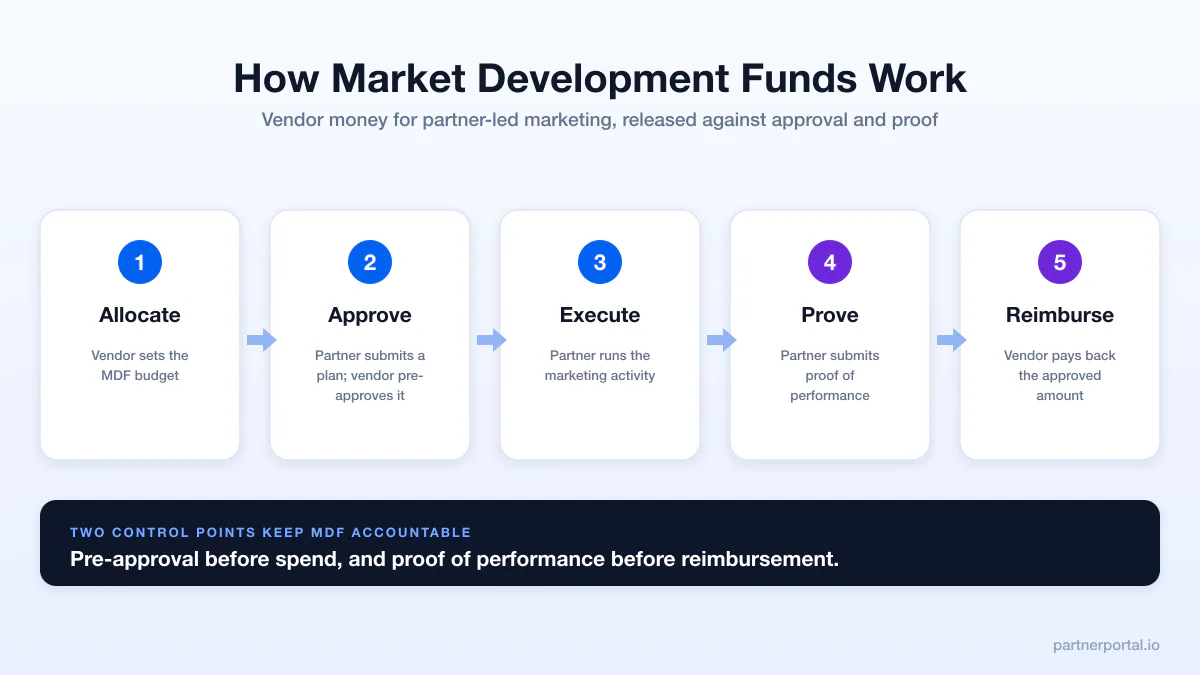
Market development funds (MDF) are money a vendor gives channel partners to spend on marketing that drives demand for the vendor’s product — co-branded campaigns, events, content, and advertising. Instead of the vendor running all its own marketing, it funds partners to generate demand in their local markets and segments, where the partner often has reach and trust the vendor does not.
Used well, MDF turns partners into an extension of your marketing team. Used carelessly, it becomes budget out the door with nothing to show for it. This guide covers what MDF is, how it differs from co-op funds, what partners actually spend it on, how an MDF program runs end to end, and — the question most programs skip — whether you need MDF at all yet.
TL;DR:
- MDF = vendor money for partner-led marketing, usually reimbursed against an approved plan and proof of spend.
- MDF vs co-op: MDF is discretionary (the vendor chooses who to fund); co-op funds are earned as a percentage of a partner’s purchases or sales. Many programs blend them.
- Common uses: events, webinars, paid ads, content, localization, and lead-generation campaigns.
- The mechanics that keep it honest: pre-approval, an eligible-activities list, and proof of performance before reimbursement.
- Most SMB programs do not need MDF yet. It is administratively heavy and belongs to mature channel programs with partners who can generate their own demand.
What are market development funds?
Market development funds are a vendor’s investment in partner-led demand generation. Rather than spend the entire marketing budget on its own campaigns, the vendor allocates a portion to partners and lets them market the product to audiences they already reach — a reseller’s install base, a system integrator’s industry vertical, a distributor’s reseller network.
The logic is reach and credibility. A partner running a regional event or a vertical-specific campaign often converts better than the vendor doing it from a distance, because the partner owns the local relationship. MDF is how the vendor pays for that reach without hiring into every market.
MDF is almost always conditional and accountable. Partners do not receive cash to spend freely; they get access to funds they can claim against approved marketing activities, usually after the fact, with evidence of what was spent and what it produced. That accountability — approvals and proof of performance — is what separates MDF from a discount.
MDF vs co-op funds
The two terms are often used interchangeably, but they are allocated differently, and the distinction matters when you design a program.
| MDF (market development funds) | Co-op (cooperative) funds | |
|---|---|---|
| How it’s allocated | Discretionary — the vendor decides who to fund | Earned — a partner accrues a percentage of purchases/sales |
| Typical trigger | Strategic goals, a launch, a target market | Automatic accrual tied to partner revenue |
| Who drives it | Vendor-initiated, often proactive | Partner-initiated, from an earned balance |
| Best for | Steering partners toward priorities | Rewarding and reinvesting with productive partners |
In practice, many mature programs run a blend: a discretionary MDF pool for strategic pushes plus a co-op accrual that rewards high-performing partners with funds they’ve effectively earned. The vocabulary is loose across the industry — what matters is that everyone understands how a given fund is allocated, what it can be spent on, and how it’s claimed.
What partners spend MDF on
Most programs publish a list of eligible activities. The common ones:
- Events and trade shows — booths, sponsorships, regional partner-hosted events.
- Webinars and virtual events — production, promotion, and follow-up.
- Digital and paid advertising — search, social, and display campaigns for the vendor’s product.
- Content and collateral — case studies, solution briefs, landing pages, and localized versions of vendor content.
- Lead-generation campaigns — telemarketing, email programs, and outbound to the partner’s audience.
- Co-branded marketing — campaigns carrying both the vendor’s and the partner’s brand.
Programs typically exclude general overhead, travel and entertainment, and anything that can’t be tied to demand for the vendor’s product. The eligible-activities list is worth writing down clearly — most MDF disputes come from a partner assuming something qualified when it didn’t.
How an MDF program works
Although the details vary, a well-run MDF program follows the same loop:
- Allocate. The vendor sets an MDF budget and decides how it’s distributed — by partner tier, by strategic priority, or as an earned co-op accrual.
- Request and approve. A partner submits a plan for a specific activity: what they’ll do, the audience, the cost, and the expected outcome. The vendor pre-approves before any money is committed.
- Execute. The partner runs the activity — the event, campaign, or content.
- Prove. The partner submits proof of performance: invoices or receipts for what was spent, plus evidence the activity ran and what it generated (registrations, leads, pipeline).
- Reimburse. The vendor pays back the approved amount, sometimes matching a share rather than the full cost, once proof of performance checks out.
- Measure. The vendor tracks what each funded activity produced, so next quarter’s allocation goes to what worked.
The two control points — pre-approval and proof of performance — are what make MDF accountable. Skip them and MDF becomes untracked spend; enforce them well and it becomes a measurable demand channel.
Do you actually need MDF?
This is the section most MDF guides leave out. MDF is powerful, but it is administratively heavy — allocation rules, approval workflows, proof-of-performance review, and ROI tracking are real ongoing work. It fits mature channel programs with partners who can genuinely generate demand: distributors, established resellers, system integrators with their own marketing capacity.
Most SMB and mid-market programs — especially referral-led ones — do not need formal MDF yet, and adopting it early usually creates more overhead than pipeline. Before building an MDF program, the lighter alternatives usually do the job:
- Shared campaign assets. Give partners ready-to-run co-branded content, email templates, and landing pages so they can market without a funding claim. A well-stocked resource center removes most of the friction MDF is meant to solve.
- Time-boxed SPIFFs. A short-term bonus is far simpler to run than an MDF program and drives a specific push.
- Co-marketing support. Co-hosting a webinar or lending design help costs less and administers more easily than reimbursing partner spend.
Adopt formal MDF when you have partners capable of independent demand generation, a budget large enough to matter, and the operational capacity to approve plans and check proof of performance. Until then, simpler co-marketing usually produces more pipeline per hour of effort.
MDF best practices and common mistakes
What separates an MDF program that drives pipeline from one that just spends budget:
- Fund incremental marketing, not activity partners would run anyway. As with any incentive, the goal is to buy demand you wouldn’t otherwise get — not subsidize a partner’s existing plans.
- Publish the rules. A clear eligible-activities list, approval process, and reimbursement terms prevent most disputes and unclaimed funds.
- Require proof of performance. Reimburse against evidence of spend and results, not intentions.
- Track ROI per activity. MDF with no measurement is the classic failure — money out the door with nothing to show. Tie funded activities back to leads and pipeline.
- Watch for unclaimed funds. Large unspent MDF balances usually mean the process is too hard or partners don’t know the funds exist — a program-design problem, not partner apathy.
- Don’t over-fund early. A distributor with its own marketing team can absorb MDF; a two-person referral partner usually can’t. Match funding to marketing capacity.
Where MDF fits in the incentive mix
MDF is one lever among several. It’s a pre-sale incentive — it funds demand generation before any deal exists — which makes it different from post-sale rewards like commissions, margin, and rebates that pay out once revenue closes. The strongest programs combine them: post-sale incentives reward closed business, while MDF and co-op funds invest in the marketing that fills the top of the funnel.
For how MDF sits alongside the other rewards — commissions, margin, rebates, SPIFFs, and tiers — see the guides to channel partner incentives and partner incentives. And whatever you fund, you still need to see whether it worked: PartnerPortal tracks partner-sourced leads and revenue so you can tie funded marketing back to pipeline, and gives partners a resource center to distribute the co-branded assets those campaigns run on. (PartnerPortal doesn’t administer MDF budgets or claims itself — for that you’d pair it with a spreadsheet or a dedicated MDF tool at the enterprise end.)
Related reading
- Channel Partner Incentives: SPIFFs, MDF, Rebates, and Tiers — how MDF fits among the full set of channel incentives.
- Partner Incentives: What Actually Works in B2B — the broader incentive picture across referral, reseller, and channel programs.
- Channel Partner Marketing: Strategy & Best Practices — marketing to and through partners, which MDF exists to fund.
- What Is Channel Management? — the full partner-channel lifecycle.
Running a partner program and want to see which partners actually produce? Claim your portal or explore the CRM integrations.
Frequently asked questions
What does MDF stand for?
MDF stands for market development funds — money a vendor gives channel partners to spend on marketing that generates demand for the vendor’s product, such as events, campaigns, content, and advertising. Partners typically submit a plan, run the activity, and are reimbursed against proof of what they spent.
What's the difference between MDF and co-op funds?
They fund the same kinds of marketing but are allocated differently. MDF is discretionary — the vendor decides which partners and plans to fund, often proactively and tied to strategic goals. Co-op (cooperative) funds are earned — a partner accrues a percentage of its purchases or sales into a fund it can then claim against approved activities. In practice many programs blend the two, and the terms are often used loosely.
What can market development funds be spent on?
Typical MDF-eligible activities include events and trade shows, webinars, digital and paid advertising, content and collateral creation, localization, telemarketing or lead-generation campaigns, and co-branded marketing. Most programs publish an eligible-activities list and exclude general overhead, travel, or entertainment.
How are market development funds paid out?
Most commonly as reimbursement: the partner gets pre-approval for a plan, runs the activity, submits proof of performance (invoices, spend records, and results), and is paid back up to the approved amount. Some programs pre-fund larger activities. Either way, approval and proof of performance are what keep MDF accountable.
Do small partner programs need MDF?
Usually not at first. MDF is administratively heavy — allocation, approvals, proof of performance, and ROI tracking — and it fits mature channel programs with partners who can generate their own demand. Smaller SMB and referral programs are usually better served by simpler co-marketing support, shared campaign assets, and time-boxed SPIFFs until the program is large enough to justify formal MDF.
What is proof of performance in an MDF program?
Proof of performance (POP) is the evidence a partner submits to claim MDF after running an activity — invoices or receipts for what was spent, plus proof the activity happened and what it produced (registrations, leads, pipeline). POP is what separates MDF from a blank check: funds are released against demonstrated spend and results, not just a promise to market.