
Channel Partner Management: A Complete Guide
What channel partner management is, what a channel partner is, and how to manage a portfolio of partner relationships — segmentation, tiering, the partner manager role, the operating cadence, and the tools that run it.
Written by the team at PartnerPortal — PRM software used to run B2B partner and channel programs.
Most of the value in a channel program is created — or lost — in the ordinary work of managing partner relationships: deciding who gets your time, keeping the right partners active, and pruning the ones that only consume. This guide is about that work. It’s the relationship-and-portfolio layer of channel management, and it’s where a program either compounds or quietly drifts.
A note on terms. “Channel management” and “channel partner management” are often used interchangeably. We use channel management for the full discipline — strategy, recruitment, deal registration, incentives, measurement, optimization — and treat channel partner management (this guide) as the part focused on managing the partners and relationships themselves. If you want the end-to-end lifecycle, start with the channel management guide; if you want how to run the partner relationships within it, you’re in the right place.
TL;DR: Managing channel partners well comes down to a few disciplines:
- Know what a partner is — and that the type drives how you manage them.
- Manage a portfolio, not a list — segment and tier by value.
- Run an operating cadence — scorecards and quarterly business reviews.
- Resource it — someone has to own the relationships.
- Run it on synced data — a PRM and CRM that agree.
What is a channel partner?
A channel partner is a third-party organization that markets, sells, resells, implements, or refers your product to end customers, instead of (or alongside) your own direct sales team. They’re an indirect route to market — you reach the customer through them.
The single most important fact about channel partners is that “channel partner” is an umbrella term, and the type of partner drives almost everything about how you manage them. Grouped by the role they play in the deal:
| Bucket | Partner types | What they own |
|---|---|---|
| Refer (influence) | Referral partner, affiliate, ambassador | Send leads; don’t own the sale |
| Resell (transact) | Reseller, VAR, distributor, MSP | Sell and often bill the end customer |
| Deliver / integrate | System integrator, technology/integration partner | Implement or build on the product |
| Strategic alliance | Large co-sell / co-market partners | Deep, mutual go-to-market at scale |
Managing a referral partner who sends two leads a quarter like a VAR who resells and implements your product is a category error. For the full breakdown of each type and how to incentivize them, see the types of channel partners.
What channel partner management actually involves
Day to day, managing partners spans the partner lifecycle — but from the relationship side of it:
- Getting the right partners in — recruiting against a profile and onboarding them to a first win.
- Keeping them productive — ongoing enablement, deal support, and co-selling.
- Protecting and rewarding them — deal registration, resolving channel conflict, and incentives that reward the behavior you want.
- Managing the portfolio — measuring each partner, investing in producers, and exiting dead weight.
The pillar covers each of these as a lifecycle stage; the job of partner management is running them across a whole book of partners at once, with limited time.
Manage partners as a portfolio
The defining skill of channel partner management is portfolio thinking. Channel revenue follows a power law — a small fraction of partners drive the majority of partner-sourced revenue — so treating every partner equally is the same as under-investing in your producers to over-invest in your dormant ones.
Managing as a portfolio means:
- Segmenting partners by value and type, so you know who your top producers, steady mid-tier, ramping, and dormant partners are.
- Allocating time deliberately — the most management attention to the partners most likely to return it, self-serve tooling for the long tail.
- Continuously pruning and promoting — moving partners up as they produce, and coaching, restructuring, or exiting the ones that consume support without returning revenue.
This is the Optimize discipline applied continuously, not once a year.
Tiering: give your best partners the most
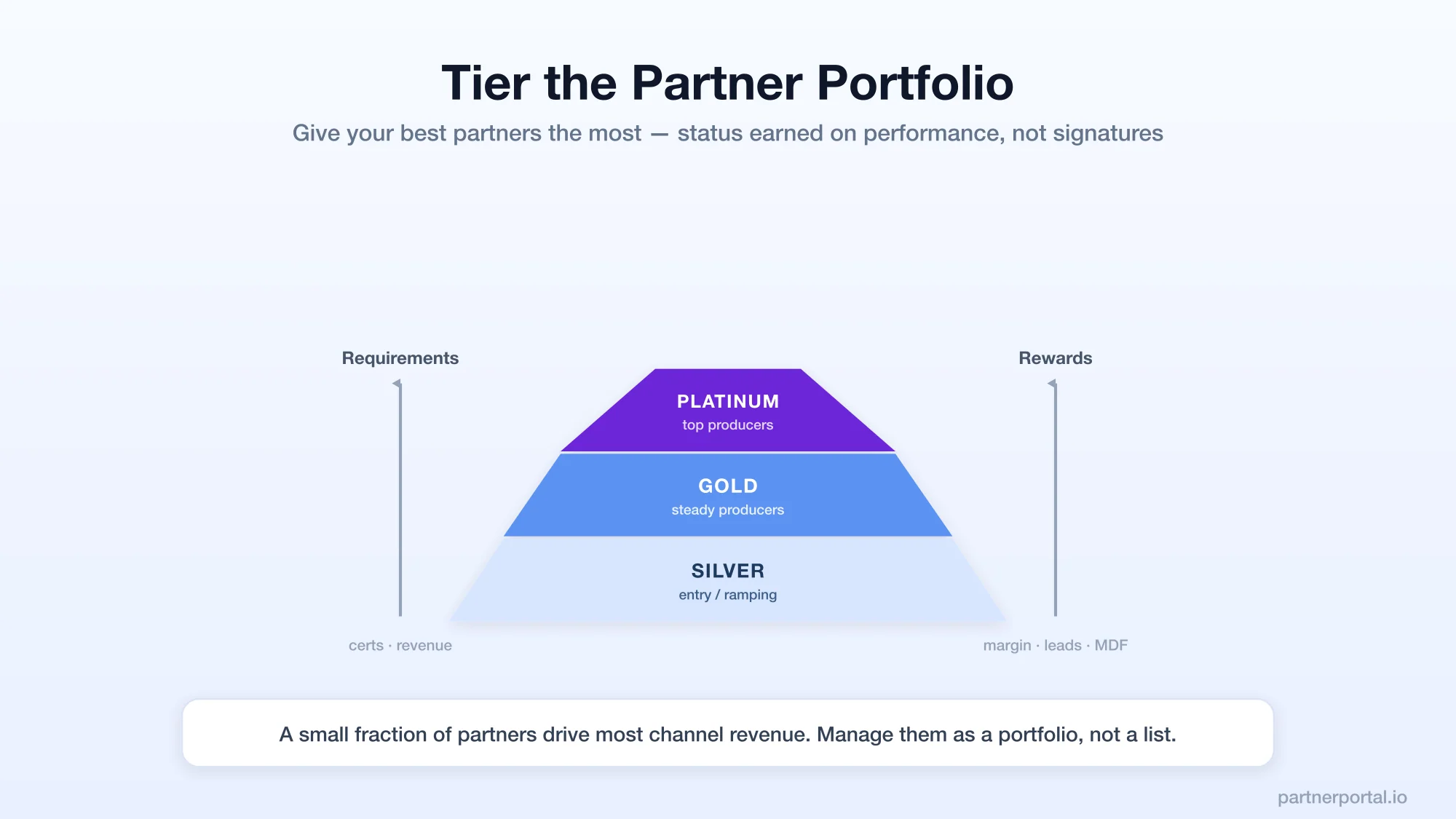
Formalized portfolio management is a tier program — Silver / Gold / Platinum, or whatever you call it. Tiers do two things: they reward commitment and production with better economics and support, and they ration your finite resources toward the partners who’ve earned them.
A workable tier model defines, for each tier: the requirements to reach it (revenue, certifications, commitments), and the benefits it unlocks (margin, leads, MDF, dedicated management, marketplace placement). The mistake is making tiers about logos-signed rather than value-produced; tiers should be earned on performance and re-evaluated regularly, so status reflects current contribution rather than a one-time achievement.
The partner manager role
Someone has to own the relationships. The channel / partner account manager (CAM / PAM) is the core role — they own a book of partners and their sourced revenue, and their week is enablement, deal support, pipeline reviews, conflict resolution, and growing each partner’s production. It’s the channel equivalent of an account executive, with one crucial difference: a partner is an organization you influence, not an employee you direct.
Around that core sit adjacent roles at scale — partner development managers (recruiting), alliance managers (strategic relationships), partner operations (the PRM/CRM stack and commissions), and partner marketing. Early on, one founder or sales leader wears all these hats, which is fine. The signal to hire your first dedicated partner person is when partner management starts eating enough of someone’s week that deals slip — commonly around a couple dozen active partners. Under-resourcing this role is a quiet, common reason programs stall. (See who runs channel management for the full org map.)
The operating cadence
Good partner management runs on a rhythm, not on reaction:
- Weekly/monthly: deal-registration hygiene, pipeline review, and unblocking active deals.
- Monthly: program-level health review — active-partner rate, sourced pipeline, and where partners are trending. (See channel performance metrics.)
- Quarterly: a partner scorecard and quarterly business review (QBR) with each meaningful partner — an objective, shared look at activity, pipeline, and results, and a plan for the next quarter.
The cadence is what keeps management proactive. Without it, partner management collapses into firefighting whichever relationship is loudest this week.
The tools that run it
The system of record for partner management is PRM (partner relationship management) software — the partner portal, deal registration, onboarding and enablement content, incentives, and partner reporting, on one data foundation. Its most important property is native, two-way CRM integration: when partner and deal data drift between the PRM and CRM, everything downstream — crediting, conflict, reporting — breaks.
Larger programs bolt on through-channel marketing automation (TCMA), an LMS for training, and payout tooling. But most programs need only a synced portal and CRM to start, and add complexity as the channel earns it. For the full category breakdown, see our guide to the best PRM software.
Common channel partner management mistakes
- Managing every partner the same. Ignoring partner type and value wastes attention on the wrong relationships.
- A flat list instead of a portfolio. Without segmentation and tiers, your producers are under-served and your dormant partners over-served.
- No operating cadence. Reactive management means the squeakiest partner wins your time, not the most valuable one.
- No owner. An under-resourced or unsponsored partner-management function lets the whole program drift.
- Drifted data. A PRM and CRM that disagree make every management decision suspect.
Channel partner management is the ongoing craft that turns a set of signed agreements into a growing revenue channel. Manage the portfolio, run the cadence, resource the role, and keep the data synced. If you’re ready to put the operational core in place — portal, deal registration, enablement, and CRM sync — you can launch a free partner portal, or start with the full channel management guide for the end-to-end lifecycle.
Frequently asked questions
What is channel partner management?
Channel partner management is the ongoing practice of managing the relationships with the third-party partners who sell, resell, or refer your product — recruiting them, keeping them productive, segmenting and tiering them by value, running a regular relationship cadence, and deciding where to invest. It is the relationship-and-portfolio layer of the broader discipline of channel management, which also spans strategy, deal registration, incentives, and measurement.
What is a channel partner?
A channel partner is a third-party organization that markets, sells, resells, implements, or refers your product to end customers instead of your own direct sales team. Common types include referral partners, affiliates, resellers, value-added resellers (VARs), distributors, managed service providers (MSPs), system integrators, and technology/integration partners. Each type owns a different part of the sale and needs a different mix of margin, enablement, and support.
What's the difference between channel management and channel partner management?
Channel management is the whole discipline of running an indirect sales channel — strategy, recruitment, onboarding, enablement, deal registration, incentives, measurement, and optimization. Channel partner management is the relationship-and-portfolio slice of that: how you actually manage the partners themselves day to day — segmenting them, tiering them, running business reviews, and deciding who to invest in or exit. In practice the terms are often used interchangeably.
What does a channel partner manager do?
A channel partner manager (CAM or PAM) owns a book of partners and their sourced revenue. Day to day that means enabling partners, supporting deal registration and co-selling, running pipeline reviews and quarterly business reviews, resolving conflict, and growing each partner's production. It's the channel equivalent of an account executive, except the “customer” is a partner you influence rather than control.
How do you manage channel partners effectively?
Manage partners as a portfolio, not a flat list: segment them by value and type, tier them so your best partners get the most investment, run a consistent operating cadence (scorecards and quarterly business reviews), keep partner and deal data synced between your PRM and CRM, and continuously prune dead weight while doubling down on producers. The core discipline is matching your limited time to the partners most likely to return it.
What tools are used for channel partner management?
The core tool is PRM (partner relationship management) software — a partner portal with deal registration, onboarding, enablement content, incentives, and partner reporting, integrated two-way with your CRM. Larger programs add through-channel marketing automation (TCMA), a learning management system (LMS) for training, and payout tools for commissions. Most programs need only a synced portal and CRM to start.
How many partners can one partner manager handle?
It depends on partner type and depth of engagement. A manager handling a few strategic alliances with deep, executive-level relationships may own only a handful. A manager supporting transactional resellers or referral partners through a self-serve portal can cover dozens. The signal you're under-resourced is when partner management starts eating enough of someone's week that deals slip — commonly around a couple dozen active partners per manager.