
Partner Incentives: What Actually Works in B2B Partner Programs
The partner incentive types that work in B2B programs — referral commissions, reseller margin, recurring commissions, tiers, SPIFFs, MDF, and non-monetary rewards — how to structure them, and the mistakes that waste incentive budget.
Written by the team at PartnerPortal — PRM software used to run B2B partner and channel programs.
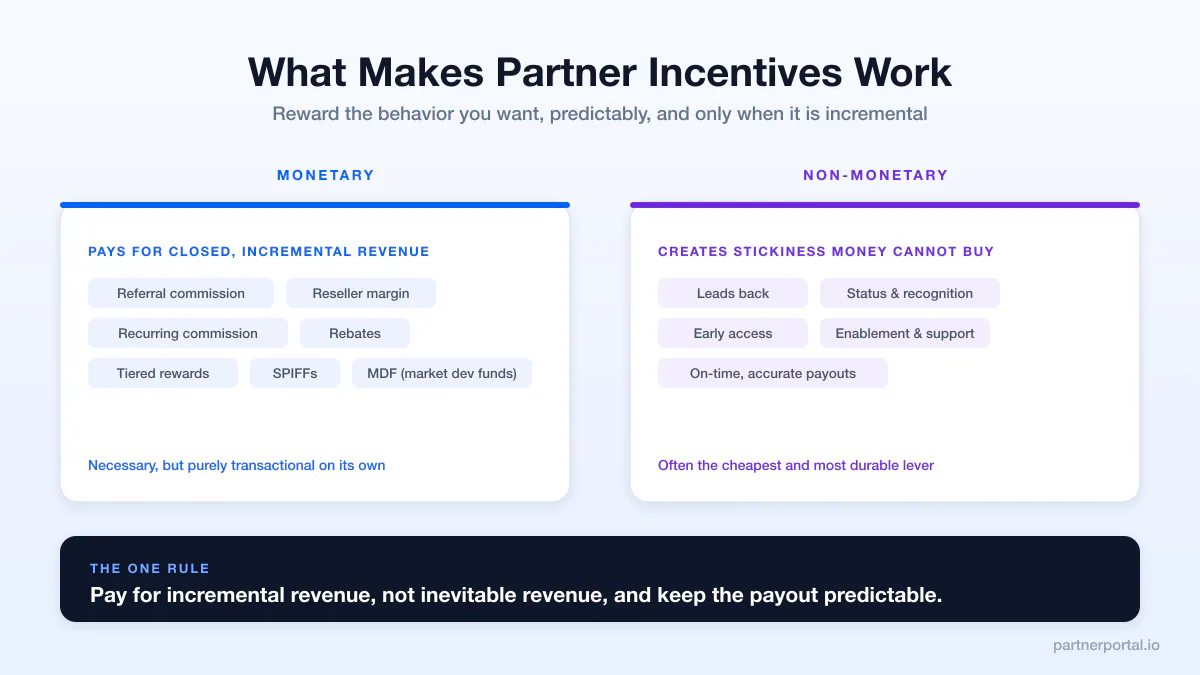
Partner incentives are the rewards — monetary and otherwise — that motivate partners to send leads, close deals, and stay engaged with your program. Get them right and partners prioritize you over the dozen other vendors competing for their attention. Get them wrong and you either overpay for revenue you would have won anyway, or underpay and watch partners quietly go dormant.
This guide covers the incentive types that work in B2B partner programs, how to structure them without creating problems later, and the common mistakes that turn an incentive budget into wasted spend. It is written for the practical reality of SMB and mid-market programs — referral, reseller, and channel — not enterprise channel-marketing theory.
TL;DR:
- The real job of a partner incentive is attention allocation — competing for a larger share of a partner’s finite time and pipeline.
- Most B2B programs use a mix of referral commission, reseller margin, recurring commission, tiered rewards, SPIFFs, MDF, and rebates, alongside non-monetary rewards.
- The single most important rule: pay for incremental revenue, not inevitable revenue — which makes incentive design and deal-registration design the same problem.
- Keep it predictable. A payout partners cannot calculate in advance does not change behavior.
- Most incentive-program pain is operational, not strategic — accurate, on-time payment is itself one of your most effective incentives.
What partner incentives are for
The core job of a partner incentive is attention allocation. Most partners — agencies, consultants, resellers, referral sources — work with several vendors at once. Their time and pipeline are finite. Incentives are how you compete for a larger share of that finite attention.
That reframes the question from “how much should we pay?” to “what behavior are we trying to drive, and is this incentive the most efficient way to drive it?” The behaviors worth incentivizing in a B2B program are usually:
- Sending qualified leads (not just any leads)
- Registering deals early, so attribution is clean
- Closing deals (for resellers who sell directly)
- Staying active and trained over time
A good incentive program pays for the behavior you actually want, in proportion to its value, and is simple enough that partners can predict what they will earn. Complexity is the enemy — a partner who cannot easily calculate their payout discounts it.
The main types of partner incentives
Most B2B programs use some mix of the following. The right combination depends on your partner types and deal economics.
| Incentive | What it rewards | Best for |
|---|---|---|
| Referral commission | Sending a lead that closes | Referral partners, consultants |
| Reseller margin / discount | Selling your product directly | Resellers, VARs |
| Recurring commission | Ongoing revenue from a partner-sourced customer | Subscription/SaaS programs |
| Tiered rewards | Higher production over time | Growing programs with a partner ladder |
| SPIFFs | A specific short-term push (e.g., a product, a quarter) | Time-bound campaigns |
| MDF (market development funds) | Co-marketing investment | Partners who can generate demand |
| Rebates | Hitting a volume or revenue threshold | High-volume reseller relationships |
| Non-monetary | Status, access, recognition | Every program, alongside the above |
Referral commission
The simplest and most common: a flat fee or percentage of revenue when a partner-sourced lead becomes a customer. Easy to understand, easy to administer, and well-suited to consultants and referral partners who introduce business but do not sell directly.
Reseller margin
For partners who sell your product to their own customers, the incentive is the margin between what they pay you and what they charge. This is structurally different from a commission — the partner owns the customer relationship and the transaction.
Recurring commission
In subscription businesses, paying a percentage of recurring revenue for as long as the customer stays (or for a defined period) aligns the partner with retention, not just the initial sale. It is one of the most effective B2B SaaS incentive structures because it rewards partners for bringing customers who stay.
Tiered rewards
A ladder — Silver / Gold / Platinum, or similar — where higher production unlocks higher commission rates, better support, or more co-marketing. Tiers give partners a reason to grow with you rather than plateau, but only work once you have enough partners to populate the tiers meaningfully.
SPIFFs
Short-term incentives for a specific push: a bonus on every deal closed this quarter, a reward for the first partner to hit a milestone. Useful for energy and focus; counterproductive if they become permanent (partners come to expect them).
MDF and rebates
MDF (market development funds) funds partner-led marketing; rebates reward hitting volume thresholds. Both are more common in larger channel programs than in SMB referral programs, but worth knowing as the program scales. For the channel-program view of these mechanics — SPIFFs, MDF, rebates, and tiers in a reseller/distributor context — see channel partner incentives.
Monetary vs non-monetary incentives
Money matters, but it is not the only lever — and over-relying on it is expensive. The most durable programs pair fair financial incentives with non-monetary ones that cost little but compound.
Monetary incentives are necessary and unambiguous. Partners need to make money, and the financial terms are the foundation. But money alone creates a purely transactional relationship — partners optimize for whoever pays most this quarter.
Non-monetary incentives create stickiness money cannot buy:
- Status and recognition — tiers, badges, “top partner” placement, public case studies.
- Access — early product access, a direct line to your team, influence on the roadmap.
- Enablement — genuinely useful training, sales support, and co-selling help that makes the partner better at their job.
- Leads back — referring business to your partners is often the single most powerful non-monetary incentive in a two-way relationship.
The cheapest and most underused incentive is simply being easy to work with: fast deal approvals, clear attribution, on-time payouts, and responsive support. Partners notice which vendors do not make them chase their commissions, and they send those vendors more business.
How to structure incentives that work
A few principles that separate effective incentive programs from expensive ones:
Pay for incremental revenue, not inevitable revenue. If a partner registers a deal you were already going to win directly, you are paying twice. Clear deal-registration rules and attribution windows are what protect against this — incentive design and attribution design are the same problem.
Keep it predictable. Partners should be able to calculate their expected payout before they invest effort. Opaque or frequently-changing terms get mentally discounted, which defeats the purpose.
Match the structure to the deal economics. Recurring commission fits subscription revenue; one-time fees fit one-time sales; margin fits resale. Forcing one structure across mismatched models creates friction.
Make recurring the default for SaaS. Recurring commission aligns partners with customer retention and tends to attract partners who care about fit, not just closing.
Build in a tier ladder before you need it. Even a simple two-tier structure gives partners a growth path and gives you a lever to reward your best partners without renegotiating every contract.
Write the rules into the partner agreement. Attribution, lookback windows, clawback on refunds, and payout cadence should be documented before a dispute, not after.
Building a partner incentive program
Individual rewards are not the same as a program. A partner incentive program is the coherent structure that ties the rewards above to your partner tiers, your rules of engagement, and a predictable payout cadence — so partners know what they earn, for what behavior, and when.
For most SMB and mid-market programs, you do not need all of it on day one. A workable starting structure is narrow on purpose:
- One primary incentive that matches your motion — referral commission for referral partners, margin for resellers, recurring commission for SaaS.
- A simple tier ladder (even two tiers) so your best partners have a reason to grow and a visibly better deal.
- Deal registration so the incentive rewards incremental, attributable revenue.
- A fixed payout cadence and the attribution rules written into the partner agreement.
Add heavier mechanics — SPIFFs, MDF, rebates — only once the program is mature enough to administer them and measure their return. A program that pays one incentive accurately beats one that promises five and pays them late.
Common mistakes
The recurring ways incentive programs go wrong:
- Overpaying for leads you would have won anyway — the deal-registration and attribution failure above. The most common and most expensive mistake.
- Too much complexity — tiered, conditional, multi-variable structures that partners cannot predict, so they do not change behavior.
- Paying late or inaccurately — nothing kills partner trust faster than a wrong or slow commission payment. Operational reliability is itself an incentive.
- All money, no relationship — purely transactional programs are easy for a better-funded competitor to outbid.
- Permanent SPIFFs — short-term bonuses that never end stop being motivating and just become baseline cost.
- No clawback for churn or refunds — paying full recurring commission on a customer who cancels in month two, with no mechanism to recover it.
- Manual commission math at scale — calculating tiered, recurring commissions across dozens of partners in a spreadsheet is where errors (and late payments) come from.
That last one is worth dwelling on: most incentive-program pain is not strategic, it is operational. The structure is fine; the problem is that calculating and paying it accurately every month becomes a part-time job, and the errors that creep in erode the trust the incentives were meant to build.
Paying incentives without the operational pain
The strategy of partner incentives is only half the job. The other half is calculating and paying them accurately, on time, every period — which is exactly where spreadsheets break down once you have more than a handful of partners on anything beyond a single flat rate.
This is what a PRM’s commission engine is for. PartnerPortal supports the incentive structures B2B programs actually use:
- Flat or percentage commissions
- One-time or recurring terms (so SaaS programs can reward retention, not just the initial sale)
- Cascade overrides for multi-level or tiered arrangements
- Automated payout generation, so commission statements are not a monthly spreadsheet exercise
- Native CRM sync (HubSpot, Salesforce, Pipedrive, Zoho, Attio), so partner-sourced deals — and the attribution that drives correct payouts — flow from the CRM the team already uses
Because deal registration, attribution, and commissions live in one system, the program pays partners for the right deals, in the right amount, on time — which, as the section above argues, is itself one of the most effective incentives you have. PartnerPortal has a genuinely free tier to launch a real portal, with paid plans at $249/month (up to 100 partners) and $399/month for unlimited partners and team — no per-seat fees.
Related reading
- Channel Partner Incentives: SPIFFs, MDF, Rebates, and Tiers — the same mechanics in a channel/reseller-distributor context.
- Best PRM Software in 2026 — how the tools that run partner commissions compare.
- Best Partnership Trackers in 2026 — where commission tooling fits in the broader partner-program stack.
- What Is Channel Management? — the full partner-channel lifecycle, including where incentives sit.
Ready to pay partners accurately and on time? Claim your portal or explore the CRM integrations.
Frequently asked questions
What are partner incentives?
Partner incentives are the rewards — monetary and non-monetary — used to motivate partners to send leads, close deals, and stay engaged with your program. Common types include referral commissions, reseller margin, recurring commissions, tiered rewards, SPIFFs, MDF, rebates, and non-monetary incentives like status, access, and enablement.
What's the most effective partner incentive for B2B SaaS?
For subscription businesses, recurring commission tends to be the most effective monetary structure because it rewards partners for bringing customers who stay, aligning them with retention rather than just the initial sale. The strongest programs pair that with non-monetary incentives — recognition, early access, and especially referring business back to partners — which create stickiness money alone can't buy.
How much should I pay partners?
There's no universal number; it depends on your margins and deal economics. The better framing is to pay for incremental revenue you wouldn't have won directly, in proportion to its value, with terms simple enough that partners can predict their payout. Referral commissions are often a percentage of first-year (or recurring) revenue; reseller margin depends on your pricing structure.
What's the difference between a SPIFF and a commission?
A commission is an ongoing, structural reward tied to every qualifying deal. A SPIFF is a short-term, time-bound bonus designed to drive a specific push — a product launch, a strong quarter. SPIFFs work as occasional energy; they lose their effect (and just become baseline cost) if they are made permanent.
How do I avoid overpaying for partner deals?
Clear deal-registration rules and attribution windows. The most common way incentive budgets get wasted is paying a partner for a deal you were already going to win directly. Define who gets credit, how long the attribution window lasts, and what happens to commission on refunds or churn — and write it into the partner agreement before a dispute arises.
How are partner commissions usually calculated and paid?
In small programs, often manually in a spreadsheet — which works until tiered or recurring terms across many partners make it error-prone and slow. PRM software with a commission engine automates the calculation (flat, percentage, one-time, recurring, with overrides) and generates payouts on a regular cadence, with the attribution flowing from the connected CRM. Accurate, on-time payment is itself one of the more effective incentives, since partners send more business to vendors who do not make them chase what they are owed.