
Channel Conflict: Types, Causes, and How to Prevent It
What channel conflict is, the three types (vertical, horizontal, multichannel), what causes it, and how to prevent and resolve it with deal registration, clear rules of engagement, defined territories, and pricing discipline.
Written by the team at PartnerPortal — PRM software used to run B2B partner and channel programs.
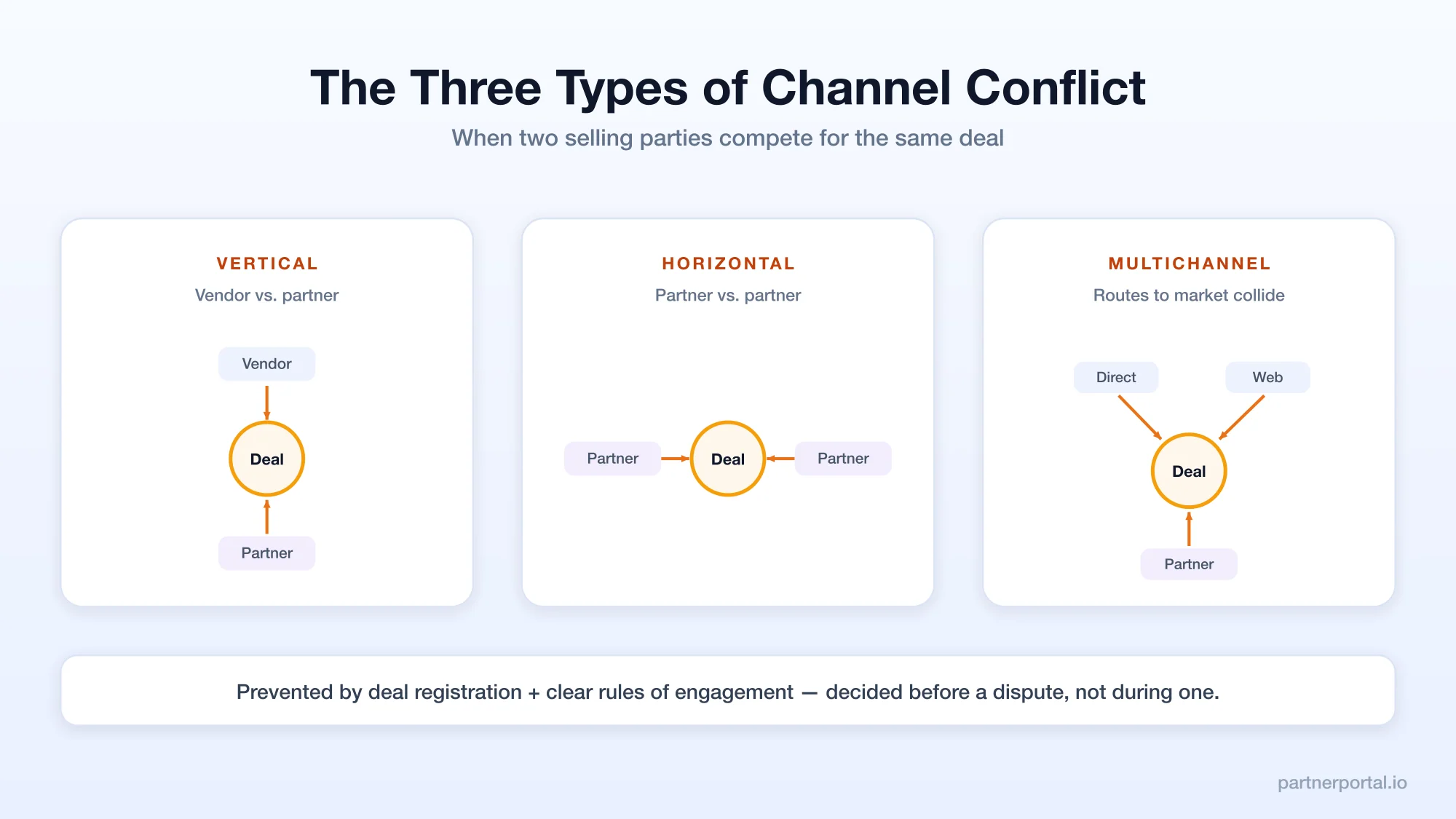
The moment you sell through more than one party — a direct team plus partners, or several partners in the same market — two of them will eventually chase the same deal. That’s channel conflict, and left unmanaged it does outsized damage: partners stop investing when they can’t trust their pipeline is safe, and a single mishandled dispute can sour a relationship you spent months building. The good news is that channel conflict is almost entirely preventable with the right rules and visibility set up in advance.
TL;DR: Channel conflict is when two selling parties compete for the same deal. It comes in three forms:
- Vertical — vendor versus partner (your direct team versus a reseller).
- Horizontal — partner versus partner (two resellers on one account).
- Multichannel — different routes to market colliding (your website versus a partner’s quote).
The primary prevention tool is deal registration, backed by clear rules of engagement, defined territories, aligned pricing, and a synced PRM and CRM. Decide the rules before you have a dispute. This is the conflict piece of the channel management “Sell” stage, in depth.
What is channel conflict?
Channel conflict is when two selling parties compete for the same deal or customer inside your sales channels. Some competitive tension is normal and even healthy — it signals demand. It becomes a problem when it erodes trust: when a partner discovers your direct team was working “their” deal, or that another reseller undercut them, or that your website sells the same product cheaper than they can quote it. At that point partners stop registering deals and stop investing, which quietly kills the channel.
The critical insight is that channel conflict is fundamentally a visibility and policy problem, not a people problem. Most collisions happen because no one could see the deal was already claimed, or because the rules for who gets it were never written down. Both are fixable.
The three types of channel conflict
Vertical conflict (vendor versus partner)
The vendor and its own partner pursue the same customer — most often the direct sales team chasing a deal a reseller is already working. This is the most damaging type because it pits you against the partners you asked to invest in you. If reps are compensated on deals partners sourced, resentment builds fast.
Horizontal conflict (partner versus partner)
Two partners at the same level compete for one deal — for example two resellers quoting the same account, or a referral partner and a reseller both claiming the same lead. Without a first-to-register rule, both feel entitled, and whoever loses feels cheated.
Multichannel conflict (routes to market collide)
Different routes to market compete on the same opportunity or, most commonly, on price. The classic case: your e-commerce site or direct team offers a price a partner can’t match, so the customer buys around the partner. Inconsistent pricing across channels is the fastest way to lose partner trust.
What causes channel conflict
The root causes are consistent, and none of them require bad intent:
- No deal visibility. When partner and deal data live in separate systems, a rep and a partner can work the same account for weeks without knowing.
- Undefined territories or segments. If no one owns a market, everyone assumes they can pursue it.
- No deal-registration process. Without a first-come record of who’s working what, ownership is a matter of opinion.
- Inconsistent pricing. Different prices across direct, e-commerce, and partner channels invite the customer to shop your own channels against each other.
- Misaligned incentives. Comp plans that reward your direct team for deals partners sourced actively manufacture vertical conflict.
Notice the pattern: these are data and policy gaps. Close them and most conflict never arises.
How to prevent channel conflict
Prevention is far cheaper than resolution. Five mechanisms, set up in advance:
- Deal registration. The single most important tool. A partner submits an opportunity, and the first to qualify gets a time-bound window of exclusivity (commonly 90–180 days) to pursue it. This creates an objective, first-come record of who owns which deal. See how deal registration works in the channel management guide.
- Clear rules of engagement. Write down who can pursue which deals, how registration is approved, how long protection lasts, and what happens when the window expires. Ambiguity is what turns a collision into a dispute.
- Defined territories or segments. Assign markets, verticals, or account segments so partners aren’t unknowingly overlapping. Even loose boundaries beat none.
- Aligned pricing. Keep pricing consistent across every route to market so no channel systematically undercuts another. If direct and partner prices must differ, make the logic explicit and defensible.
- Shared visibility. Keep partner and deal data in one place both partners and reps can see. A PRM synced to your CRM is what makes “check before you pursue” actually possible.
The unifying principle: decide the rules before you have a dispute. Rules invented mid-conflict always look self-serving, whatever the outcome.
How to resolve a conflict when it happens
Even well-run programs see occasional disputes. Resolve them by process, not by whoever escalates loudest:
- Check the record. The deal-registration timeline usually answers “who qualified first” objectively.
- Apply the written rules. Decide against your pre-agreed rules of engagement, not the pressure of the moment.
- Communicate transparently. Tell everyone involved what was decided and why. Partners can accept losing a deal to a clear rule; they can’t accept losing one to a mystery.
- Fix the gap. If the rules were ambiguous, tighten them so the same dispute can’t recur.
How you handle disputes matters more than any single deal’s outcome. Consistent, transparent, rule-based resolution is what preserves partner trust over the long run.
The role of PRM software in preventing conflict
Most channel-conflict disasters trace back to a PRM (partner relationship management) system and a CRM that have drifted apart. When a partner registers a deal in the portal but your reps can’t see it in the CRM, the entire prevention mechanism fails — the record exists, but not where the people who’d collide can see it.
That’s why native, two-way CRM integration matters more than almost any other PRM feature for conflict prevention. With partner and deal data synced in real time:
- Partners register deals and reps see them immediately in the CRM.
- Everyone can check what’s already claimed before pursuing an account.
- Deal-registration windows and approvals are enforced by the system, not by memory.
- Reporting is trustworthy because both sides are looking at the same data.
Channel conflict is one of the clearest cases where the right tooling directly prevents a business problem. To run deal registration and rules of engagement on partner data that stays synced with your CRM, you can launch a free partner portal, or compare how the platforms handle it in our guide to the best PRM software.
Frequently asked questions
What is channel conflict?
Channel conflict is when two selling parties compete for the same deal or customer within your sales channels. It comes in three forms: vertical (vendor versus partner — for example your direct team chasing a deal a reseller is already working), horizontal (partner versus partner — two resellers on the same account), and multichannel (different routes to market colliding, such as your website selling the same product a partner is quoting at a different price).
What are the three types of channel conflict?
Vertical conflict is between a vendor and its partner (the vendor and a reseller pursuing the same customer). Horizontal conflict is between partners at the same level (two resellers competing for one deal). Multichannel conflict is between different routes to market (direct sales, e-commerce, and partners) colliding on the same opportunity or on price. Most real disputes are one of these three.
How do you prevent channel conflict?
The primary prevention tool is deal registration, which gives the first qualifying partner a time-bound window of exclusivity on an opportunity. Back it with clear rules of engagement (who can pursue which deals), defined territories or customer segments, aligned pricing across all channels, and a synced PRM and CRM so everyone can see which deals are already claimed. Decide these rules before a dispute happens, not during one.
What causes channel conflict?
Channel conflict is usually caused by a lack of visibility and unclear rules rather than bad intent. When partner and deal data live in separate systems, a rep and a partner can unknowingly work the same account. Add undefined territories, inconsistent pricing across direct and partner channels, and no deal-registration process, and collisions become inevitable. It's fundamentally a data and policy problem.
What is deal registration and how does it reduce conflict?
Deal registration is the process where a partner submits an opportunity they are working and the first to qualify receives a time-bound window of exclusivity (commonly 90–180 days) to pursue it. It reduces conflict by creating a clear, first-come record of who owns which deal, so partners and the direct team can see what is already claimed and avoid competing for it. It is the foundation of a fair, low-conflict program.
How do you resolve a channel conflict once it happens?
Resolve disputes against pre-agreed rules, not in the heat of the moment. Check the deal-registration record to see who qualified first, apply your written rules of engagement, and communicate the decision transparently to everyone involved. If the rules were ambiguous, fix them so the same dispute cannot recur. Consistent, rule-based resolution protects partner trust far more than the outcome of any single deal.