
Channel Partner Marketing: Strategy and Best Practices
A practical channel partner marketing strategy for B2B — the three modes of partner marketing (to, through, and with partners), how MDF and co-op funds work, the best practices that make it pay off, and how it differs from direct marketing.
Written by the team at PartnerPortal — PRM software used to run B2B partner and channel programs.
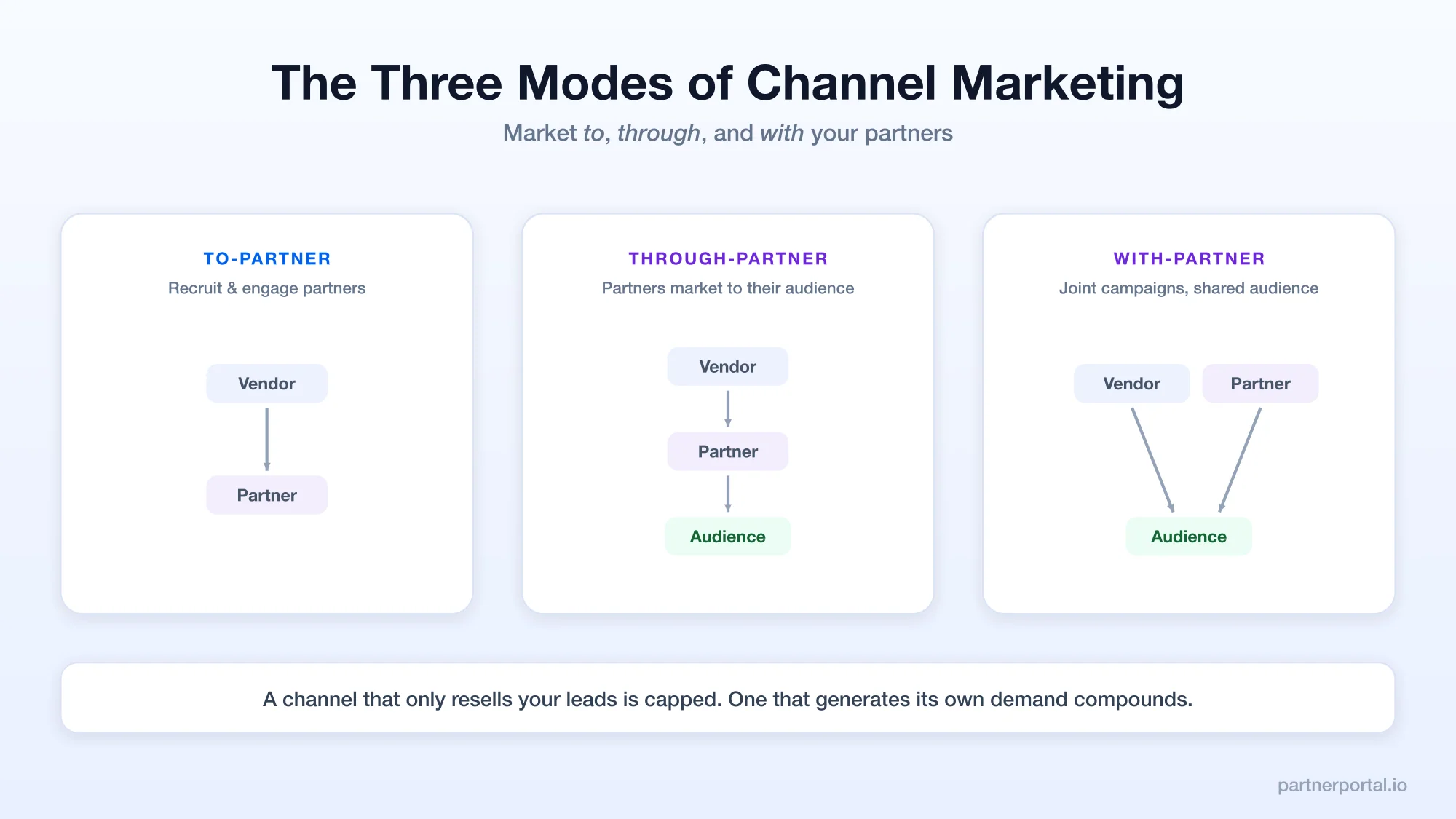
“Channel partner marketing” is one of the most overloaded terms in the channel, because it means two different things at once: marketing to partners (to win and keep them) and marketing through and with partners (to reach end customers). Both matter, and a strong program runs both — but they’re different jobs with different audiences, and blurring them is why the topic so often feels muddled. This guide separates them cleanly.
TL;DR: “Channel partner marketing” is really two jobs with two audiences:
- Marketing to partners — recruit and engage them. Audience: the partner. Applies to every partner type.
- Marketing through and with partners — generate customer demand via or alongside them. Audience: the end customer. Only fits partners who own the customer relationship (resellers, VARs, technology/alliance partners, and affiliates); pure referral partners live in job #1.
- Fund the customer-facing side with MDF and co-op — tied to measurable outcomes.
- Measure pipeline, not activity — partner-sourced demand is the goal.
This piece expands the co-marketing thread of the Enable stage of channel management.
Two things called channel partner marketing
The term is confusing because it names two related but genuinely different activities, aimed at two different audiences:
- Marketing to partners — the audience is the partner. This is how you recruit partners and keep them engaged so they choose to sell or refer you. The partner is the “customer” you’re trying to win.
- Marketing through and with partners — the audience is the end customer, reached via or alongside the partner. This is how the channel generates demand for your product in the market.
The three modes people usually name map onto that split:
| Mode | You’re marketing to… | Purpose |
|---|---|---|
| To-partner | the partner | win and retain the partner |
| Through-partner | the partner’s audience (they run it) | partner-generated customer demand |
| With-partner | a shared audience (you run it jointly) | co-generated customer demand |
A mature program does both — but they’re different jobs, with different audiences, budgets, and metrics, and conflating them is exactly why channel marketing so often feels muddled. The rest of this guide takes each half in turn: first marketing to partners, then marketing through and with them.
One thing shapes both halves, and separates channel marketing from direct marketing: you influence rather than control execution. Direct B2B marketing targets end customers and owns the whole funnel — message, channel, and data. Channel marketing works to and through partners, so the partner owns the customer relationship, often the brand touchpoint, and the decision whether to run your campaign at all. Your leverage isn’t your own execution; it’s how many partners you can activate to act on your behalf — which is why channel marketing lives so close to partner enablement.
Part 1: Marketing to partners
Here the partner is your audience. The goal is a partner who chooses to spend their finite selling time on you rather than the other vendors in their portfolio. This is marketing in service of recruitment and engagement, and it applies to every partner type — including referral partners, who send you leads but still have to be recruited and kept active.
What it includes:
- Recruitment marketing — the campaigns, partner-facing landing pages, and outreach that attract and sign good-fit partners (the demand-generation side of partner recruitment).
- Program communications — newsletters, product and program updates, and partner-facing content that keep your program top-of-mind in a partner’s portfolio.
- Engagement and retention — recognition, partner events, and the ongoing nurture that keeps signed partners active rather than dormant.
This is a different job from enabling partners to sell: enablement equips them with content and training once they’re in; marketing to partners is about winning their attention and mindshare in the first place. In practice the two blur, and both aim at the same outcome — an active, committed partner.
Part 2: Marketing through and with partners
Here the audience shifts to the end customer. The channel is now a route to market, and the job is generating product demand via partners. This is what most people mean when they say a channel “generates its own demand,” and it comes in two modes.
Through-partner marketing
Equipping partners to generate demand to their own audiences under their own brand (co-branded with yours). In practice that’s campaign-in-a-box kits — ready-to-run email sequences, landing pages, social content, and ad creative a partner can deploy with minimal customization. At scale, this is automated with through-channel marketing automation (TCMA) platforms so partners can launch pre-built campaigns from a portal. The whole point is to reduce the effort a partner needs to run a campaign to near zero.
With-partner (co-)marketing
Joint marketing run together to a shared audience: co-hosted webinars and events, co-authored content, joint case studies, and integrated go-to-market with technology or alliance partners. With-partner marketing is highest-effort and highest-trust, and it’s reserved for your most strategic partners where the audiences and interests genuinely overlap.
Which partners actually do this?
Not all of them — and this is where partner type matters. Marketing through and with partners only fits partners who own enough of the customer relationship to market onward:
- Resellers and VARs are the heaviest users of through-partner marketing — they own the sale and benefit directly from generating their own demand.
- Technology and alliance partners are where with-partner co-marketing pays off, because your audiences overlap.
- Referral partners mostly do neither — they generate leads from their own relationships rather than run your campaigns, so they live almost entirely in Part 1 (marketing to them). The exception is affiliates, whose whole model is through-partner demand generation — publishing content and links to their audience on your behalf.
So a pure referral partner sits almost entirely in Part 1; a reseller sits in both. Match the marketing motion to what the partner actually owns.
MDF and co-op funds
Through-partner and with-partner marketing are frequently financed with vendor money:
- Market development funds (MDF) — funds allocated upfront to a partner for agreed marketing activities (a campaign, an event, content). Discretionary and proposal-based; you approve the plan before the spend.
- Co-op funds — funds earned as a percentage of the partner’s sales and reimbursed after the partner spends on qualifying activities. Accrual-based; the more they sell, the more marketing budget they earn.
Both are powerful and both are operationally heavy. The recurring failure is untracked spend — MDF handed out with no proof-of-performance and no ROI measurement becomes a line item nobody can defend. Tie every dollar to a plan and an outcome. Because of that overhead, formal MDF/co-op programs belong to larger, more mature channels; a program still proving the motion is usually better served by great campaign kits than by a funds program it can’t administer. (MDF and co-op also appear as pre-sale incentives — the two disciplines overlap here.)
Channel partner marketing best practices
- Make it turnkey. Partners run what’s easy. Ship ready-to-run, co-brandable campaigns, not a folder of raw assets they have to assemble. Effort is the number-one predictor of whether a partner runs your campaign.
- Focus on partners who execute. A minority of partners will actually run marketing. Concentrate funds and effort there rather than spreading them evenly across a roster that mostly won’t participate.
- Tie funds to outcomes. Every MDF or co-op dollar should map to a plan and a measurable result. No proof-of-performance, no next allocation.
- Align with enablement and sales. Channel marketing that isn’t connected to enablement and deal support generates leads partners can’t convert. The motions have to line up.
- Segment your marketing by partner type. A referral partner, a reseller, and a technology partner need completely different marketing support. Match the program to the partner type.
- Measure pipeline, not downloads. Asset downloads are a leading indicator at best. The scoreboard is partner-sourced pipeline and revenue.
How to measure channel marketing
Measure on outcomes, tied back to the program’s performance metrics:
- Partner-sourced and partner-influenced pipeline — the demand generated through partner marketing.
- MDF / co-op ROI — revenue attributable to funded activities against the funds spent.
- Campaign participation rate — the share of partners actually running the campaigns you build (a direct read on whether you’ve made it easy enough).
- Partner-sourced revenue — the ultimate lagging confirmation.
If participation is low, the problem is almost always effort or relevance — the campaigns are too much work or don’t fit the partner’s audience. Fix the offer before spending more on funds.
Common channel marketing mistakes
- Shipping assets, not campaigns. Raw materials partners have to assemble mostly go unused. Turnkey wins.
- Spreading funds evenly. MDF sprinkled across every partner underfunds the few who’d actually execute.
- No ROI tracking. Untracked MDF is indistinguishable from waste, and it’s the first budget cut when scrutiny comes.
- Marketing disconnected from sales and enablement. Leads with no deal support or enablement behind them don’t convert.
- Treating partners like a direct channel. You influence, you don’t control — build for partner willingness and ease, not for command.
Channel marketing is how a partner program generates its own demand instead of rationing yours. Make it turnkey, fund the partners who execute, connect it to enablement, and measure pipeline. If you want partner marketing, enablement, deal registration, and reporting on one CRM-synced portal, you can launch a free partner portal, or compare the tooling in our guide to the best PRM software.
Frequently asked questions
What is channel partner marketing?
Channel partner marketing is the practice of marketing to, through, and with your channel partners to drive partner-sourced demand. "To-partner" marketing recruits and engages partners; "through-partner" marketing equips partners to run demand generation to their own audiences on your behalf; and "with-partner" (co-marketing) marketing runs joint campaigns to a shared audience. It is how a channel generates its own pipeline instead of only consuming leads you hand out.
How is channel marketing different from direct B2B marketing?
Direct B2B marketing targets end customers and controls the whole funnel. Channel marketing targets and works through partners, so you influence rather than control execution — the partner owns the customer relationship and often the brand touchpoint. That changes the playbook: you invest in enabling partners to market (content, campaign kits, funds) rather than running every campaign yourself, and you measure partner-sourced pipeline rather than direct response.
What are the three types of channel partner marketing?
The three modes are: to-partner marketing (marketing aimed at recruiting, onboarding, and engaging partners themselves); through-partner marketing (giving partners campaigns, content, and funds to generate demand to their own audiences, often via through-channel marketing automation); and with-partner or co-marketing (joint campaigns, events, and content run together to a shared audience). Mature programs use all three.
How do referral partners fit into channel marketing?
The three modes of channel marketing are motions, not partner types, so a referral partner maps onto some but not all of them. You still market to referral partners — to recruit them and keep them engaged so they keep sending leads — which is the to-partner mode. Pure referral partners don't run demand-generation campaigns for you, so they mostly sit outside through-partner marketing; affiliates are the exception, since affiliate marketing is itself through-partner demand generation. They rarely do with-partner co-marketing. Referral partners are simply the lightest-touch partner in the framework: their demand generation is their own relationships, not your campaigns.
What are MDF and co-op funds?
Market development funds (MDF) and co-op funds are money a vendor provides to partners to finance demand-generation activities — campaigns, events, content, and advertising. MDF is typically allocated upfront for agreed activities; co-op funds are usually earned as a percentage of the partner\u2019s sales and reimbursed after the fact. Both fund through-partner marketing, and both require ROI tracking or they become untracked spend.
What are channel partner marketing best practices?
The core best practices: make partner marketing easy (ready-to-run, co-brandable campaign kits, not raw assets), focus funds and effort on partners who will actually execute, tie MDF and co-op to measurable outcomes, align channel marketing with partner enablement and sales, and measure partner-sourced pipeline and marketing-influenced revenue rather than activity. The biggest lever is reducing the effort a partner needs to run a campaign.
How do you measure channel marketing success?
Measure channel marketing on outcomes, not activity: partner-sourced and partner-influenced pipeline, marketing-qualified leads generated through partners, MDF/co-op ROI (revenue against funds spent), partner participation rate in campaigns, and ultimately partner-sourced revenue. Activity metrics like assets downloaded matter only as leading indicators of whether partners are actually running the programs you built.