
Partner Engagement: How to Keep Partners Active
A practical guide to partner engagement — what it means, why partners go dormant, how to measure it, and the tactics and cadence that keep partners selling, referring, and coming back after onboarding.
Written by the team at PartnerPortal — PRM software used to run B2B partner and channel programs.
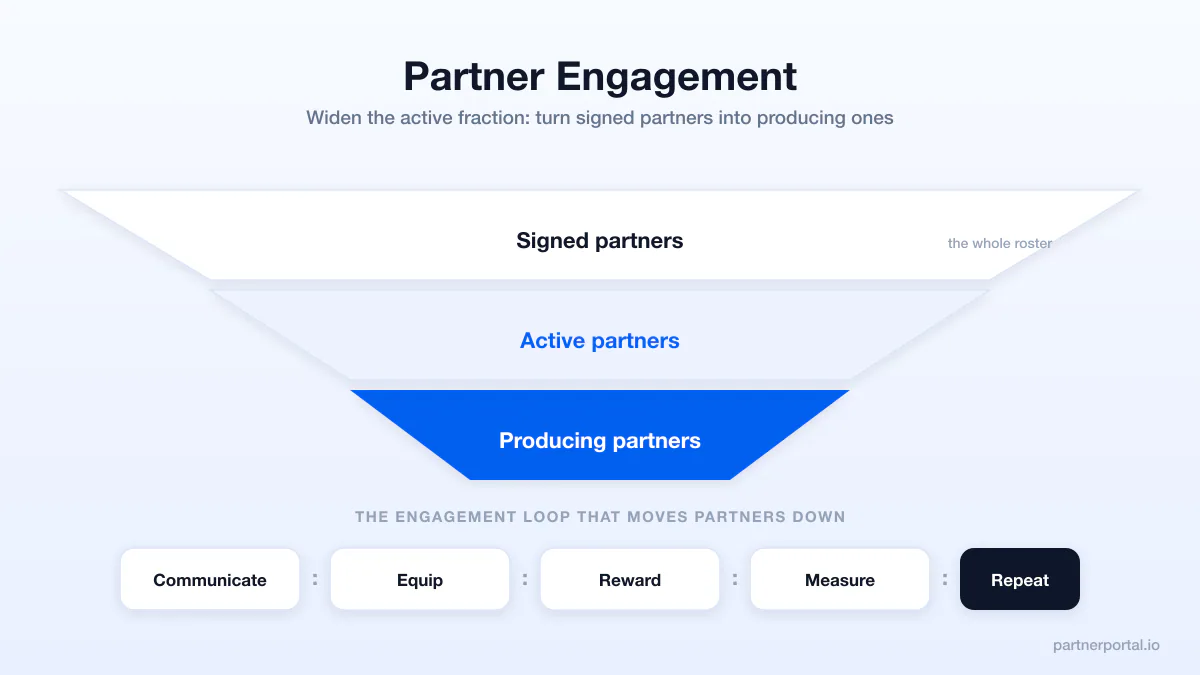
Partner engagement is the ongoing work of keeping partners active — selling, referring, and staying current — after they’ve onboarded, by giving them reasons to keep showing up and making it easy to transact. It’s the difference between a partner roster that looks impressive on a slide and one that actually produces revenue.
Most signed partners go quiet. In nearly every program, a small fraction of partners drive the majority of partner-sourced revenue, and the rest drift into dormancy. Engagement is the discipline of widening that active fraction — not engaging everyone equally, but giving more partners a reason to stay in the game.
TL;DR:
- Partner engagement is sustained partner activity after onboarding — the outcome, not the input.
- Partners go dormant mostly from friction and no reason to return, not disloyalty.
- Measure it with leading indicators: active-partner rate, logins, deal/lead registration, content usage.
- The tactics that work: relevant communication, fresh enablement, fast deal support, behavior-based incentives, and tiering.
- Run a cadence scaled by tier so it survives past 50+ partners.
What partner engagement means (and what it doesn’t)
It helps to place engagement precisely in the partner lifecycle, because it’s often confused with the stages around it:
- Onboarding gets a new partner in — signed, set up, and to a first deal.
- Enablement equips them — the content, training, and tools they need to sell.
- Engagement is the outcome — whether partners actually stay active over time and keep using what you’ve given them.
The distinction that matters most: enablement is an input, engagement is a result. You can produce a flawless resource library and a full certification path and still have terrible engagement if partners never open any of it. Engagement asks the harder question — not “did we give partners what they need?” but “are partners actually showing up?”
Why partners go dormant
Dormancy is rarely disloyalty. It’s almost always the program quietly ceasing to give the partner a reason to show up. The recurring causes:
- No early win. A partner who doesn’t close (or register) something in their first few weeks loses momentum, and momentum rarely comes back on its own.
- Too much friction. If registering a deal, finding a deck, or getting an answer is slow, partners route around you — usually to a competitor whose program is easier.
- No reason to return. Nothing new to log in for: no fresh content, no announcements, no visible pipeline, no update on their rewards.
- No visible upside. The partner can’t see what’s in it for them — unclear incentives, no view of their own performance, no tiering to work toward.
Every one of these is fixable, and none of them is about the partner “not caring.” They’re about the experience of working with you.
How to measure partner engagement
Engagement is a leading indicator — it moves before partner-sourced revenue does, which is exactly what makes it worth tracking. The metrics that matter:
| Metric | What it tells you |
|---|---|
| Active-partner rate | The share of partners who did something meaningful in the last 30 / 60 / 90 days. The single best health signal. |
| Portal logins | Whether partners are showing up at all. Falling logins precede falling revenue. |
| Deal / lead registration frequency | Whether partners are bringing you pipeline, not just browsing. |
| Content and training usage | Whether your enablement is actually being consumed. |
| Time-to-first-deal | How fast new partners reach a first win — the strongest predictor of long-term activity. |
Avoid vanity metrics. A high login count that never converts to registered deals is engagement theater. Tie engagement measures back to partner-sourced pipeline and revenue, and watch the trend, not the snapshot. For the full measurement picture, see channel performance metrics.
Tactics that keep partners active
The practical levers, roughly in order of impact:
- Get every new partner to an early win. Prioritize time-to-first-deal above almost everything — it’s the difference between a partner who stays and one who fades.
- Communicate regularly and relevantly. Product updates, new content, wins, and program changes — a steady, low-noise stream of reasons to pay attention. Irrelevant blasts train partners to ignore you.
- Keep enablement fresh. A resource center that’s current and easy to search, not a stale drive folder. Partners return to programs that keep giving them something new.
- Make deal support fast. When a partner is in front of a customer, speed wins. Slow answers are the most expensive kind of friction.
- Reward the behavior you want. Incentives tied to the actions that drive revenue — registering deals, closing, completing training — not vague loyalty.
- Tier your partners. Give your best partners more: more support, better margins, earlier access. Tiering creates something to work toward and concentrates your effort where it pays off.
An engagement cadence you can actually run
Engagement fails when it depends on one person remembering to reach out. It scales when it’s a rhythm scaled by tier:
- Whole base (light, recurring): a monthly update or newsletter, timely announcements, and a steady trickle of fresh content. Automated where possible so it survives a busy quarter.
- Producing partners (higher touch): a regular check-in and a quarterly business review — pipeline, what’s working, what they need next.
- Top / strategic partners (highest touch): a named relationship, joint planning, and co-marketing or co-sell support.
The point isn’t equal attention for every partner — it’s a sustainable operating cadence that doesn’t collapse when the program grows past fifty partners. This is the relationship discipline at the heart of partner management.
How software helps
Most engagement problems are, underneath, friction-and-visibility problems — which is what a PRM (partner relationship management) system addresses. PartnerPortal gives a program the pieces that keep partners showing up:
- A partner portal partners actually log into — one place for content, deals, and rewards.
- Announcements and email to keep the base informed without manual one-off outreach.
- A resource center and courses so there’s always something current to come back for.
- Lead and deal registration that gives partners a concrete reason to log in — and gives you a live view of who’s active.
- Incentives and commissions tied to the behavior you want to see.
- Reporting on logins, registrations, and partner activity, with native CRM sync so engagement signals line up with real pipeline.
Software won’t make a disengaged program engaging on its own — the cadence and the relationships still have to be real — but it removes the friction and gives you the visibility to see who’s slipping before their revenue does. For how the tools compare, see the guide to the best PRM software.
Related reading
- Channel Partner Enablement: How to Equip Partners to Sell — the input that engagement depends on.
- Partner Incentives: What Actually Works in B2B — rewarding the behavior that keeps partners active.
- Channel Partner Onboarding — the stage before, where engagement is won or lost.
- What Is Partner Management? — the discipline this all sits inside.
Ready to give partners a portal worth logging into? Claim your portal or explore the CRM integrations.
Frequently asked questions
What is partner engagement?
Partner engagement is the ongoing work of keeping partners active — selling, referring, and staying current — after they have onboarded. It is measured by sustained activity over time: how many partners log in, register deals, complete training, and produce revenue, versus how many have gone quiet. Engagement is a leading indicator of partner-sourced revenue.
Why do partners become inactive?
Partners go dormant for a few recurring reasons: they never got an early win, so momentum never built; working with you has too much friction; they have no ongoing reason to log in or come back; or they cannot see what is in it for them. Most dormancy is not disloyalty — it is a program that stopped giving the partner a reason to show up.
How do you measure partner engagement?
Track leading indicators: active-partner rate (the share of partners who did something meaningful in the last 30/60/90 days), portal logins, how often partners register deals or leads, training and content usage, and time-to-first-deal for new partners. These predict the lagging outcome — partner-sourced revenue. If activity is falling, revenue usually follows.
What's the difference between partner engagement and partner enablement?
Enablement is what you give partners — the content, training, and tools that equip them to sell. Engagement is the outcome: whether partners actually use any of it and stay active over time. You can have excellent enablement material and terrible engagement if nobody opens it. Enablement is the input; engagement is the result.
How often should you engage partners?
Run a recurring cadence scaled by partner tier: light, regular touches for the whole base (a monthly update or newsletter, fresh content, timely announcements), and higher-touch check-ins or quarterly business reviews for your top-producing partners. The goal is a rhythm you can actually sustain as the program grows, not equal attention for every partner.