
Channel Partner Incentives: SPIFFs, MDF, Rebates, and Tiers That Actually Work
A practical guide to channel partner incentives — commissions, margin, rebates, SPIFFs, MDF, and tier structures — how each one works, when to use it, and how to design a channel incentive program that rewards revenue, not sign-ups.
Written by the team at PartnerPortal — PRM software used to run B2B partner and channel programs.
Incentives are how you tell partners what you want them to do — and get it. Design them well and partners sell more, sell the right things, and invest in the relationship. Design them badly and you either overspend on partners who’d have sold anyway, or reward the wrong behavior entirely (signing up, not selling). The mechanics aren’t complicated, but choosing the right ones for your program’s stage is where most channel incentive programs go wrong.
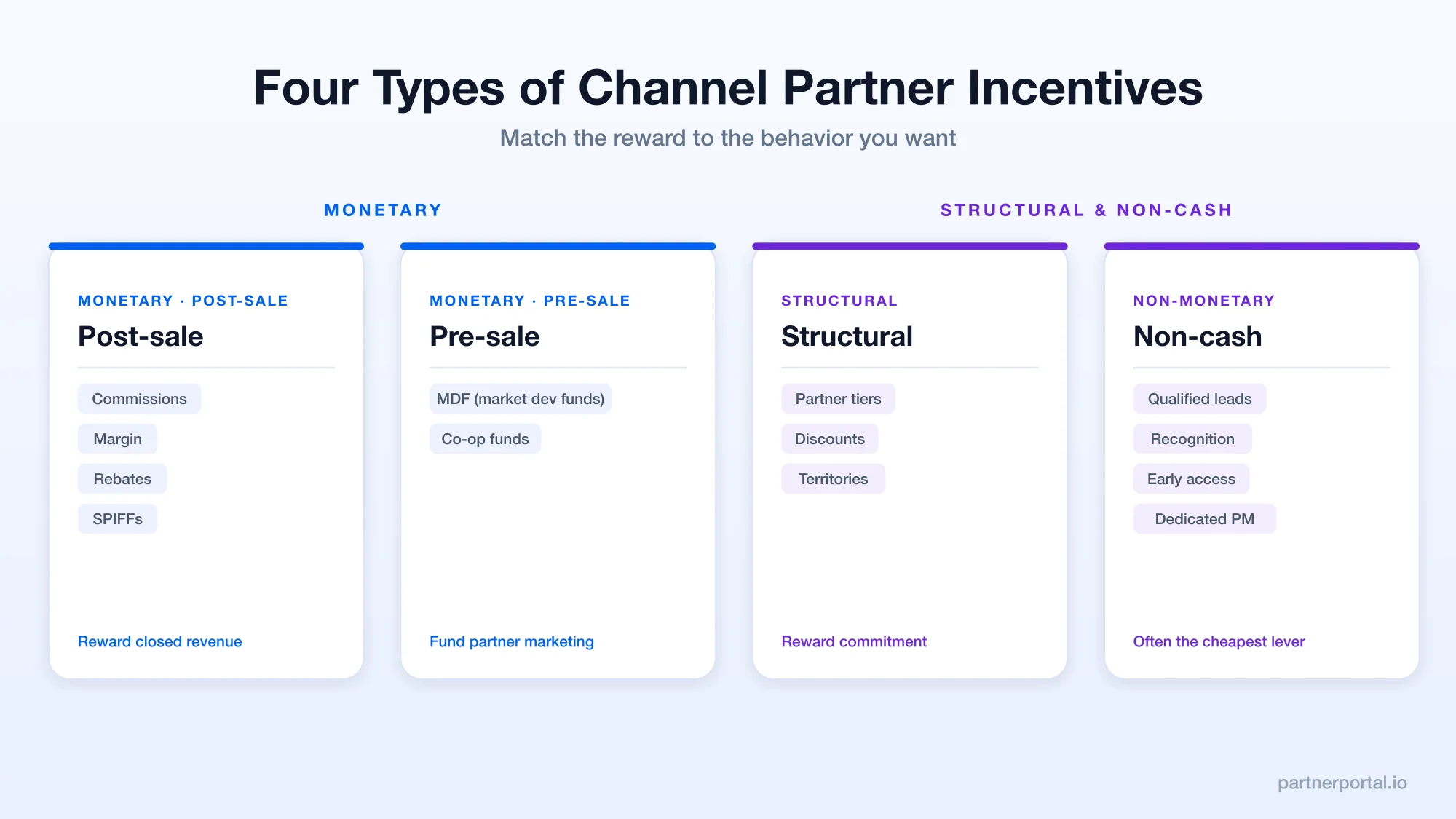
TL;DR: Channel partner incentives fall into four groups:
- Monetary, post-sale: commissions / resale margin, rebates, SPIFFs, margin uplift on registered deals.
- Monetary, pre-sale: market development funds (MDF) and co-op funds.
- Structural: partner tiers, pricing discounts, protected territories.
- Non-monetary (underrated): qualified leads, recognition, early access, a dedicated partner manager, free certification.
For most SMB and mid-market programs, commissions plus a simple tier structure are enough to start. This is the “Incentivize” stage of channel management, in depth.
What channel partner incentives are for
An incentive is a lever, and every lever should move a specific behavior. Before choosing mechanics, name the behavior: do you want partners to source more new deals, sell a specific product, grow year over year, generate their own demand, or invest in certification and capacity? The incentive follows the goal, not the other way around.
The most important principle in the whole discipline: reward revenue and activity, not sign-ups. Paying partners to join, or rewarding the mere existence of a logo on your roster, is how programs fill up with dormant partners. Tie reward to the outcomes you actually want, and the roster sorts itself out.
The four types of channel incentives
Monetary, post-sale (commissions, margin, rebates, SPIFFs)
The core of most programs — money paid after a sale closes:
- Commission — a payment (often a percentage) to a referral or reselling partner for a closed deal. The default incentive for most programs.
- Resale margin — the discount off list price a reseller or VAR keeps as its profit. Functionally the reselling equivalent of commission.
- Rebate — a retroactive bonus for hitting a threshold: volume, growth, or a target over a period. Rewards cumulative performance rather than each individual sale.
- SPIFF — a short-term, targeted cash bonus to a partner’s individual reps for a specific action (push a launch, win a competitive deal, clear a quarter). Tactical and time-boxed.
- Margin uplift on registered deals — extra margin or commission for deals a partner registers first, which rewards good deal-registration behavior directly.
Monetary, pre-sale (MDF and co-op funds)
Money given before revenue, to finance partner-run demand generation:
- Market development funds (MDF) — vendor money for partner marketing activities (events, campaigns, content), usually reimbursed against an approved plan and proof of spend.
- Co-op funds — a related, often accrual-based version where partners earn a marketing budget as a percentage of their sales.
Both are powerful for driving partner-led demand, but operationally heavy — they need approval workflows, proof tracking, and ROI measurement. They belong to larger, mature channels, not a program still proving the motion. See channel partner marketing for how MDF and co-op fund through-partner demand generation.
Structural (tiers, discounts, territories)
Incentives built into the shape of the program:
- Partner tiers — escalating status and benefits (e.g. Silver / Gold / Platinum) that partners earn through revenue, certification, or activity. Higher tiers unlock more margin, more leads, better support, and recognition — and partners can be demoted for inactivity. Tiers give partners a visible path to greater reward and make commitment pay off.
- Pricing discounts — preferential pricing tied to status or commitment.
- Protected territories or segments — exclusivity that rewards investment and reduces conflict.
Non-monetary incentives (the underrated lever)
Often the most cost-effective motivators, especially for technical partners who care less about margin:
- Qualified leads — handing partners real opportunities is frequently the single most valued incentive.
- Recognition and awards — status within your ecosystem and their market.
- Early or beta product access — a genuine draw for partners building on or integrating with you.
- A dedicated partner manager — attention and support signal the relationship matters.
- Marketplace placement and free certification — visibility and capacity that partners would otherwise pay for.
Matching incentives to partner type
Incentives only work when they fit how the partner creates value — the same theme that runs through the types of channel partners:
| Partner type | Primary incentive | Also effective |
|---|---|---|
| Referral / affiliate | Commission or bounty per lead/deal | Fast, reliable payouts |
| Reseller | Resale margin | Deal registration, volume rebates |
| VAR | Higher margin + services revenue | Certification, leads |
| Distributor | Margin across its reseller base | Rebates, MDF, tier status |
| MSP | Recurring margin | Predictable pricing, support |
| SI / technical | Services revenue | Certification, co-sell support, leads |
| Technology / ISV | Ecosystem exposure | Joint go-to-market, marketplace placement |
| Strategic alliance | Joint business plan | Executive alignment, co-innovation |
Paying every partner type the same way is a classic and costly mistake — a referral partner and a system integrator are motivated by completely different things.
How to design a channel incentive program
- Start simple. For most SMB and mid-market programs, commissions plus a basic tier structure are enough to launch. Complexity is something you earn into, not start with.
- Reward the behavior you want. Pay for sourced revenue and activity, never for sign-ups. If you want growth, add a growth rebate; if you want a product pushed, run a time-boxed SPIFF.
- Keep it understandable. A comp plan partners can’t explain to their own reps doesn’t motivate anyone. Simplicity beats cleverness.
- Protect deals. Incentives are only worth chasing if partners trust their pipeline is safe. Deal registration and clear rules of engagement are the foundation under every margin point.
- Add heavy mechanics only when mature. MDF, co-op, and structured rebates drive real results but need administration and ROI tracking. Introduce them once the program can support them — not before.
- Measure and adjust. Track which incentives move which behaviors and prune the ones that don’t earn their cost.
Channel incentive mistakes to avoid
- Rewarding sign-ups instead of revenue. Fills the roster with inactive partners.
- Comp plans nobody understands. Complexity kills motivation.
- MDF with no ROI tracking. Marketing money out the door with nothing to show is just spend.
- One incentive for all partner types. Margin means little to an SI; leads mean little to a pure affiliate.
- Ignoring non-monetary incentives. Leads, recognition, and access are often cheaper and more motivating than another point of margin.
- Over-relying on SPIFFs. Constant bonuses train reps to wait for the next one instead of selling at baseline.
Get incentives right and partners point their effort exactly where you want it. Get them wrong and you pay for activity you’d have gotten anyway. To run commissions, tiers, and payouts alongside deal registration and reporting in one place, you can launch a free partner portal, or compare the platforms in our guide to the best PRM software.
Frequently asked questions
What are channel partner incentives?
Channel partner incentives are the rewards a vendor offers partners to drive the behavior it wants — selling more, selling the right products, or investing in the relationship. They fall into four groups: monetary post-sale (commissions, resale margin, rebates, SPIFFs), monetary pre-sale (market development funds and co-op funds), structural (partner tiers, pricing discounts, protected territories), and non-monetary (qualified leads, recognition, early access, dedicated support).
What is a SPIFF in a channel program?
A SPIFF (sometimes written SPIF) is a short-term, targeted cash bonus paid to a partner's individual sales reps for a specific action — closing a particular product, hitting a monthly target, or winning a competitive deal. Unlike standing commission, SPIFFs are tactical and time-boxed. They're useful for pushing a launch or clearing a quarter, but overusing them trains reps to wait for bonuses.
What is MDF (market development funds)?
Market development funds (MDF) are money a vendor gives partners to finance demand-generation activities — events, campaigns, content — usually reimbursed against approved plans and proof of spend. Co-op funds are a related, often accrual-based version. MDF is powerful for driving partner-led marketing but operationally heavy, so it belongs to larger, mature programs rather than one still proving the motion.
What's the difference between a rebate and a commission?
A commission (or resale margin) is paid on each deal as it closes. A rebate is paid retroactively for hitting a threshold — a volume, growth, or target-based bonus over a period, often as a percentage of total sales once a partner crosses a tier. Commissions reward every sale; rebates reward cumulative performance and are a common way to motivate partners to grow their business with you.
How do partner tiers work as an incentive?
Partner tiers (for example Silver, Gold, Platinum) reward commitment and performance with escalating benefits — higher margin or commission, more leads, better support, co-marketing funds, and status. Partners earn their way up based on revenue, certification, or activity, and can be demoted for inactivity. Tiers are a structural incentive: they make investing in the relationship pay off and give partners a visible path to more reward.
How do you design a channel incentive program that works?
Start simple and reward the behavior you actually want. For most SMB and mid-market programs, commissions plus a basic tier structure are enough. Reward revenue and activity, not sign-ups; keep comp plans simple enough that partners understand them; protect deals with registration so incentives are worth chasing; and add heavier mechanics like MDF, co-op, and rebates only once the program is mature enough to administer them and measure their ROI.