
Channel Partner Programs: How They Work and How to Build One
What a channel partner program is, the main program types (referral, reseller, technology, and more), how tiers, benefits, and commissions are structured, real B2B examples, and a step-by-step plan to build one.
Written by the team at PartnerPortal — PRM software used to run B2B partner and channel programs.
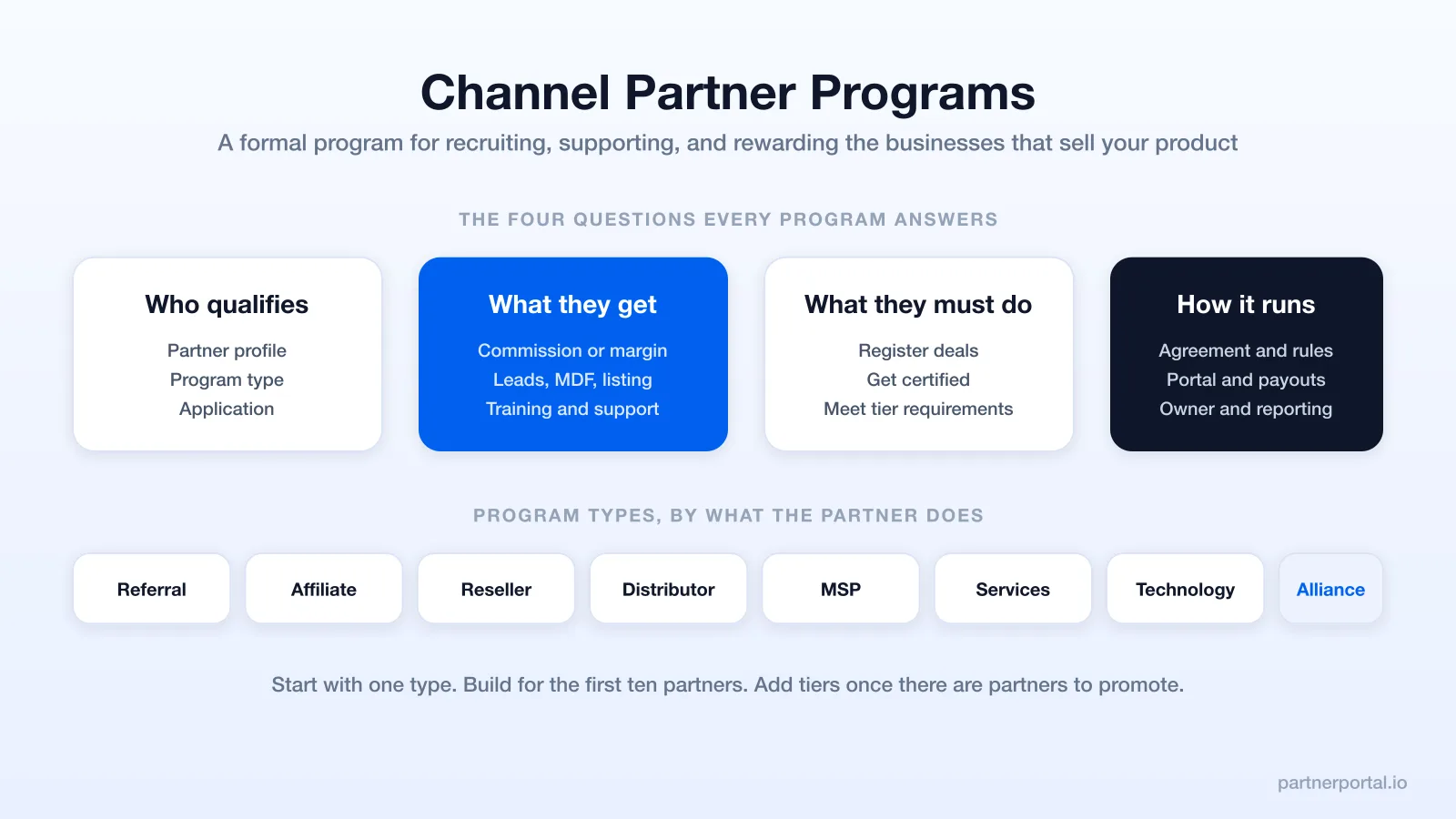
A channel partner program — usually just called a partner program — is a formal program a company runs to recruit, support, and reward other businesses that sell, refer, implement, or build on its product. Those businesses are its channel partners: resellers, referral partners, agencies, distributors, managed service providers, and technology partners. The program sets out who can join, what partners receive, what the company expects from them, and how the company supports them.
A program can be small. Five committed partners with clear terms is a partner program. What makes it a program rather than a set of one-off relationships is consistency. Every partner gets the same terms, the same onboarding, and the same support. The company can see which partners are producing.
This guide is for two readers. The first is deciding whether to start a partner program and what it should look like. The second has inherited one and needs to understand its parts. It covers what a partner program is, the types, the components, tiers, the economics, real examples from B2B and SaaS, a step-by-step build sequence, how to run and measure one, and the mistakes that sink first attempts.
Full disclosure: PartnerPortal makes PRM (partner relationship management) software that companies use to run partner programs. We also run our own program for consultants and agencies. Where that is relevant below, we say so.
TL;DR:
- A partner program is the formal structure around your partnerships. It defines who can join, what partners get, what you expect, and how you support them — once, for everyone, instead of negotiating each relationship from scratch.
- Choose the program type first. Referral, reseller, technology, services, and affiliate programs are different arrangements for different partners. Start with one.
- Every program has the same components. An agreement, compensation, deal registration and rules of engagement, onboarding and enablement, a portal, payouts, reporting, and an owner.
- Add tiers later. Launch with one tier. Add a second once you have partners to promote.
- Build for the first ten partners. Get them to a first deal. Measure for 90 days. Then expand.
What is a channel partner program?
A partner program is the formal structure a company puts around its partnerships. Without one, each partnership is negotiated and managed on its own. With one, the company decides once how it will work with partners and applies that to everyone who joins.
Every partner program answers four questions:
- Who do we partner with? The kinds of companies, what they do for customers, and what it takes to join.
- What do partners get? Commission, margin, or fees. Leads. Training. Marketing support. A directory listing. A person to call.
- What do we expect from partners? Registering deals. Completing training. Meeting revenue or activity thresholds. Following rules of engagement.
- How do we support and manage them? The agreement, the partner portal, deal registration, payouts, reporting, and who owns the relationship.
The word channel refers to the indirect route to market: selling through third parties instead of, or alongside, your own sales team. A channel partner program organizes that route.
In B2B software, several terms are used for the same thing. Partner program, channel program, and partnership program are interchangeable in most contexts. Partner ecosystem is newer and broader. The emphasis differs slightly. “Channel” tends to mean resellers and distributors. “Partnership” tends to mean referral and technology partners. “Ecosystem” tends to mean all of it, plus the integrations and marketplaces around a product.
What a partner program is not. It’s not an affiliate link on a pricing page, though an affiliate program is one kind of partner program. Nor is it an integration listed in a marketplace, though a technology partner program often starts there. And a single reseller who sends you deals on a handshake isn’t a program either. That’s a partnership. When you want a second partner on the same terms, you need a program.
A practical test: a new partner asks what they get, what they have to do, and where they register a deal. Can you send them a page that answers all three? If so, you have a program.
Why companies run partner programs, and when they should not
Partners bring four things a company cannot easily buy.
Reach. A partner already sells into a region, an industry, or a customer base. Building a direct team to cover the same ground could take years. A reseller in a market you have never visited, or an agency with forty clients who need what you sell, is distribution you rent instead of build.
Trust. Buyers trust the advisor they already pay more than a vendor they have never met. A recommendation from a consultant who implements your product carries weight a cold email cannot.
Lower cost per deal. Partner-sourced deals often skip the top of the funnel. The partner has already qualified the need. Vendor-published studies claim higher close rates and lower acquisition cost for partner-sourced deals. Treat the specific numbers with caution. The mechanism is real.
Retention. A partner who implemented the product and earns a recurring commission has a reason to keep the customer successful. That alignment is why recurring compensation has become common in SaaS.
How much revenue comes through partners varies widely. In a September 2025 survey by PartnerStack and Wynter, mid-market and enterprise B2B software companies reported that about 35% of new pipeline was partner-influenced or partner-sourced. Directional targets cited by Unifyr, a PRM vendor, put channel-first companies above 50% partner-sourced revenue, hybrid models at 20–40%, and direct-led companies with a supporting channel at 5–20%. Close, a CRM vendor, has written that its program took partner revenue from under 4% to 10% in under a year, with the program lead spending about a fifth of his time on it. None of these are targets. They show the range.
When not to start one yet. A partner program amplifies demand that already exists. It won’t create product-market fit, and it won’t sell a product your own team can’t. Four preconditions:
- Customers already recommend you. If nobody refers you unprompted, a program formalizes a motion that is not there.
- You can afford to share. A referral fee, reseller margin, or commission has to leave enough gross margin to serve the customer. If unit economics are thin, fix them first.
- Someone owns it. The owner can be part-time. The ownership cannot be nobody.
- You can support a partner’s customer. If onboarding or support can’t absorb customers you didn’t sell to, partners will bring you churn.
If those hold, the question is which kind of program to run.
The types of partner programs
The type of program is the most important design decision. It decides who the partner is, what they do, how they are paid, and what you have to provide. Different types need different onboarding, enablement, incentives, and support.
The table sorts programs by what the partner does. These are common shapes, not rigid categories. Many programs combine two.
| Program type | What the partner does | How they are usually paid | What you must provide | Common starting point for |
|---|---|---|---|---|
| Referral | Introduces a qualified lead. You close and own the customer. | Fee, or % of first-year or recurring revenue | Easy lead registration, fast feedback on referrals, prompt payout | Many B2B SaaS companies |
| Affiliate | Promotes to an audience through tracked links. No customer relationship. | % commission per sale, often recurring in SaaS | Links, creative, a dashboard, reliable attribution | Self-serve and product-led products |
| Reseller / VAR | Sells and often bills the customer. May add services. | Margin: a discount off list price | Pricing and discount structure, deal registration, sales training, demo environments | Products with a sales cycle and implementation |
| Distributor | Sells to resellers, not end customers (two-tier channel) | Deeper discount that stacks with reseller margin | Distributor agreements, license management, channel marketing | Hardware, and software at enterprise scale |
| MSP | Bundles your product into a managed service it sells | Wholesale or per-seat pricing | Multi-tenant management, consumption billing, technical enablement | IT, security, and infrastructure products |
| Services / SI | Implements, customizes, and supports. May or may not resell. | Fees from the customer, sometimes a referral fee from you | Technical certification, implementation docs, a directory listing | Products that need configuration |
| Technology / ISV | Builds an integration or app on your platform | Usually no cash. Mutual leads, marketplace placement, sometimes revenue share | APIs, a marketplace, co-marketing, partner-facing docs | Platforms with an ecosystem |
| Strategic alliance | Joint go-to-market with a peer company | Co-selling, shared pipeline | Executive sponsorship, a joint business plan | A small number of partners that move the business |
Two observations help when choosing.
Many B2B companies start with referral. A referral program is the cheapest to launch. You still close and own the customer. It tests whether partners will send you business at all. Reseller programs tend to come later, once partners want to own the customer relationship and you have the pricing and enablement to let them. Technology programs tend to come when integrations start generating demand on their own.
The partner and the program are different things. A consulting firm can be a referral partner, a services partner, and a reseller for the same product. That can be three programs or three tracks of one. Our guide to the types of channel partners covers the partner side: who these companies are and what motivates them. This page covers the program side.
The components of a partner program
Every partner program is built from the same parts. A ten-partner referral program and a global reseller channel differ in how formal each part is, not in whether it exists. Each part is covered in depth on its own page. This section is the map.
The agreement. The contract that sets scope, territory, compensation, attribution, deal registration rights, intellectual property, confidentiality, and termination. Sign it before the first deal, not after the first dispute. See channel partner agreement.
The partner profile and application. A written description of who you want: industry, customer base, capabilities, geography. A short application that screens for it. Close, which runs a referral program, reports that asking applicants why they want to partner is the most revealing question on its form.
Compensation. Commission, margin, fees, or non-cash benefits, plus the rules that decide which deals qualify. Match it to the deal economics: recurring commission for subscription revenue, margin for resale, and flat fees for low-touch referrals. See partner incentives for structures and channel partner incentives for SPIFFs, rebates, MDF, and tiers.
Deal registration and rules of engagement. Deal registration lets a partner claim an opportunity. The first qualifying partner gets a time-bound window of protection on it. Rules of engagement settle what happens when your direct team and a partner, or two partners, pursue the same deal. Without both, partners cannot trust their pipeline and stop investing. See channel conflict.
Tiers and requirements. The ladder partners climb, and what each rung requires and returns. Covered in the next section.
Benefits beyond money. Leads. A listing in your partner directory. Co-marketing. Market development funds. Early roadmap access. A named partner manager. Sales and technical support. For technology and services partners, these often matter more than commission.
Recruitment. How partners find you and how you find them. A public partner page and application. Outreach to the agencies and consultants your customers already use. Marketplace listings. Referrals from existing partners. See channel partner recruitment.
Onboarding and enablement. The path from signed to producing: agreement, portal access, first training, deal-registration setup, a first opportunity, a check-in. Then the ongoing supply of content, tools, and co-marketing that keeps partners able to sell. See channel partner onboarding and channel partner enablement.
Training and certification. Courses that teach partners to position, demo, and support the product. A credential that proves it and unlocks benefits. See partner training software for what to teach and the partner LMS guide for the system that delivers it.
The partner portal. The branded place partners log in to register deals, find current resources, take training, and see what they have earned. Early programs run on a spreadsheet and email. The portal is what lets the program grow without the owner in every transaction. See what is a partner portal.
Payouts. Calculating what each partner is owed, approving it, paying it on a promised cadence, and giving the partner a statement they can reconcile. Late or wrong payouts erode trust faster than a lower rate would.
Reporting. Who is active. Who is registering deals. What partner-sourced pipeline and revenue look like. Which partners to invest in, coach, or let go. See channel performance metrics.
Governance. An owner, an operating cadence, and periodic review of benefits and requirements. See channel partner management.
A quick audit of your own program: list these twelve parts and write one line on how each works today. The blanks are your to-do list.
Partner program tiers
Tiers are the most visible feature of mature programs and the most over-built feature of new ones. They do two things. They give partners a reason to invest more. They let you concentrate benefits on the partners who produce.
How they work. A program groups partners into three or four named levels. Registered, silver, gold, and platinum is the classic ladder. Naming varies. TechTarget describes Dell EMC’s tiers as Authorized, Gold, Platinum, Titanium, and Titanium Black, and Nutanix’s as Pioneer, Master, and Scaler. Each tier has requirements and benefits.
| Requirements (what the partner must show) | Benefits (what the partner gets) | |
|---|---|---|
| Entry tier | Signed agreement, approved application, basic training | Base commission or margin, portal access, standard resources |
| Middle tier | Referred revenue or active-customer threshold, deal registrations, one or more certifications | Higher rate, leads, co-marketing slots, directory badge |
| Top tier | Higher revenue threshold, several certified people, a joint business plan | Highest rate, named partner manager, market development funds, early roadmap access, priority support |
Reditus, a partner-software vendor, publishes an illustrative SaaS ladder that makes this concrete. The entry tier is open to any approved partner at 20% recurring commission. The middle tier requires 10 active referred customers or $5,000 in referred MRR and pays 25% plus a quarterly co-marketing slot. The top tier requires 25 active customers or $15,000 in referred MRR and pays 30% with a named partner manager and market development funds. The thresholds are one company’s example. The shape is typical.
Four rules for tiers.
- The pyramid is normal. In most programs, the majority of partners sit in the entry tier. A small group at the top produces most partner-sourced revenue. Tiers let you serve the top group well without serving everyone that way.
- Use both kinds of requirement. A revenue threshold rewards what a partner has already done. A certification requirement signals what they can do next. Good ladders use both. Gate at least one tier on a certification so the credential means something.
- Review on a cadence, with a grace period. Quarterly or annual review is common, with one cycle of grace before demotion. A partner with one slow quarter should not lose a tier.
- Do not launch with tiers. Four tiers and three partners is a ladder with nobody on it. Launch with one tier. Add a second once you have partners to promote and benefits worth promoting them to.
Partner program economics
Compensation is where programs are won or lost. Pay too little and nobody sells. Pay too much and every partner deal loses money. The structures below are organized by program type, with the ranges commonly cited in 2026.
Referral and affiliate: a percentage of revenue. The common SaaS structure is a percentage of subscription revenue. It is paid either on the first year or for as long as the customer stays. Commonly cited ranges are 15–30% recurring, with top tiers somewhat higher. Rewardful’s analysis of live SaaS affiliate programs, as reported by the analytics firm Webtonic, puts the average affiliate commission at about 24% and the referral-to-sale conversion at roughly 0.8% of clicks. Affiliate volume is high and conversion is low. Two public B2B examples: HubSpot pays Solutions Partners 20% for three years on deals they source. Close pays 30% of first-year subscription revenue. Flat fees per qualified referral are common for lower-touch programs and for products where contract value varies too much to share a percentage.
Reseller: margin off list. Resellers buy at a discount and sell at or near list price. They keep the difference. Commonly cited margins run roughly 10–40%, depending on tier and how much selling, implementation, and support the partner takes on. In a two-tier channel, the distributor takes an additional discount. A product that lists at $100 might sell to the distributor at $60, to the reseller at $70, and to the customer at $100.
Technology and services partners: usually not cash. Integration partners are typically compensated with leads, marketplace placement, and co-marketing. Some platforms share revenue on marketplace sales. Services partners earn from the customer for implementation. Vendors sometimes add a referral fee when the partner also sources the deal.
Three design choices that matter more than the rate.
- Recurring or one-time. Recurring commission aligns the partner with retention. It also attracts partners who care about fit. One-time fees are simpler and suit products without subscription revenue. For SaaS, recurring is the usual default.
- Attribution rules. How long after a referral a closed deal still counts. Protection windows of 90 to 180 days are common for registered deals. What happens when a referred lead was already in your pipeline. Whether the partner must register the deal first. Ambiguity here is a leading cause of partner disputes.
- Clawbacks. What happens to a commission when a customer refunds or churns in the first months. Write it down before it happens.
The cost side. A program costs more than its commissions. It costs the owner’s time, even part-time. It also means either a PRM or the spreadsheet hours a PRM would replace, plus enablement content, partner marketing, market development funds once you offer them, and the support load of customers you didn’t sell to.
A simple model before launch: estimate partner-sourced deals in year one. Be conservative, because the first partners take months to produce. Multiply by average contract value and your margin after commission. Compare that with the owner’s time and tooling. If the model only works at optimistic deal counts, start with a referral program and a lower fee.
Channel partner program examples
The best way to understand program design is to look at the choices companies with established programs have made. The examples below come from each company’s public partner pages as of October 2026. They span the program types. They are not ranked. The right design for your program depends on your product and your partners, not on which of these is largest.
HubSpot Solutions Partner Program (services and referral). Built for agencies and consultancies that implement HubSpot. Membership costs $400 a month. It is waived for partners whose own HubSpot spend exceeds that. Partners earn 20% commission for three years on deals they bring, and 20% for one year on certain upmarket deals co-sold with HubSpot’s sales team. Benefits include waived client onboarding fees of up to $6,000 per client, a dedicated account manager, partner certifications, and a listing in the Solutions Directory. The membership fee screens for serious partners. The three-year commission window ties partners to retention.
Close partner program (referral, several tracks). One application covers four tracks: agencies and solution partners, affiliates and creators, technology partners, and investors and accelerators who recommend Close to portfolio companies. Partners earn 30% of first-year subscription revenue per referred customer. No existing customer base is required. Approval takes one to two business days. There are no tiers. A single, generous, plainly stated rate and a fast yes can work well for a referral-led program.
monday.com partner program (solution, service, and technology tracks). Three partner types. Solution Partners refer, sell, and implement. Service Partners deliver professional services and receive projects sourced by monday.com. Tech Partners build marketplace apps. Joining and certification are free. Silver, Gold, and Platinum tiers receive leads from monday.com, market development funds, event and speaking opportunities, and case-study support. The company reports over 5,000 partners. Separate tracks let each partner type get a program designed for it. Leads are the top-tier benefit.
Zapier Partner Program (technology). It’s free, and enrollment is automatic once an integration launches. A partner’s level depends on integration quality: bug reports, feature requests, integration health, and usage. Benefits are brand resources, marketing guidance, and rewards tied to the integration’s success. For technology partners, the requirements can be product quality rather than revenue, and the reward is distribution.
Shopify Partner Program (technology, services, and referral). Partners build apps, build and theme stores, or deliver services. They earn across those streams plus referrals. Shopify reports more than 100,000 partners and $1.3 billion paid to partners in 2025. It uses a “Built for Shopify” quality designation rather than revenue tiers to recognize apps that meet its standards. At that scale, the program’s main job is to make it easy to earn in several ways and to signal quality to merchants.
Atlassian and Salesforce (enterprise ecosystems). Both run several partner programs in parallel. Atlassian has Solution, Marketplace, Global Alliance, and Platform partner programs. Salesforce has ISV, consulting and implementation, and ecosystem partner paths. Atlassian describes its Solution Partner Program as rewarding “competency, capacity, and proven success.” The lesson for smaller companies is the principle, not the structure: each partner motion gets its own program with its own requirements.
PartnerPortal (referral, disclosed). We run a small program for the consultants, agencies, and CRM specialists who help their clients set up partner programs. It is a single-tier referral program with a portal, deal registration, and commissions, run on our own product. Details are at become a partner. We include it because it is the kind of program many B2B software companies start with, and because it is the one we can describe from the inside.
What these programs share is clarity. A partner can tell in one page what they get, what they must do, and how to register a deal.
How to build a partner program, step by step
The sequence below works for most B2B companies starting from zero. It produces a working program in roughly 90 days. It is built for the first ten partners, not the eventual hundred.
1. Check readiness
Confirm the four preconditions. Customers already recommend you. Your margins leave room to share. Someone will own the program. You can support customers you did not sell to. If one is missing, fix it before you write a partner page. Programs launched before the product has pull are the most common failures.
2. Pick one program type and one partner profile
Choose the type from the table above that matches how your product is bought. For many B2B SaaS companies that is referral. For products that need implementation it may be services or reseller. For platforms it may be technology. Then write a one-paragraph ideal partner profile: what they do, who they serve, what they already recommend, and how they would meet your customers. Resist launching two types at once. The second program is easier to design once the first is producing.
3. Decide what partners get and what you expect
Set compensation: the rate, recurring or one-time, the attribution window, and the clawback rule. List the non-cash benefits you can deliver on day one: training, resources, a listing, a named contact. List the requirements: a signed agreement, completed onboarding, deal registration. Keep it to one tier, and write it on one page in the partner’s language. If a partner cannot work out what they would earn from a typical deal, it is not finished.
4. Write the rules
The agreement. Deal registration: what qualifies, how long protection lasts, what happens to a lead already in your pipeline. Rules of engagement between your direct team and partners. Decide the uncomfortable cases now. A partner refers a customer your rep is already working. Two partners claim the same account. A customer churns in month two. The channel partner agreement guide covers the clauses. The channel conflict guide covers the rules.
5. Set up the infrastructure
A partner portal where partners register deals and find resources. Deal registration synced to your CRM, so your team sees partner deals in its own pipeline. A payout process with a fixed cadence. A first course: a 20-minute onboarding that teaches a partner to position the product and register a deal. A spreadsheet can track ten partners. If you expect to pass twenty, start on a PRM so you do not migrate mid-program. Build the public partner page and application last, after the internal pieces work.
6. Recruit the first ten by hand
Do not launch publicly yet. List the agencies, consultants, and complementary vendors your best customers already use. Add the customers who have referred you unprompted. Reach out personally with the one-page summary. Ten engaged partners recruited by hand will teach you more in a quarter than a hundred who filled in a form. See channel partner recruitment.
7. Onboard to a first deal
Treat onboarding as a momentum problem. Agreement signed. Portal access the same day. The first course that week. Deal registration set up. A first opportunity to work, handed over if you can. A check-in at 30 days. The target is a first registered deal per partner within the first month. See channel partner onboarding.
8. Launch publicly
Once ten partners are active and the rough edges are fixed, publish the partner page and application. Announce the program to customers. List it where your partners look: your site, your marketplace, the communities they belong to. Keep the screening question on the application. From here, recruitment runs on two tracks: inbound from the page and continued outbound to the profile you defined.
9. Measure for 90 days, then expand
Watch activation (partners who registered a deal), registered deals, and the first partner-sourced revenue. Talk to the partners who produced and the ones who did not. Then make the one change the data supports. A second tier if the top partners deserve more. A second program type if a different kind of partner keeps applying. A benefit partners asked for. One measured change per quarter beats a redesign.
Running the program
A launched program is a commitment to operate it. The parts of that commitment:
An owner and a realistic load. As a rule of thumb, one person can run fifty to a hundred referral partners part-time, or twenty to forty reseller or services partners who need hands-on work. Past that, partner management becomes a role, then a team. See channel partner management.
An operating cadence. Weekly: review registered deals, approve or reject within a day, chase anything stuck. Monthly: review activation, pipeline, revenue, and payouts, and send partners one update on what shipped and what they can do with it. Quarterly: business reviews with the partners that matter, tier reviews, and a look at which benefits and requirements need to change.
Engagement before dormancy. Most partners who stop producing do so quietly. Watch logins, deal registrations, and training completion as early signals. Intervene in the first month of silence, not the fourth. See partner engagement.
Conflict handled by the rules. When a dispute comes, resolve it against the deal-registration record and the written rules of engagement. Communicate the decision. Fix any rule that was ambiguous so the same dispute cannot recur.
An annual refresh. Benefits that were generous at launch become ordinary within a couple of years. Once a year, revisit compensation, benefits, requirements, and the partner profile against what the data shows about who produces.
B2B and SaaS partner programs: what is different
Much of the published advice on partner programs comes from enterprise hardware channels or consumer affiliate marketing. B2B software sits between them. A few things change.
Recurring compensation is the usual default. Subscription revenue means the partner’s reward can be recurring. That aligns partners with retention and keeps them interested in the customer after the sale.
Partners are often agencies and consultants, not resellers. For many B2B SaaS companies, the partner who matters most is the agency or consultant that already runs the customer’s CRM, marketing, or operations. These partners refer and implement. They rarely want to bill for your software. Design for them: a referral commission plus a services relationship, not a reseller margin.
Deal registration matters more. B2B deals take months. Several people touch them. Your own sales team works the same accounts. A clear first-to-register rule and a protection window are what let a partner invest in a long sales cycle.
Technology partnerships are a channel of their own. Integrations and marketplace listings generate demand from the partner’s customers. A technology partner program, with APIs, a listing, co-marketing, and mutual referrals, can produce pipeline without paying commission. Treat it as a separate program with its own requirements.
Product-led products change the mix. When customers can self-serve, affiliate and referral programs with tracked links work well. The partner’s job is awareness. When a sales cycle is involved, the partner’s job is introduction and influence, and the program should be built around registered deals rather than links.
Many programs are small. Plenty of B2B SaaS partner programs have tens of partners and are run by one person part-time. The enterprise playbook of tiers, MDF, distributor agreements, and advisory boards is a destination, not a starting point. Build for the program you have.
Measuring a partner program
These are the numbers that show whether a program is working, in order of how early they tell you.
- Active-partner rate. Partners who registered a deal, logged in, or completed training in the last 30, 60, or 90 days, divided by signed partners. A program with 100 signed partners and 12 active ones is a 12-partner program.
- Time to first deal. Days from partner activation to first registered deal. If it stretches past a couple of months, onboarding is the problem.
- Registered deals and partner-sourced pipeline. Volume and value of the deals partners bring, by partner and by cohort.
- Partner-sourced revenue and its share of total. The lagging number everyone watches. It moves last.
- Partner retention. Partners still producing a year after signing.
- Program cost per partner-sourced dollar. Commissions plus the owner’s time, tooling, and partner marketing, divided by partner-sourced revenue.
These numbers are only as good as the data behind them. Partner activity, deal registration, and closed revenue need to live in, or sync between, the partner portal and the CRM. When the two drift apart, partner deals get miscredited or double-counted and every report becomes an argument. The full metric set and the partner scorecard are in channel performance metrics.
Common partner program mistakes
- Launching with four tiers and no partners. One tier until there are partners to promote.
- Paying for sign-ups. Rewarding partners for joining fills the roster with logos that never produce. Pay for registered deals and revenue.
- No deal registration. Without it, partners cannot trust their pipeline, reps and partners collide, and attribution becomes a negotiation.
- No owner. The most common reason a program that launched well goes quiet.
- Treating partners as a lead source rather than a channel. Partners who only hear from you when you want a referral stop answering.
- Stale benefits and content. A resource library from two releases ago and a commission rate from three years ago both tell partners the program is not maintained.
- Measuring only revenue. By the time partner-sourced revenue drops, the partners went quiet a quarter earlier.
- Copying an enterprise program into a 30-partner company. MDF, distributor agreements, and advisory boards solve problems you do not have yet.
- Launching publicly before the first ten partners have produced. The public launch is the second step, after the program has been tested with partners you chose.
Partner program software
A partner program can start on a spreadsheet and a form. It stops working there at a predictable point. Partners need to register deals themselves rather than email them. They need to find current resources without asking. They need training, and they need to see what they are owed. You need partner deals in your CRM pipeline without re-keying them. For many programs, that point arrives somewhere past ten to twenty active partners.
Partner relationship management (PRM) software is the category that replaces the spreadsheet. It provides a branded partner portal, deal registration synced to your CRM, resources and training, commission and payout management, and reporting on partner activity and revenue. The market splits roughly into modern self-serve platforms for SMB and mid-market programs, mid-market channel platforms, and enterprise suites with through-channel marketing and MDF management. Our best PRM software comparison covers the options and how to choose.
PartnerPortal is one of the modern self-serve options. It runs the components described on this page: portal, deal registration with native CRM sync, resources, courses and certifications, commissions and payouts, and reporting. It launches in minutes on a free tier, with paid plans at $249 and $399 a month. We built it for the programs this guide is written for: tens to hundreds of partners, run by a small team, without an implementation project. We run our own program on it. See become a partner.
Related reading
- What Is Channel Management? — the broader discipline a partner program lives inside, from strategy to optimization.
- The Types of Channel Partners — who the partners are, by what they do and what motivates them.
- Channel Partner Agreement — the clauses every program agreement needs.
- Partner Incentives and Channel Partner Incentives — compensation structures, SPIFFs, rebates, MDF, and tiers.
- Channel Partner Recruitment and Channel Partner Onboarding — finding partners and getting them to a first deal.
- Partner Training Software and Partner LMS — training and certification for partners.
- Channel Performance Metrics — the full measurement set and the partner scorecard.
- Best PRM Software in 2026 — the platforms that run partner programs, compared.
Frequently asked questions
What is a channel partner program?
A channel partner program is a formal program a company runs to recruit, support, and reward other businesses that sell, refer, implement, or build on its product. Those businesses are its channel partners: resellers, referral partners, agencies, distributors, and technology partners. The program sets out who can join, what partners receive, what the company expects from them, and how the company supports them. A program can have five partners or five thousand.
What's the difference between a partner program and an affiliate program?
An affiliate program is one type of partner program. Affiliates promote a product to their audience through tracked links and earn a commission per sale. They usually have no relationship with the customer. Other partner types are more involved. Referral partners make warm introductions. Resellers own the sale and the customer. Technology partners integrate with the product. Service partners implement it. Affiliate programs are high-volume and low-touch. Most other partner programs are lower-volume and higher-touch.
What are the types of partner programs?
The common types, by what the partner does: referral (introduces leads for a fee), affiliate (promotes through tracked links for a commission), reseller or VAR (buys at a discount and sells to the customer), distributor (sells to resellers in a two-tier channel), MSP (bundles the product into a managed service), services or systems integrator (implements and supports), technology or ISV (integrates with or builds on the product), and strategic alliance (joint go-to-market with a peer company). Many companies start with one type and add others later.
How do partner program tiers work?
Tiers group partners by commitment and performance. Most programs use three or four levels, such as registered, silver, gold, and platinum. Each tier has requirements, such as referred revenue, active customers, deal registrations, or certifications. Each tier has benefits, such as a higher commission or margin, leads, market development funds, or a named partner manager. Partners move up by meeting the requirements, usually reviewed quarterly or annually. In most programs the majority of partners sit in the entry tier and a small group at the top produces most of the revenue.
How much commission do partner programs pay?
It depends on the program type. Commonly cited ranges in 2026: SaaS referral and affiliate commissions of roughly 15–30% of subscription revenue, often paid for 12 months or longer. Reseller margins of roughly 10–40% off list, depending on tier and how much work the partner does. Flat fees are common for low-touch referral programs. Two public examples: HubSpot pays Solutions Partners 20% for three years on deals they source, and Close pays 30% of first-year subscription revenue. Rates change often. Check each vendor’s partner page.
How many partners do you need to start a partner program?
Fewer than most people assume. A program with five committed partners is a real program. Build the first version for your first ten partners, not for the hundred you hope to have. Recruit those ten by hand from the customers, agencies, and consultants who already recommend you. Get them to a first registered deal. Let what you learn shape the tiers and benefits you add later.
What should a partner program include?
A partner agreement. A clear description of who you want as a partner and a short application. Compensation, with the rules that decide which deals qualify. Deal registration and rules of engagement. Onboarding and enablement content. Training and, eventually, certification. A partner portal where partners register deals, find resources, and see what they have earned. A payout process. Reporting on partner activity and revenue. A named owner with a regular cadence. Tiers and market development funds usually come later.
What is a B2B partner program?
A B2B partner program is a partner program run by a company that sells to other businesses. That shapes the design. Deals are larger and take longer. Partners are often agencies, consultants, resellers, or technology vendors rather than individual affiliates. Compensation is more often recurring and tied to contract value. Deal registration matters more, because a partner-sourced deal can take months to close. Many B2B SaaS programs start with referral or agency partners and add reseller or technology partners later.
How long does it take to build a partner program?
A minimal working program can be launched in about 90 days by one owner working on it part-time. That means one partner type, one tier, an agreement, deal registration, a portal, a first course, and ten recruited partners. Reaching a meaningful share of pipeline usually takes 12 to 24 months. Partner-sourced deals build slowly, and the first partners need to reach their first deals before the next group is worth recruiting.
What software do you need to run a partner program?
At the start, a spreadsheet and a form are enough to track partners and referred deals. That stops working once partners need to register deals themselves, find current resources, and see what they are owed. For many programs that happens somewhere past ten to twenty active partners. A partner relationship management (PRM) platform replaces the spreadsheet with a partner portal, deal registration synced to your CRM, commission and payout management, training, and reporting. Modern PRMs range from free tiers to a few hundred dollars a month. Enterprise suites run to five or six figures a year.