
The Types of Channel Partners: Referral, Reseller, VAR, Distributor, MSP, and More
The main types of channel partners — referral, affiliate, reseller, VAR, distributor, MSP, system integrator, ISV, and strategic alliance — what each one does, and how to incentivize each type.
Written by the team at PartnerPortal — PRM software used to run B2B partner and channel programs.
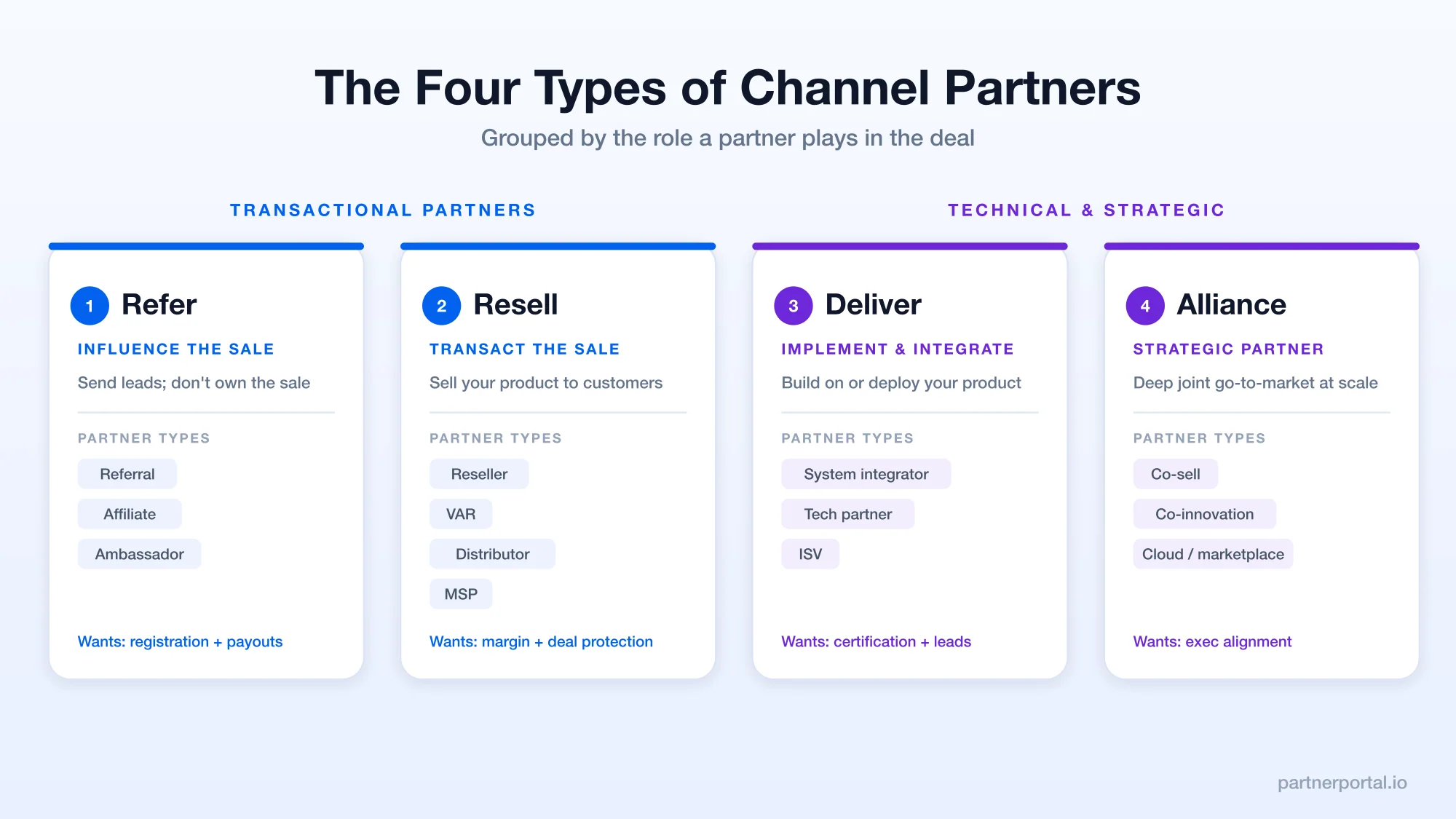
“Channel partner” is an umbrella term, and the type of partner drives almost everything about how you manage them — the margin they expect, the enablement they need, how they get paid, and the conflict they can create. Signing the wrong type, or managing every type identically, is one of the most common ways a channel program stalls.
TL;DR: The types of channel partners group into four roles by what they do in the deal:
- Refer (influence the sale): referral partners, affiliates, ambassadors — they send leads but don’t own the sale.
- Resell (transact the sale): resellers, value-added resellers (VARs), distributors, MSPs — they sell (and often bill) your product to the end customer.
- Deliver / integrate (technical): system integrators (SIs), technology/integration partners, ISVs — they implement, integrate, or build on your product.
- Strategic alliance: large co-sell and co-innovation partners in deep, mutual go-to-market relationships.
Most real programs run a blend of these. This guide covers each type, how they differ, how to incentivize each, and how to decide which types to recruit.
What is a channel partner?
A channel partner is a third-party organization that markets, sells, implements, or refers your product to end customers, instead of (or alongside) your own direct sales team. Collectively they make up your indirect sales channel — the partner-led route to market that sits at the center of channel management.
The label covers a wide range of relationships. A solo consultant who occasionally recommends your product and a global distributor moving your product through hundreds of downstream resellers are both “channel partners,” but almost nothing about how you manage them is the same. The useful question is never just “is this a channel partner?” — it’s “what role does this partner play in the deal?”
The four roles a channel partner can play
Rather than a flat list of a dozen partner names, it’s clearest to group channel partners by the role they play in the sale. This is what actually determines the margin they expect, the enablement they need, and how you pay them.
| Role | Partner types | What they do | What they need most from you |
|---|---|---|---|
| Refer (influence) | Referral partner, affiliate, ambassador | Send you leads or endorsements; don’t own the sale | Dead-simple registration and fast, reliable payouts |
| Resell (transact) | Reseller, value-added reseller (VAR), distributor, MSP | Sell (and often bill) your product to the end customer | Margin, deal protection, pricing, and sales enablement |
| Deliver / integrate (technical) | System integrator (SI), technology/integration partner, ISV | Implement, integrate, or build on your product | Technical training, certification, and co-sell support |
| Strategic alliance | Large co-sell / co-market / co-innovation partners | Enter deep, mutual go-to-market relationships at scale | Executive alignment, joint planning, and shared goals |
The rest of this guide walks each role and the partner types inside it.
Partners who refer (referral, affiliate, ambassador)
Referral-type partners influence a sale without owning it. They send you a lead or an introduction; your team qualifies, closes, and manages the customer from there.
- Referral partner — typically a B2B company or individual (a consultant, an adjacent vendor, a happy customer) who recommends you and passes warm introductions. Relationships are often high-trust and low-volume.
- Affiliate — a higher-volume, lower-touch version of the same idea, usually driven by tracked links and paid per lead or per sale. Common where the sales cycle is short and self-serve.
- Ambassador / advocate — an individual (often an influencer or community member) who promotes you for a mix of commission and recognition.
Why start here: referral partners are the easiest type to recruit and manage. They need almost nothing operationally — just a clean way to register a lead and confidence they’ll get paid. That low overhead is exactly why most new programs start with referrals to prove the motion before taking on the complexity of reselling.
The main risk is attribution: if a partner isn’t sure their lead was credited, they stop sending them. Reliable lead registration and transparent payout tracking are the whole game for this type.
Partners who resell (reseller, VAR, distributor, MSP)
Reselling partners transact the sale — they sell your product to the end customer, and often handle the billing relationship too. In exchange for owning more of the sale, they expect margin and deal protection, which raises the operational bar on your side.
Reseller
A reseller sells your product directly to end customers, usually earning a discount off list price as margin. Plain resellers mostly transact — they find and close the deal but add little of their own service on top. They need pricing they can rely on, protection against another partner (or your direct team) chasing the same deal, and enough sales enablement to represent you well.
Value-added reseller (VAR)
A VAR is a reseller that adds its own value — implementation, customization, training, industry expertise, or ongoing support — on top of your product, then sells the bundle. Because a VAR does more of the delivery work and owns more of the customer relationship, it typically earns higher margin than a plain reseller and expects deeper technical enablement and certification. VARs are the backbone of many mature B2B channels.
Distributor
A distributor sits one level up from resellers. Instead of selling to end customers, it buys from you and sells to a network of resellers, handling logistics, credit, billing, and reseller enablement on your behalf. Distributors create a multi-tier channel (you → distributor → reseller → customer). They’re common in hardware and large global channels; most SaaS programs deal directly with resellers and never add a distributor layer. Managing distributors means managing a relationship whose customers are themselves partners, which adds a layer of reporting and margin complexity.
Managed service provider (MSP)
An MSP resells your product and then operates it for its own clients as part of a broader managed service. Effectively a recurring-revenue reseller, an MSP bundles your software into a monthly service offering, so it values predictable pricing, multi-client management (one pane of glass across many customer accounts), and dependable support far more than a one-time margin bump. MSPs are increasingly important in IT, security, and infrastructure channels.
Partners who deliver or integrate (SI, ISV, technology)
Technical partners create value by making your product work in the real world — implementing it, integrating it, or extending it. They may not resell at all, yet they can drive enormous influence and pull.
- System integrator (SI) — implements and integrates your product into a customer’s broader environment, often on large or complex deployments. SIs earn services revenue, not primarily product margin, so their motivation is billable work and successful outcomes, backed by certification and co-sell support.
- Technology / integration partner — another software vendor whose product connects to yours. The “partnership” is often a built integration plus joint go-to-market. These partners drive ecosystem pull: your product becomes more valuable and more discoverable inside the tools your customers already use.
- ISV (independent software vendor) — builds software on or alongside your platform. Common where you offer an API, marketplace, or platform others can extend.
The common thread: technical partners care less about margin and more about enablement, certification, and qualified co-sell opportunities. Pay them in leads, technical support, and joint pipeline rather than a standard reseller discount.
Strategic alliance partners
At the top end are strategic alliances — deep, mutual relationships with large partners (major SIs, cloud providers, category leaders) built on joint business plans, executive sponsorship, and shared revenue goals. These aren’t managed from a standard incentive table; they run on named executive relationships, co-innovation, and quarterly joint planning. Few companies have more than a handful, and each is effectively its own program.
How to incentivize each type of channel partner
The single biggest mistake in channel design is paying every partner type the same way. Incentives only work when they match how the partner creates value. A quick map:
| Partner type | Primary incentive | Also motivated by |
|---|---|---|
| Referral / affiliate | Commission or bounty per lead or closed deal | Fast payouts, transparent attribution |
| Reseller | Margin (discount off list) | Deal registration protection, volume rebates |
| VAR | Higher margin + services revenue | Certification, technical enablement, leads |
| Distributor | Margin spread across its reseller base | Rebates, marketing funds, tier status |
| MSP | Recurring margin | Predictable pricing, multi-client tooling, support |
| SI / technical | Services revenue (not product margin) | Certification, co-sell support, qualified leads |
| Technology / ISV | Ecosystem exposure and shared pipeline | Joint go-to-market, marketplace placement |
| Strategic alliance | Joint business plan and shared goals | Executive alignment, co-innovation |
A few principles that hold across types:
- Reward revenue and activity, not sign-ups. Paying for logos on a page fills your roster with dormant partners.
- Protect deals for anyone who transacts. Deal registration is what makes margin worth chasing for resellers and VARs.
- Use non-monetary incentives deliberately. Qualified leads, early product access, a dedicated partner manager, recognition, and free certification are often more motivating than another margin point — especially for technical partners.
For a deeper treatment of the full incentive toolkit — commissions, tiers, SPIFFs, MDF, and rebates — see the incentives stage in the channel management guide.
How to choose which partner types to recruit
You don’t need every type. The right mix follows from what your product needs and what your team can support:
- Start with the simplest type that fits. For most programs that’s referral partners — lowest overhead, fastest to prove the motion, minimal risk.
- Add reselling partners when you can support margin and deal protection. Resellers and VARs let partners own deals, which multiplies reach but requires pricing discipline, deal registration, and real sales enablement.
- Add technical partners when ecosystem pull matters. If customers buy partly because your product fits their existing stack, integration and SI partners become a growth engine in their own right.
- Reserve strategic alliances for when you have the muscle. They demand executive time and joint planning; a program still finding its footing isn’t ready for them.
- Never manage them all identically. Different registration flows, margins, enablement, and payouts per type. This is the point of the whole exercise.
Whatever mix you land on, the operational core is the same: a partner portal, deal registration, enablement, and CRM-synced reporting to run all your partner types in one place. If you’re building that foundation, you can launch a free partner portal today, or see how the software category compares in our guide to the best PRM software.
Frequently asked questions
What are the main types of channel partners?
The most common types of channel partners are referral partners, affiliates, resellers, value-added resellers (VARs), distributors, managed service providers (MSPs), system integrators (SIs), technology/integration partners (ISVs), and strategic alliance partners. They group into four roles: partners who refer (influence a sale), resell (transact the sale), deliver or integrate (implement the product), and form strategic alliances (deep, mutual go-to-market relationships).
What's the difference between a reseller and a distributor?
A reseller sells your product directly to the end customer. A distributor sits one level up — it buys from you and sells to a network of resellers rather than to end customers, handling logistics, credit, and reseller enablement on your behalf. Distributors are common in hardware and large multi-tier channels; most SaaS programs deal directly with resellers and skip the distributor layer.
What's the difference between a reseller and a VAR?
A value-added reseller (VAR) is a reseller that adds its own services — implementation, customization, training, or support — on top of your product before selling the bundle. A plain reseller mostly transacts the sale. VARs typically earn higher margin because they do more of the delivery work and own more of the customer relationship.
What is a referral partner?
A referral partner sends you leads or introductions but does not own the sale — your team closes and manages the customer. Referral partners need almost nothing operationally: a dead-simple way to register a lead and fast, reliable payouts. They're the easiest partner type to recruit and manage, which makes them a common starting point for a new program.
What is an MSP as a channel partner?
A managed service provider (MSP) resells and then operates your product on behalf of its own clients as part of a managed service. MSPs are effectively a recurring-revenue reseller: they bundle your software into their monthly service, so they value predictable pricing, multi-client management, and strong support over one-off margin.
How do incentives differ by partner type?
Referral and affiliate partners are paid a commission or bounty per lead or closed deal. Resellers, VARs, and distributors earn margin (a discount off list) plus deal-registration protection and sometimes rebates for volume. Technical partners (SIs, ISVs) are motivated less by margin and more by services revenue, certification, co-sell support, and qualified leads. Strategic alliances run on joint business plans and executive alignment rather than a standard incentive table.
Which type of channel partner should I start with?
Most programs start with referral partners because they're the simplest to sign, pay, and manage, and they prove the motion with the least operational overhead. Add resellers or VARs when you're ready to give partners margin and let them own deals, and add technology/integration partners when ecosystem pull matters to your growth. Match the partner type to what your product and team can actually support.