
Channel Partner Agreement: What to Include (with a Template Walkthrough)
What a channel partner agreement should contain — a clause-by-clause walkthrough of the essential sections, from scope and margins to deal registration, territories, and termination, plus the common mistakes that turn agreements into disputes.
Written by the team at PartnerPortal — PRM software used to run B2B partner and channel programs.
The partner agreement is where the incentives you promised during recruitment become enforceable — or where the ambiguity you signed today becomes the dispute you fight next year. It’s the least exciting artifact in channel management and one of the most consequential: nearly every serious channel conflict traces back to something the agreement left vague.
Not legal advice. This is a practical walkthrough of what channel partner agreements typically contain, written to help you prepare an informed draft and negotiate confidently. It is not legal advice. Have a qualified attorney in your jurisdiction draft or review any agreement you sign.
TL;DR: A channel partner agreement should make the relationship’s expectations explicit and enforceable:
- Scope — what the partner is authorized to do, and whether it’s exclusive.
- Economics — margin or commission, stated plainly.
- Deal registration and rules of engagement — how deals are claimed and protected.
- Territories or segments — where and to whom the partner sells.
- Term and termination — how the relationship renews and how it ends.
This is the contractual layer of the Strategy & program design stage of channel management.
Why the agreement matters more than it looks
An agreement does three jobs. It authorizes the partner (what they can and can’t do in your name), it aligns incentives (how they earn, and what they must do to earn it), and it allocates risk (who’s liable when something goes wrong). Get those right and the document mostly sits in a drawer. Get them wrong — or leave them implicit — and you’ll relitigate them under pressure during a live deal, which is the worst possible time.
The goal isn’t a longer contract. It’s a clear one: mutual expectations set before the relationship starts, so both sides know the rules of the game they’re agreeing to play.
Match the agreement to the partner type
The right agreement depends on the type of partner and how much of the sale they own:
- Referral / affiliate agreement — the simplest. The partner introduces leads and is paid a commission; they don’t own the sale, hold no pricing authority, and carry little risk. Keep it short.
- Reseller / VAR agreement — more involved, because the partner transacts the sale. It must address resale margin or discount, pricing conduct, order and payment terms, and often support and warranty obligations.
- Distributor agreement — the most complex, adding multi-tier resale rights, inventory or credit terms, and sub-reseller management.
- Technology / alliance agreement — shifts emphasis to IP, integration rights, co-sell terms, and joint go-to-market, with margin often secondary.
Don’t paper a referral partner with a distributor contract, or vice versa. The friction of an over-heavy agreement deters exactly the good partners you want.
Section-by-section walkthrough
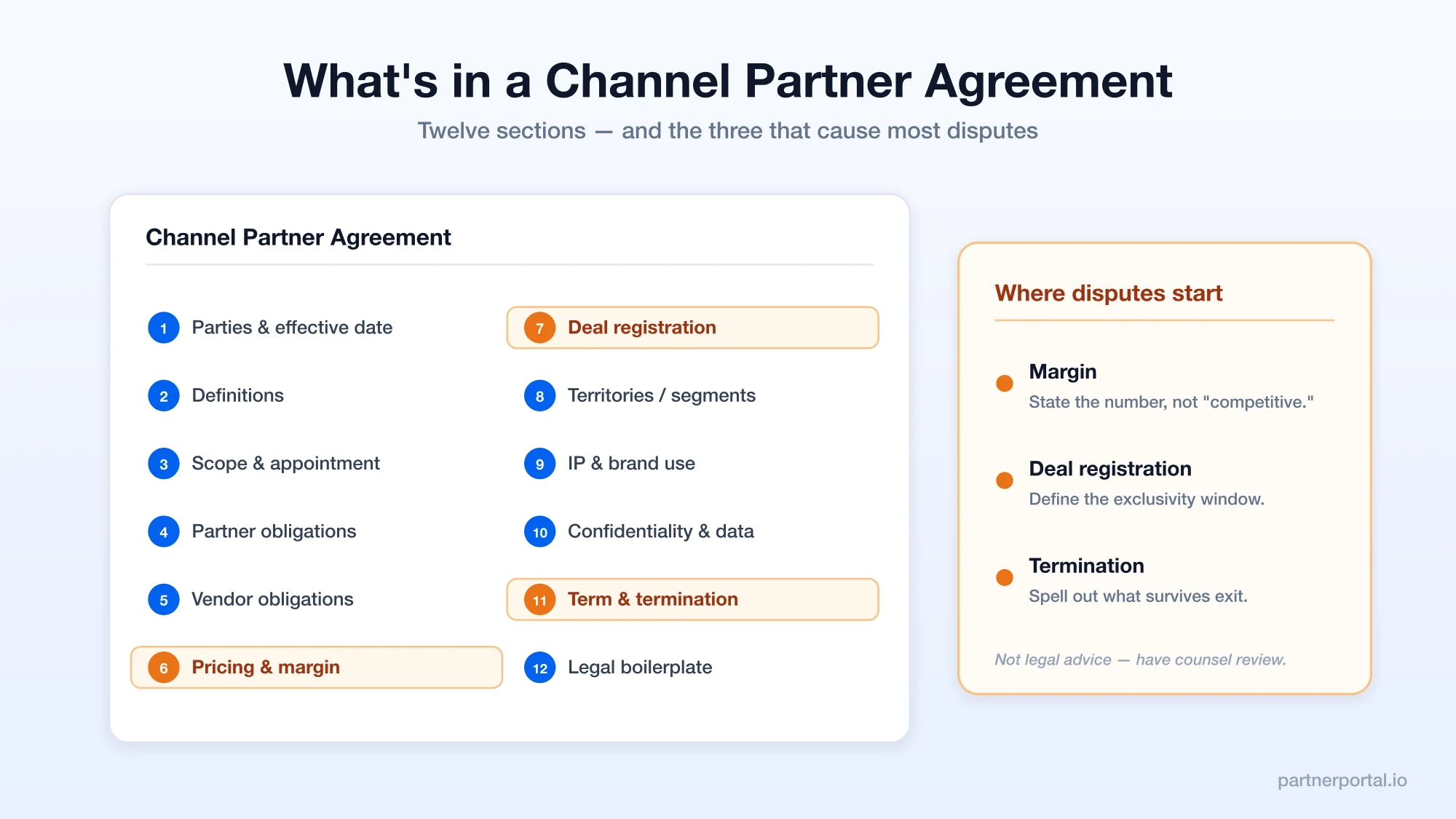
A typical channel partner agreement contains the following sections. Treat this as the skeleton of a template — the structure to prepare and then have counsel refine.
- Parties and effective date. Who’s contracting and when it starts.
- Definitions. The defined terms used throughout — “Products,” “Registered Deal,” “Territory,” “Confidential Information” — so the rest reads unambiguously.
- Appointment and scope. What the partner is authorized to do (refer, resell, distribute, integrate), and critically whether the appointment is exclusive or non-exclusive. Most programs start non-exclusive.
- Partner obligations. What the partner commits to: sales or performance expectations, certification or training requirements, brand and conduct standards, and any minimum commitments tied to tier or exclusivity.
- Vendor obligations. What you commit to: product access, enablement and support, lead sharing, and the tools (portal, deal registration) you’ll provide.
- Pricing, margin, and payment. How the partner earns — resale discount, margin, or commission rate — plus order, invoicing, and payment terms. State the economics plainly; vague comp is the most-disputed clause in any channel contract.
- Deal registration and rules of engagement. That registered deals receive a time-bound window of exclusivity, how conflicts are resolved, and a reference to the current registration policy (see below).
- Territories or market segments. Any geographic, vertical, or account boundaries — and whether they’re exclusive.
- Intellectual property and brand use. How the partner may use your trademarks, logos, and materials, and the limits on that use.
- Confidentiality and data protection. Handling of confidential information and any customer-data / privacy obligations (GDPR, CCPA, DPAs where relevant).
- Term and termination. Initial term, renewal, notice periods, termination for cause vs. convenience, and — importantly — what happens to registered deals and in-flight commissions on exit.
- Legal boilerplate. Warranties, limitation of liability, indemnification, governing law, dispute resolution, and assignment.
The clauses that actually cause disputes
If you spend your negotiation energy anywhere, spend it here — these three sections are where nearly all channel disputes originate:
- Margin / commission. Ambiguity about what a partner earns and when it’s payable is the number-one source of partner conflict. Be explicit: the rate, what it’s calculated on, when it’s paid, and how registered-deal uplift or clawbacks work.
- Deal registration and rules of engagement. Unclear rules about who “owns” a deal produce channel conflict — partner-vs-partner and vendor-vs-partner fights over the same opportunity. Define the exclusivity window and the tie-break rules before you need them.
- Termination and what survives it. The relationship will end someday. Spell out notice, cause, and — the part everyone forgets — whether the partner still gets paid on deals registered or in-flight when the agreement terminates.
Keep the mechanics out of the contract
A practical structuring tip: put the operational mechanics in a referenced policy, not the contract itself. The agreement should reference deal registration and rules of engagement; the actual registration window, submission process, and current pricing should live in a partner-program policy or the partner portal that you can update without amending and re-signing the contract.
This keeps the legal document stable while letting the program evolve. It also means the rules partners actually operate under live where they work every day — in the portal — rather than buried in a PDF nobody reopens after signing.
Common channel partner agreement mistakes
- Vague economics. “Competitive margin” isn’t a term; a number is. Ambiguous comp is the most-disputed clause there is.
- No deal-registration or engagement rules. Leaving deal ownership undefined guarantees conflict the moment two partners touch the same account.
- Over-heavy agreements for light partners. A distributor-grade contract on a referral partner is friction that costs you the partner.
- Baking mechanics into the contract. Hard-coding the registration window or price list means every process change needs a contract amendment.
- No clean exit. Skipping the detail on termination and what survives it turns the end of every relationship into a negotiation under duress.
- Signing without counsel. A template gets you an informed draft; a lawyer keeps it enforceable in your jurisdiction.
A clear agreement is what makes everything downstream — recruitment promises, deal protection, incentives — actually enforceable. Once it’s signed, the relationship moves into onboarding, and the rules you set here become the ones the partner operates under day to day. If you want deal registration, rules of engagement, and partner terms living in one place your partners actually use, you can launch a free partner portal, or compare the tooling in our guide to the best PRM software.
Frequently asked questions
What is a channel partner agreement?
A channel partner agreement is the contract between a vendor and a channel partner (a reseller, referral partner, VAR, distributor, or similar) that defines the terms of their relationship — what the partner is authorized to do, how they earn margin or commission, how deals are registered and protected, territories or segments, and how either side can end the relationship. It turns a verbal understanding into enforceable, mutual expectations.
What should a channel partner agreement include?
A complete channel partner agreement covers: the parties and effective date, definitions, scope of the appointment (and whether it is exclusive), partner obligations, vendor obligations, pricing and margin or commission, deal registration and rules of engagement, territories or market segments, intellectual property and brand use, confidentiality, data protection, term and termination, and standard legal boilerplate (liability, warranties, governing law). The commercial sections — margin, deal registration, and termination — are where most disputes actually originate.
What is the difference between a reseller agreement and a referral agreement?
A referral (or affiliate) agreement is simpler: the partner introduces leads and is paid a commission or bounty, but never owns the sale, holds no pricing authority, and takes on little risk. A reseller agreement is more involved because the partner transacts the sale — so it must address resale margin or discount, pricing conduct, order and payment terms, and often support and warranty obligations. Match the agreement type to the partner type.
Do you need a lawyer for a channel partner agreement?
Yes — have a qualified attorney draft or review any agreement you will actually sign. This walkthrough explains the sections a channel partner agreement typically contains so you can prepare an informed draft and negotiate the commercial terms confidently, but it is not legal advice and is not a substitute for counsel licensed in your jurisdiction.
How should deal registration be handled in a partner agreement?
The agreement should reference deal registration and the rules of engagement rather than bury the operational detail in the contract. Specify that registration grants a time-bound window of exclusivity on a qualifying opportunity (commonly 90–180 days), how conflicts between partners are resolved, and where the current registration process and terms live. Keeping the mechanics in a referenced policy lets you update the process without amending the contract.
How long should a channel partner agreement last?
Most channel partner agreements run for an initial term of one year and then renew automatically for successive periods unless either side gives notice. What matters more than the length is a clean termination clause — notice periods, termination for cause versus convenience, and what happens to registered deals and in-flight commissions when the relationship ends. Evergreen auto-renewal with a clear exit is the common, practical structure.
Should a channel partner agreement be exclusive?
Usually not, especially early. Exclusivity — granting a partner sole rights to a territory, segment, or account — is a powerful incentive but a serious commitment that is hard to unwind if the partner underperforms. Most programs start non-exclusive and reserve exclusivity for proven, strategic partners, often tied to performance commitments so the exclusivity is earned and revocable rather than permanent.