
Channel Partner Recruitment: How to Find and Sign Partners Who Actually Sell
A practical channel partner recruitment process — how to define your ideal partner profile, source and vet the right partners, pitch them, and sign partners who actually produce revenue instead of dead-weight logos.
Written by the team at PartnerPortal — PRM software used to run B2B partner and channel programs.
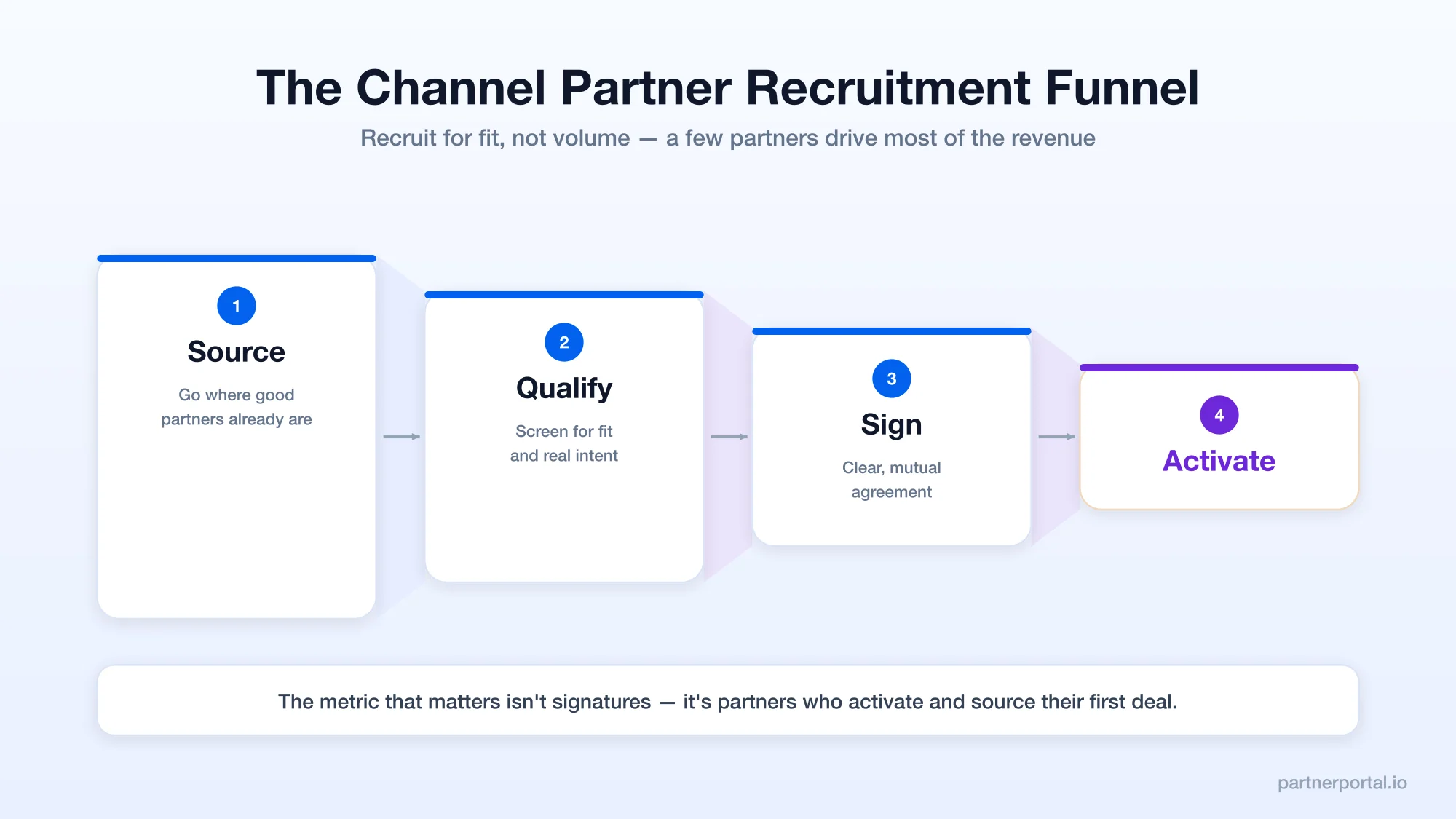
Recruitment is where most channel programs are quietly won or lost. Sign the wrong partners — or sign everyone — and you inherit a roster of logos that never sell, consuming onboarding and support without returning revenue. Recruit deliberately against a clear profile, and a handful of partners can become your most efficient growth channel.
TL;DR: Effective channel partner recruitment is a targeted process, not a numbers game:
- Define your ideal partner profile so you know who you’re looking for.
- Source candidates who already reach your target customers.
- Qualify for fit and intent, not just interest.
- Pitch the mutual opportunity — sell the partnership the way you’d sell to a customer.
- Sign a clear agreement with mutual expectations.
- Measure activation, not signatures — a signed partner who never sells isn’t a win.
This piece is the “Recruit” stage of channel management, covered in depth.
Recruit for fit, not volume
The instinct when launching a channel is to sign as many partners as possible. It’s the wrong instinct. Channel revenue follows a power law: a small fraction of partners drive the large majority of partner-sourced revenue. Every partner you sign carries a real cost — onboarding time, enablement, portal access, support, and management attention — whether or not they ever produce.
A roster of 100 signed partners with 12 active ones isn’t a 100-partner channel. It’s a 12-partner channel with a data-hygiene problem and a lot of wasted acquisition effort. The goal of recruitment is not signatures; it’s activated partners who sell. That single reframe changes how you source, qualify, and pitch.
Step 1: Define your ideal partner profile
Before you contact a single partner, write down what a good one looks like. An ideal partner profile (IPP) is the partner equivalent of an ideal customer profile — a concrete target so recruitment isn’t guesswork. A useful IPP captures:
- Reach — the customer segments, industries, and geographies the partner already sells into. The best partners already have relationships with your target customers.
- Complementary offering — what they sell that sits alongside (not against) your product. Their existing offering should make recommending you natural.
- Business model — whether they refer, resell, or deliver services. This determines the type of partner they are and how you’ll manage them.
- Size and capacity — enough sales or delivery capacity to actually move product, but not so large that you’re a rounding error to them.
- Track record of investment — evidence they meaningfully invest in the vendors they represent (certified staff, marketing, dedicated practice) rather than listing dozens of logos they never sell.
The IPP is what lets you say no. Without it, every interested company looks like a prospect, and you can’t distinguish a future top producer from a future dormant logo until you’ve spent months on them.
Step 2: Source the right partners
With a profile in hand, go where partners who match it already are. The highest-yield sources:
- Partners of complementary vendors. Companies that already sell non-competing products to your target customers are the richest vein — they have the relationships and the motion.
- Consultants and agencies your customers use. The advisors your customers already trust are natural referral and services partners.
- Your own customers. Happy customers — especially agencies and service firms — often make excellent referral or reselling partners.
- Marketplaces and ecosystems. Technology marketplaces, app directories, and industry communities surface partners actively looking for products to add.
- Inbound applications. A clear public partner page turns your website into a recruitment channel. Inbound applicants have self-selected for interest — you still qualify for fit.
- Existing-partner referrals. Good partners know other good partners. Once you have a few producers, ask them.
Sourcing against the IPP is what separates recruitment from spray-and-pray. A targeted list of 20 well-matched candidates beats 500 cold contacts.
Step 3: Qualify for fit and intent
Interest is cheap; fit and intent are what matter. A lightweight application and a qualifying conversation should surface:
- Fit against the IPP — do they actually reach your customers with a complementary offering?
- Intent — are they prepared to invest (train staff, run marketing, dedicate a rep), or are they collecting logos?
- Motion match — does their business model line up with the partner type and economics you offer?
- Conflict check — do they represent a direct competitor in a way that would undermine the relationship?
A real vetting step also signals that your program is worth taking seriously. Programs anyone can join instantly tend to attract partners who treat them as disposable.
Step 4: Pitch the mutual opportunity
Recruiting a good partner is a sale, and the partner is the buyer. They’re asking one question: what’s in it for us? A strong recruitment pitch answers it directly:
- The opportunity. The customer demand and revenue potential — why selling or referring your product is worth their time.
- The economics. Margin, commission, or services revenue, stated plainly. Partners discount vague “great earning potential.”
- Ease of selling and getting paid. How simple you make it to register a deal, sell, and receive reliable, on-time payouts. Friction here kills otherwise-good partnerships.
- Enablement and support. The training, content, and support they’ll get so they can succeed rather than being handed a login and abandoned.
- Deal protection. That their pipeline is safe from other partners and your direct team via deal registration and clear rules of engagement.
The best partners have options and limited time. Lead with their upside, not your feature list.
Step 5: Sign a clear agreement
Close with a partner agreement that sets mutual expectations before the relationship starts: margins or commission, deal-registration rules, territories or segments if any, tier requirements, and what each side commits to. Ambiguity signed today becomes a dispute later. A clear agreement isn’t bureaucracy — it’s what makes the incentives you promised enforceable, and it’s the natural handoff into onboarding.
Measure recruitment the right way
The metric that matters is not how many partners you signed — it’s how many activated. Track:
- Activation rate — the share of signed partners who complete onboarding and register or source their first deal within a defined window.
- Time-to-first-deal — how long from signature to first partner-sourced opportunity.
- Source quality — which recruitment sources produce partners who actually sell, so you can double down.
If activation is low, the fix is almost always upstream — a loose IPP or weak qualification letting in partners who were never going to produce. Recruit better, not just more.
Common channel partner recruitment mistakes
- Volume over fit. Signing every interested company. The single most common and most expensive recruitment mistake.
- No ideal partner profile. Without a target, you can’t qualify, and everyone looks like a maybe.
- Pitching features instead of partner upside. Partners buy their opportunity, not your product tour.
- Over-long, opaque signup. Friction and mystery in the application deter exactly the busy, high-quality partners you want.
- Recruiting faster than you can onboard. Signing partners you can’t ramp just moves the drop-off from recruitment to onboarding. Match recruitment pace to activation capacity.
Recruitment feeds the rest of the program. Get the profile and qualification right, and every later stage — onboarding, enablement, incentives — starts with partners worth the investment. If you’re building the operational core to run recruitment and activation in one place, you can launch a free partner portal, or compare the tooling in our guide to the best PRM software.
Frequently asked questions
What is channel partner recruitment?
Channel partner recruitment is the process of finding, vetting, and signing the third-party partners — resellers, referral partners, VARs, MSPs, system integrators, and others — who will sell or refer your product. Done well it is deliberate and targeted: you define an ideal partner profile, source partners who match it, qualify them, and sign a clear agreement, rather than signing every interested company.
How do you find channel partners?
The best channel partners usually already sell to your target customers. Common sources include partners of complementary (non-competing) vendors in your space, consultants and agencies your customers already use, your own happy customers, technology marketplaces and communities, inbound applicants from a public partner page, and referrals from existing partners. Sourcing against a defined profile beats casting a wide net.
What is an ideal partner profile (IPP)?
An ideal partner profile is a concrete definition of a good-fit partner — the equivalent of an ideal customer profile, but for partners. It captures the customer segments and geographies a partner reaches, the complementary products they sell, their business model (referral vs. reseller vs. services), their size, and evidence they actually invest in the vendors they represent. It gives recruitment a target so you can tell a good partner from a bad one before you sign them.
How many channel partners should you recruit?
Fewer than most programs think. Channel revenue follows a power law — a small number of partners drive the majority of partner-sourced revenue — so recruiting for fit beats recruiting for volume. Signing large numbers of partners produces a roster of inactive logos that consume onboarding and support without producing. Recruit deliberately against your ideal partner profile and measure activation, not signature count.
What should a channel partner recruitment pitch include?
A recruitment pitch should answer the partner's real question — what's in it for them. Lead with the mutual opportunity (the customer demand and revenue potential), the economics (margin, commission, or services revenue), how easy you make it to sell and get paid, the enablement and support they'll receive, and deal protection so their investment is safe. Treat it like selling to a customer, because you are.
How long does channel partner recruitment take?
It varies by partner type. Referral partners can sign in days. Resellers and VARs usually take weeks — application, vetting, commercial terms, and a signed agreement. Strategic alliances and large system integrators can take months of relationship-building and executive alignment. Build your pipeline expecting these different cycle lengths rather than treating all partners the same.