
What Is Channel Management? The Complete Guide for B2B
Channel management is the discipline of recruiting, enabling, and optimizing the partners who sell your product. Here's the full process, metrics, and tooling — and where most programs break.
Written by the team at PartnerPortal — PRM software used to run B2B partner and channel programs.
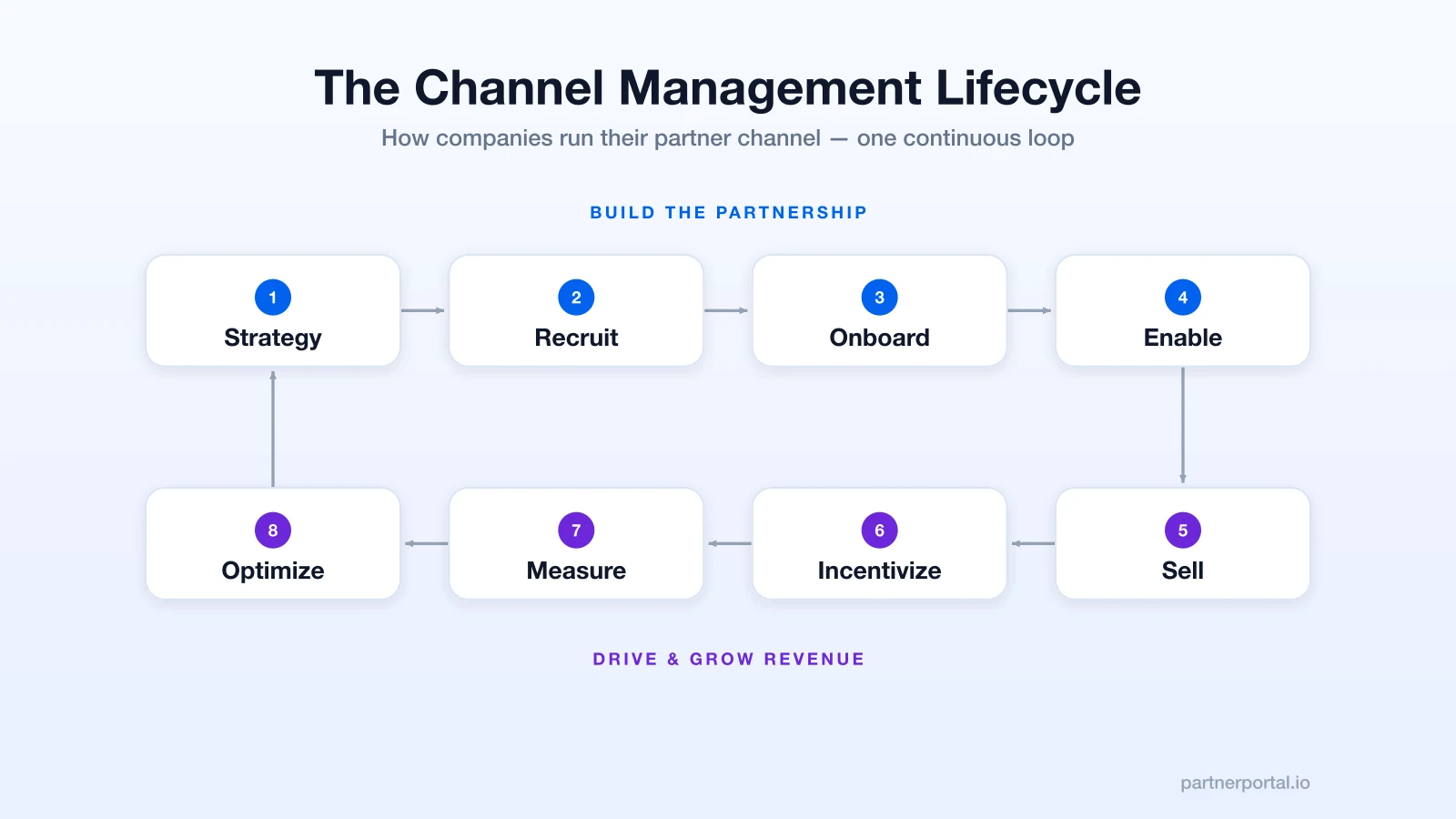
TL;DR: Channel management is the operational discipline of recruiting, enabling, and optimizing the third-party partners — resellers, distributors, VARs, MSPs, system integrators, and referral partners — who sell your product to end customers. It spans the full partner lifecycle:
Strategy → Recruit → Onboard → Enable → Sell → Incentivize → Measure → Optimize
A CRM and a PRM (partner relationship management) platform are the software that runs it.
What is channel management?
Channel management is the set of decisions, processes, and systems a company uses to run its indirect sales channel — the partners who sell, resell, implement, or refer its product instead of its own direct sales team. The scope is broader than “partner sales.” It covers finding the right partners, getting them productive, keeping them selling, paying them correctly, resolving the conflicts that inevitably arise, and measuring the whole thing well enough to know what’s working.
A useful way to hold it: you’re orchestrating four things at once.
- People — the partners themselves, plus the internal team that manages them.
- Process — recruitment, onboarding, deal registration, business reviews, renewals.
- Policy — pricing, territories, rules of engagement, tier requirements.
- Platform — the CRM and PRM software that hold the data and automate the workflow.
A note on scope. In classical distribution theory, a “channel” is any route from producer to customer, so “channel management” can technically include your direct and owned channels too. In B2B and SaaS — and throughout this guide — the term means something more specific: managing your indirect, partner-led channel. Your direct sales team, paid ads, SEO, and email are separate routes to market with their own disciplines. Channel management is the discipline for the partner route.
Why companies build a channel
Before the mechanics, the motive. Companies invest in an indirect channel because partners provide things a direct sales team can’t easily or cheaply replicate:
- Reach and coverage you can’t hire for — partners bring existing relationships in segments, industries, and geographies where you have no presence.
- Lower cost of acquisition — you pay partners on results (commission or margin) rather than carrying fixed headcount, so customer acquisition cost scales with revenue instead of ahead of it.
- Faster market entry — a local reseller or system integrator gives you instant credibility and go-to-market in a new region or vertical.
- Trusted-advisor access — customers often buy on a partner’s recommendation, and partner-influenced deals tend to be larger and stickier.
- Ecosystem pull — technology and integration partners make your product more valuable and more discoverable inside the tools your customers already use.
The trade-off is real and worth stating plainly: you gain leverage but give up control. You share margin, you depend on organizations you can only influence, and you take on the operational complexity of running a program. Channel management is the work of making that trade-off pay off.
The types of channel partners
“Channel partner” is an umbrella term, and the type of partner drives almost everything about how you manage them — the margin they expect, the enablement they need, and the conflict they can create. Rather than a flat list, it’s clearest to group partners by the role they play in the deal:
| Bucket | Partner types | What they do | What they need most from you |
|---|---|---|---|
| Refer (influence) | Referral partner, affiliate, ambassador | Send you leads or endorsements; don’t own the sale | Dead-simple registration and fast, reliable payouts |
| Resell (transact) | Reseller, value-added reseller (VAR), distributor, MSP | Sell (and often bill) your product to the end customer | Margin, deal protection, pricing, and sales enablement |
| Deliver / integrate (technical) | System integrator (SI), technology/integration partner, ISV | Implement, integrate, or build on your product | Technical training, certification, and co-sell support |
| Strategic alliance | Large co-sell / co-market / co-innovation partners | Enter into deep, mutual go-to-market relationships at scale | Executive alignment, joint planning, and shared goals |
Two things worth knowing. First, most real programs run a blend — say, referral partners plus a few resellers and a handful of technology integrations. Second, a common early mistake is managing them all identically. A referral partner who sends two leads a quarter and a VAR who resells and implements your product need completely different registration flows, margins, and support. Match the model to the bucket.
For a full breakdown of each partner type — reseller vs. VAR vs. distributor vs. MSP, and how to incentivize each — see the types of channel partners.
The channel management lifecycle
Every partner, whatever their type, moves through the same lifecycle — and this lifecycle is the backbone of the whole discipline. Each stage below is a body of practice in its own right; the standalone topics people search for (deal registration, channel conflict, incentives, metrics) all live inside these stages, which is where we cover them.
Strategy and program design
Before recruiting a single partner, decide why you have a channel and design the program to match. This stage sets the rules everything else runs on:
- Goals — what the channel is for (new segments, new geographies, added implementation capacity) determines what partners you need and how many.
- Ideal partner profile — the concrete definition of a good-fit partner, so recruitment has a target.
- Program design — your tier model (e.g. Silver / Gold / Platinum), coverage model, and margin/commission structure.
- Rules of engagement and the partner agreement — how deals are claimed and protected, territories or segments, pricing discipline, and the contractual terms that make all of it enforceable.
Skipping this stage is the most expensive mistake in channel management, because every later stage inherits its gaps.
Recruit
With a profile in hand, recruit against it deliberately. The best partners usually already sell to your target customers and have a track record of investing in the vendors they represent. Recruitment spans sourcing, a real application and vetting step, and a signed agreement with clear, mutual expectations. The goal is fit, not volume — a small number of partners will drive the majority of channel revenue. See channel partner recruitment for the full process — ideal partner profile, sourcing, qualifying, and pitching.
Onboard
Onboarding turns a signed partner into a productive one. It covers agreement execution, portal provisioning, product and sales training, deal-registration mechanics, and where to find resources. The goal is time-to-first-value — but what that means, and how much raw speed matters, depends on the partner type.
For transactional partners (referral and reseller), early momentum genuinely matters: enthusiasm peaks at signing, and a slow or manual onboarding often lets a partner go dormant before their first deal. For strategic and technical partners, ramp is naturally longer — an integration build or a joint go-to-market plan plays out over quarters — so the goal is clear milestones and an early win, not speed for its own sake. The failure mode is the same in both cases (a partner who signs and then stalls); the right pace is what differs. See channel partner onboarding for the step-by-step process and a reusable checklist.
Enable
Onboarding gets a partner started; enablement keeps them selling. This is the ongoing supply of what partners need to win:
- Sales content — pitch decks, demo environments, battle cards, competitive intelligence.
- Training and certification paths, with visibility into who’s actually completed them.
- Through-partner and co-marketing support so partners can generate their own demand.
Enablement is where “partners as an extension of your sales team” becomes real — or stays a slogan. See channel partner enablement for the four pillars of an enablement program and how to enable by partner type.
Sell
This is the active-selling stage, where the relationship produces revenue. Three mechanics make it work.
Deal registration
Deal registration is the process where a partner submits an opportunity they’re working, and the first to qualify receives a time-bound window of exclusivity (commonly 90–180 days) to pursue it. It credits the right partner, protects their investment, and is the foundation of a fair program. It only works when partner and deal data stay in sync with your CRM — if a partner registers a deal in the portal but your reps can’t see it, the whole mechanism fails.
Channel conflict
Channel conflict is when two selling parties compete for the same deal. It comes in three shapes:
- Vertical — vendor versus partner (e.g. your direct team chasing a deal your reseller is already working).
- Horizontal — partner versus partner (e.g. two resellers on the same account).
- Multichannel — different routes to market colliding (e.g. your website selling the same product a partner is quoting, at a different price).
Deal registration is the primary prevention tool, backed by clear rules of engagement, defined territories or segments, and aligned pricing. Decide these rules before you have a dispute. See channel conflict for the three types, causes, and how to prevent and resolve each.
Co-selling
Beyond protecting deals, mature programs actively co-sell: joint account planning, shared pipeline, and increasingly co-selling through cloud marketplaces and partner ecosystems where two vendors bring a deal to a mutual customer together.
Incentivize
Incentives are how you reward the behavior you want. They fall into four buckets:
- Monetary, post-sale — commissions or resale margin, rebates (for hitting volume or growth targets), SPIFFs (short-term bonuses to partner reps), and margin uplift for registered deals.
- Monetary, pre-sale — market development funds (MDF) and co-op funds that finance partner-run demand generation.
- Structural — partner tiers and status, pricing discounts, and protected territories that reward commitment.
- Non-monetary (often underrated) — handing partners qualified leads, recognition and awards, early or beta product access, a dedicated partner manager, marketplace placement, and free training or certification.
For most SMB and mid-market programs, commissions plus a simple tier structure are enough to start. MDF, co-op, and rebate programs are powerful but operationally heavy — they belong to larger, more mature channels, not a program still proving the motion. See channel partner incentives for how each mechanic works and how to design a program by stage.
Measure
You can’t manage what you can’t see. The programs that succeed watch a balance of leading (predictive) and lagging (confirming) indicators:
| Leading indicators (predict) | Lagging indicators (confirm) |
|---|---|
| Percentage of partners active in last 30/60/90 days | Partner-sourced revenue / ARR |
| Partners onboarded and certified | Partner-sourced win rate vs. direct |
| Registered deals per period | Partner retention / churn |
| Portal engagement and resource usage | Program ROI (revenue vs. program cost) |
| Time-to-first-deal for new partners | Average deal size and margin |
The single most important number in most B2B channels is percentage of active partners. A program with 100 signed partners and 12 active ones doesn’t have a 100-partner channel — it has a 12-partner channel and a data-hygiene problem. Regular partner scorecards and quarterly business reviews (QBRs) turn these numbers into action. See channel performance metrics for the leading-vs-lagging framework, the partner scorecard, and how to run a channel performance analysis.
Optimize
Finally, treat your partners as a portfolio. Double down on the ones producing — more leads, higher tiers, richer incentives, co-marketing — and coach, restructure, or exit the ones that consume support without returning revenue. Promote and demote partners between tiers based on performance. Channel management is never “done”; it’s a continuous cycle back through the earlier stages.
The channel management tech stack
Two systems do the heavy lifting, and the relationship between them is the whole game:
- CRM — the system of record for your direct sales: accounts, opportunities, your reps’ pipeline.
- PRM (partner relationship management) — the system of record for your partners: the portal they log into, deal registration, onboarding, enablement content, incentives, and partner-facing reporting.
The critical requirement is that these two stay in sync. When a partner registers a deal in the PRM, your reps need to see it in the CRM immediately; when a rep advances that deal, the partner needs to see the update without emailing anyone. Most channel-data disasters — double-selling, stale reporting, conflict — trace back to a PRM and CRM that have drifted apart. This is why native, two-way CRM integration matters more than almost any other PRM feature.
Depending on program size, a few adjacent tools round out the stack: TCMA (through-channel marketing automation) for co-marketing at scale, an LMS for partner training, a DAM for sales assets, affiliate platforms for high-volume link-based programs, and payout tools for commissions.
How much tooling do you actually need? Less than the enterprise channel-software industry implies. A global program with distributors, MDF, and thousands of partners genuinely needs heavyweight infrastructure. But most companies starting or growing a channel need only a small core: a partner portal, deal registration, onboarding and enablement content in one place, commissions and a basic tier structure, and reporting that’s synced with the CRM. You add complexity as the program earns it. For a full breakdown of the software category, see our guide to the best PRM software.
Who runs channel management (roles and org)
Channel management is a job, not just a system — and someone has to own it. Titles vary by company heritage (enterprise and infrastructure vendors tend to say “channel,” B2B SaaS says “partnerships”), but the roles sort cleanly into three levels. For the day-to-day craft of managing a book of partners — segmentation, tiering, and the operating cadence — see channel partner management.
Entry level — support and sourcing. These roles keep the machine running and feed the top of the funnel. A partner coordinator or partner operations analyst maintains partner data, deal-registration hygiene, and reporting; an associate partner manager supports senior managers and looks after smaller partners; a partner development rep (PDR) focuses on sourcing and recruiting new partners. Most people enter here from sales, marketing, or customer success.
Mid level — the people who carry the program. This is where most of the work lives, and it splits by focus:
- Channel / partner account manager (CAM / PAM) — owns a book of partners and their sourced revenue: enablement, deal registration, pipeline reviews. The channel equivalent of an account executive.
- Partner development manager (PDM) — owns the “hunt”: recruiting and activating new partners.
- Alliance manager — owns a handful of high-value strategic relationships (major system integrators, cloud providers) with deeper, longer, executive-level engagement.
- Partner operations manager — owns the PRM/CRM stack, commission calculations, and program data.
- Partner marketing manager — owns co-marketing, MDF programs, and partner events.
Senior / leadership — strategy and P&L. A senior partner manager handles the most strategic relationships and mentors the team; a director of partnerships leads the function for a segment or region and owns forecasting; a VP or head of partnerships owns the whole program, its revenue target, and the team, usually reporting to the CRO. At larger companies, a chief partner officer carries it at the executive level with full P&L responsibility.
Early on, one founder or sales leader wears all of these hats, which is fine. The signal to hire your first dedicated partner person is usually when partner management is eating enough of someone’s week that deals start slipping — commonly around a couple dozen active partners. Under-resourcing the channel team is a quiet, common reason programs stall: a channel is not “set and forget,” and without a clear owner it drifts.
Why channel programs fail
Most channel programs underperform, and the causes are consistent and mostly avoidable. Nearly all of them are execution and data problems, not strategy problems. Mapped to the lifecycle stage where each originates:
- Recruitment — volume over fit. Signing every interested partner produces a roster of logos that never sell. Without an ideal-partner profile, you can’t tell a good partner from a bad one until you’ve wasted months on them.
- Onboarding — stalling after signing. A partner who signs and then never activates is wasted acquisition. For transactional partners this usually comes from a slow, manual start that lets early enthusiasm decay; for strategic and technical partners it comes from a ramp with no clear milestones or early win. Either way, the partner goes dormant before producing.
- Enablement — content nobody uses. Materials buried in a shared drive that partners can’t navigate and you can’t track aren’t enablement. If you can’t see who’s completed training or opened the latest deck, you’re enabling blind.
- Sell — unmanaged conflict. No deal registration and unenforced rules of engagement lead to double-selling, disputes, and your direct team competing with the partners you asked to invest. Pricing leaks across channels erode trust further.
- Incentives — misaligned or over-complex. Rewarding sign-ups instead of revenue fills your roster with inactive partners. Comp plans nobody understands don’t motivate anyone, and MDF with no ROI tracking is just spend.
- Measurement — watching only revenue. Revenue is a lagging signal. By the time it dips, the partner has usually been disengaging for a quarter. Programs that ignore leading indicators find out too late — and dirty data makes every number suspect.
- Data and tooling — fragmentation. When the portal and CRM drift apart, partner and deal data no longer match, and nobody trusts either system. This single failure quietly causes many of the others.
- Portfolio and org — no pruning, no owner. Dead-weight partners accumulate because ending relationships is awkward, and an under-resourced or unsponsored channel team lets the whole program drift.
The through-line: channel management is won or lost in the unglamorous operational details, not the plan.
How channel management is changing in 2026
The discipline is shifting in a few clear directions worth building toward:
- Ecosystem-led growth. The frame is moving from a linear “channel” to a broader partner ecosystem — referral, reseller, and especially technology/integration partners working together. Companies increasingly treat ecosystem pull, not just resale, as a primary growth motion.
- Marketplace and cloud co-sell. More B2B deals are transacting through cloud marketplaces (AWS, Azure, Google Cloud) and co-sell programs, making marketplace presence and co-sell mechanics a first-class part of channel strategy rather than an afterthought.
- AI in the channel. AI is starting to handle partner matching, onboarding guidance, enablement content generation, and predictive partner-health scoring — surfacing at-risk or high-potential partners earlier than manual review ever could.
- From volume to experience. The mature view has moved past recruiting as many partners as possible toward partner experience (PX) — making it genuinely easy and rewarding to do business with you, on the theory that a great partner experience compounds the way a great customer experience does.
The fundamentals in this guide don’t change; these trends mostly raise the bar on how well you execute them.
The bottom line
Channel management is the discipline of turning a set of independent organizations into a reliable, growing source of revenue. The strategy — deciding to sell through partners — is the easy part. The value is created or destroyed in the execution: recruiting the right partners, ramping them fast, protecting their deals, rewarding them correctly, and measuring it all on data you trust.
Start lean, keep your partner and CRM data in one synced system, and add complexity only when the program has earned it. If you’re building or scaling a program, you can launch a free partner portal to put the operational core — portal, deal registration, enablement, and CRM sync — in place today.
Frequently asked questions
What is channel management?
Channel management is the operational discipline of recruiting, enabling, and optimizing the third-party partners — resellers, distributors, VARs, MSPs, system integrators, and referral partners — who sell your product to end customers. It spans the full partner lifecycle: strategy, recruitment, onboarding, enablement, co-selling and deal registration, performance measurement, and optimization.
What is the channel management process?
The channel management process is the partner lifecycle: define your channel strategy, recruit the right partners, onboard them quickly, enable them with training and content, support co-selling with deal registration, measure performance against leading and lagging indicators, and continuously optimize — doubling down on top partners and exiting ones that consume resources without producing revenue.
What's the difference between channel management and channel sales?
Channel sales is the go-to-market motion — selling through third parties instead of, or alongside, a direct sales team. Channel management is the operational discipline of running that motion: recruitment, enablement, conflict resolution, incentives, and performance tracking. Channel sales is the what; channel management is the how.
What is a channel partner?
A channel partner is a third-party organization that markets, sells, or delivers your product to end customers. Common types include referral partners, resellers, value-added resellers (VARs), distributors, managed service providers (MSPs), system integrators, technology/integration partners, and affiliates. Each type needs a different mix of margin, enablement, and support.
What is channel conflict, and how do you prevent it?
Channel conflict happens when two selling parties compete for the same deal — partner versus partner (horizontal), vendor versus partner (vertical), or across multiple routes to market (multichannel). The primary prevention tool is deal registration, which gives the first qualifying partner a time-bound window of exclusivity on an opportunity, backed by clear rules of engagement, defined territories or segments, and aligned pricing.
Do I need a PRM to manage a channel?
Not on day one, but soon. Channel management is the discipline; PRM (partner relationship management) software is the platform that operationalizes it — partner portal, deal registration, enablement, incentives, and reporting on one data foundation. Just as a CRM runs direct sales, a PRM runs the channel. Small programs can start in a spreadsheet, but most outgrow it once partners need self-service and deal registration.
What are the most important channel management metrics?
Track leading indicators — percentage of active partners, partners onboarded and certified, registered deals, portal engagement, and time-to-first-deal — alongside lagging indicators like partner-sourced revenue, partner-sourced win rate versus direct, partner retention, and program ROI. Leading indicators predict; lagging indicators confirm. Programs that only watch revenue find out too late that a partner has gone dormant.
How do you build a successful channel program?
Start by defining why you have a channel and what a good partner looks like, then recruit deliberately rather than signing everyone. Get partners productive fast with structured onboarding, keep them selling with ongoing enablement, protect their deals with registration, reward the behaviors you want, and measure leading indicators so you can intervene early. Success is far more about disciplined execution than about strategy.