
What Is Partner Management? A Practical Definition
What partner management (or partnership management) is, what a partner manager actually does day to day, the stages of the partner lifecycle, how strategic partner management differs from managing a long tail, and how it relates to channel management and PRM software.
Written by the team at PartnerPortal — PRM software used to run B2B partner and channel programs.
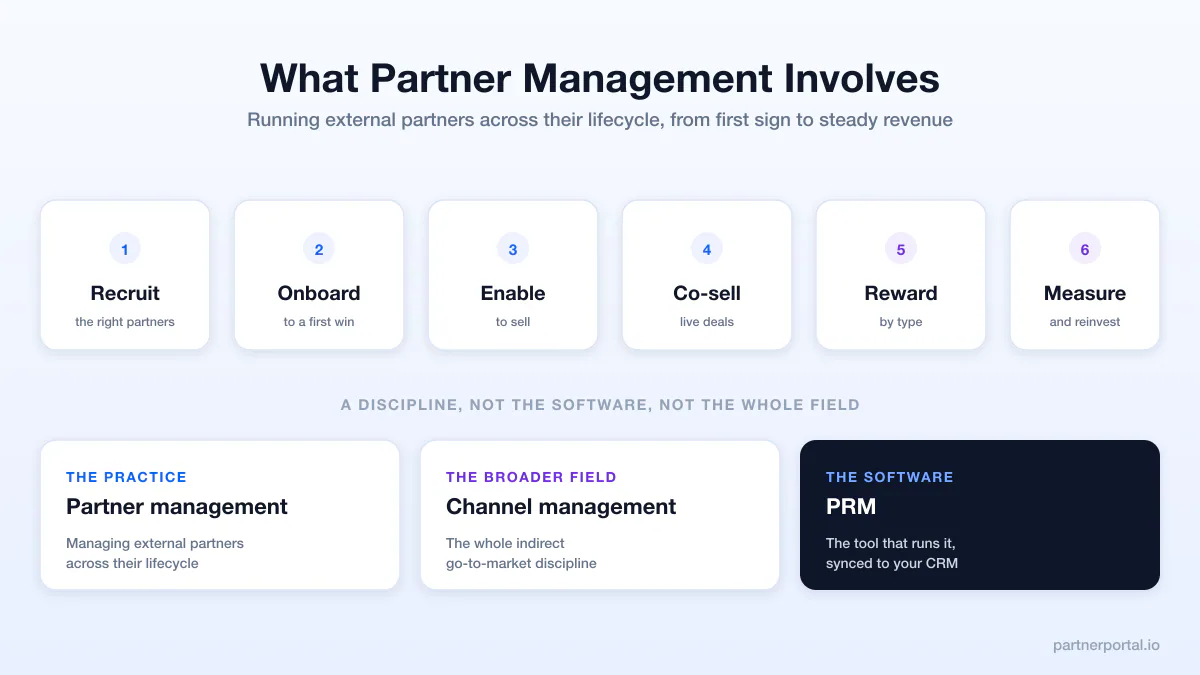
Partner management is the practice of recruiting, onboarding, enabling, and growing the external partners — referral, reseller, affiliate, technology, and alliance — that a company relies on to reach customers it would not reach directly. If your CRM is where you manage direct sales, partner management is the equivalent discipline for the revenue that comes through other companies.
This guide defines partner management plainly: what it is, what a partner manager actually does, the stages of the partner lifecycle, and — the part that trips people up — how partner management differs from channel management and from the PRM software used to run it.
TL;DR:
- Partner management is the discipline of running the external partners that bring you customers indirectly.
- A partner manager owns those relationships: recruit, onboard, enable, co-sell, reward, and measure.
- It spans a lifecycle — the same stages, run across a whole book of partners at once.
- Partner management vs channel management vs PRM: channel management is the broader discipline; partner management is the relationship layer; a PRM is the software that runs it.
- The type of partner (referral, reseller, technology, alliance) drives how you manage each one.
What is partner management?
Partner management is how a company runs the indirect side of its go-to-market: the partners who refer, resell, implement, or co-sell its product to customers the company would not reach on its own. It’s a distinct discipline from direct-sales management because partners are independent businesses with their own priorities — you don’t manage them, you influence them, by making it easy and rewarding to work with you.
At its core, partner management answers three ongoing questions:
- Who should we partner with? — recruiting the right partners against a clear profile, not signing every logo.
- How do we make them productive? — onboarding, enablement, and deal support that get partners to real revenue.
- Where should we invest? — measuring which partners actually produce and concentrating time and rewards there.
Done well, partner management turns a roster of logos into a predictable, growing source of partner-sourced revenue. Done poorly, it produces a long list of inactive partners and no way to tell the productive ones from the dormant.
What a partner manager does
The person who owns this work is usually a partner manager (or partnerships manager, partner account manager, channel manager — titles vary by program). The role is part relationship manager, part operator. Day to day it spans:
- Recruiting partners that fit the program’s profile.
- Onboarding them to a first deal quickly, before early enthusiasm fades.
- Enabling them with the training, content, and answers they need to sell.
- Supporting live deals — co-selling, deal registration, and unblocking partners in front of customers.
- Running a cadence — regular check-ins and business reviews with the partners that matter.
- Deciding where to invest — reading partner performance and concentrating effort on producers.
The best partner managers spend their time disproportionately on the partners who produce, and build repeatable systems (onboarding paths, enablement content, scorecards) so the program doesn’t depend on their memory. For a closer look at the role itself, see the partnering manager breakdown.
The partner management lifecycle
Partner management runs the same set of stages, over and over, across every partner:
- Recruit — find and sign partners against a profile. See channel partner recruitment.
- Onboard — get a new partner to a first win. See channel partner onboarding.
- Enable — equip partners to sell with training and content. See channel partner enablement.
- Co-sell and support — work live deals together, with deal registration protecting partner-sourced pipeline.
- Reward — pay incentives that fit each partner type.
- Measure — track performance and reinvest in what works.
Managing a program is running these stages across a whole book of partners at once, with limited time — which is why partner management is as much about systems and prioritization as it is about relationships. For the full end-to-end discipline, see the guide to channel management.
Partner management vs channel management vs PRM
These three terms are used loosely and often confused. The clean distinction:
| Term | What it is |
|---|---|
| Partner management | The practice of managing external partners across their lifecycle. The general term — covers referral, affiliate, reseller, technology, and alliance partners. |
| Channel management | The broader discipline of running an indirect go-to-market, usually implying resellers and distributors specifically — strategy, recruitment, deal registration, incentives, and optimization. |
| PRM (partner relationship management) | The software used to do partner management — onboarding, deal registration, enablement, commissions, and reporting in one system, synced to your CRM. |
In short: partner management is the job, channel management is the broader field it often lives in, and a PRM is the tool. A company can practice partner management with spreadsheets; a PRM is what makes it scale.
The types of partners you manage
The single most important fact in partner management is that the type of partner drives how you manage them. A referral partner who sends the occasional lead and a reseller who sells and bills your product directly need completely different onboarding, enablement, and incentives.
Partners are usually grouped by the role they play in the deal — those who refer (referral partners, affiliates), those who resell (resellers, VARs, distributors, MSPs), those who deliver (system integrators, technology/ISV partners), and strategic alliances. Managing them all the same way is the most common and costly mistake in the discipline. For the full breakdown, see the types of channel partners.
Strategic partner management vs. managing the long tail
One split matters more than the others. Strategic partner management is the high-touch work of running a handful of partners who each move the business — a major alliance, a key distributor, a technology partner with an integrated go-to-market. It looks like account management: a named owner, a joint business plan, executive sponsors, quarterly reviews, and co-investment.
Managing the long tail — the dozens or hundreds of referral and reseller partners who each produce a little — is a different job. It is run on process and software rather than relationships: self-serve onboarding, automated deal registration, tiered incentives, and portfolio-level reporting that surfaces who to promote into the strategic group and who to let go. Most partner programs need both, and the most common failure is applying the strategic playbook to the tail (it does not scale) or the tail playbook to strategic partners (they leave).
Common partner management challenges
The recurring problems every partner program runs into:
- Partner sprawl. A long roster of signed-but-inactive partners that consumes attention without producing revenue. The fix is measurement and honest portfolio pruning.
- Attribution. Knowing which revenue a partner actually sourced or influenced — hard without deal registration and a CRM the partner data flows into.
- Engagement decay. Partners who onboard with enthusiasm and go quiet. Ongoing partner engagement — enablement and a real cadence — is what keeps them active.
- Under-resourcing. Expecting partners to produce with no one owning the relationships. Partner management is a job, not a side task.
- Managing on disconnected data. Running the program in spreadsheets that don’t agree with the CRM, so no one trusts the numbers.
How partner management software helps
Most of the challenges above are, underneath, a data-and-systems problem — which is what a PRM (partner relationship management) system exists to solve. PartnerPortal gives a partner program one place to run the lifecycle:
- Onboarding and a partner portal partners actually use.
- Deal and lead registration so partner-sourced pipeline is tracked and attributed.
- Enablement — a resource center, courses, and announcements to keep partners equipped.
- Commissions and incentives that fit each partner type.
- Reporting on partners, leads, and revenue, with native CRM sync (HubSpot, Salesforce, Pipedrive, Zoho, Attio) so the program and the CRM agree.
Partner management is still a discipline, not a tool — but the right software is what lets one partner manager run a growing program without it collapsing into spreadsheets. For how the tools compare, see the guide to the best PRM software.
Related reading
- What Is Channel Management? — the full indirect go-to-market lifecycle.
- Channel Partner Management: A Complete Guide — the relationship-and-portfolio layer in depth.
- The Types of Channel Partners — each partner type and how to manage it.
- Best PRM Software in 2026 — the software that runs partner management.
Ready to run your partner program in one place? Claim your portal or explore the CRM integrations.
Frequently asked questions
What is partner management?
Partner management is the practice of recruiting, onboarding, enabling, and growing the external partners — referral, reseller, affiliate, technology, and alliance — that a company relies on to reach customers it would not reach directly. It covers the full relationship: finding the right partners, getting them productive, rewarding the behavior you want, and measuring which partners actually drive revenue.
What does a partner manager do?
A partner manager owns the relationships in a partner program. Day to day that means recruiting partners against a profile, onboarding them to a first deal, enabling them with training and content, supporting live deals and co-selling, running an operating cadence (check-ins, business reviews), and deciding where to invest based on partner performance. The role is part relationship manager, part operator.
What's the difference between partner management and channel management?
Channel management is the broader discipline of running an indirect go-to-market — strategy, recruitment, deal registration, incentives, and optimization across a channel. Partner management is the relationship layer within it: managing the individual partners and the portfolio. Channel management usually implies resellers and distributors specifically; partner management is the more general term that also covers referral, affiliate, and technology partners.
What is a PRM, and how does it relate to partner management?
A PRM (partner relationship management) system is the software used to do partner management — a central place for partner onboarding, deal registration, enablement content, commissions, and reporting, usually synced to a CRM. Partner management is the practice; a PRM is the tool that runs it, the way a CRM runs direct-sales management.
What are the stages of partner management?
The partner lifecycle typically runs: recruit the right partners, onboard them to a first win, enable them with training and content, co-sell and support live deals, reward them with incentives that fit their type, and measure performance to decide where to invest. Managing a program means running these stages across a whole book of partners at once.
Is partner management the same as partnership management?
The terms are used interchangeably. Both describe managing the external partners a company works with to reach customers. "Partnership management" is sometimes used more broadly to include strategic alliances and co-marketing relationships, while "partner management" leans toward a structured partner program, but in practice they mean the same discipline.