
PartnerStack vs PartnerPortal (2026): A Side-by-Side Comparison
PartnerStack vs PartnerPortal compared — a partner network and payout engine vs. an accessible, broad-CRM PRM. CRM integrations, pricing, features, and reviews so you can decide which fits your program.
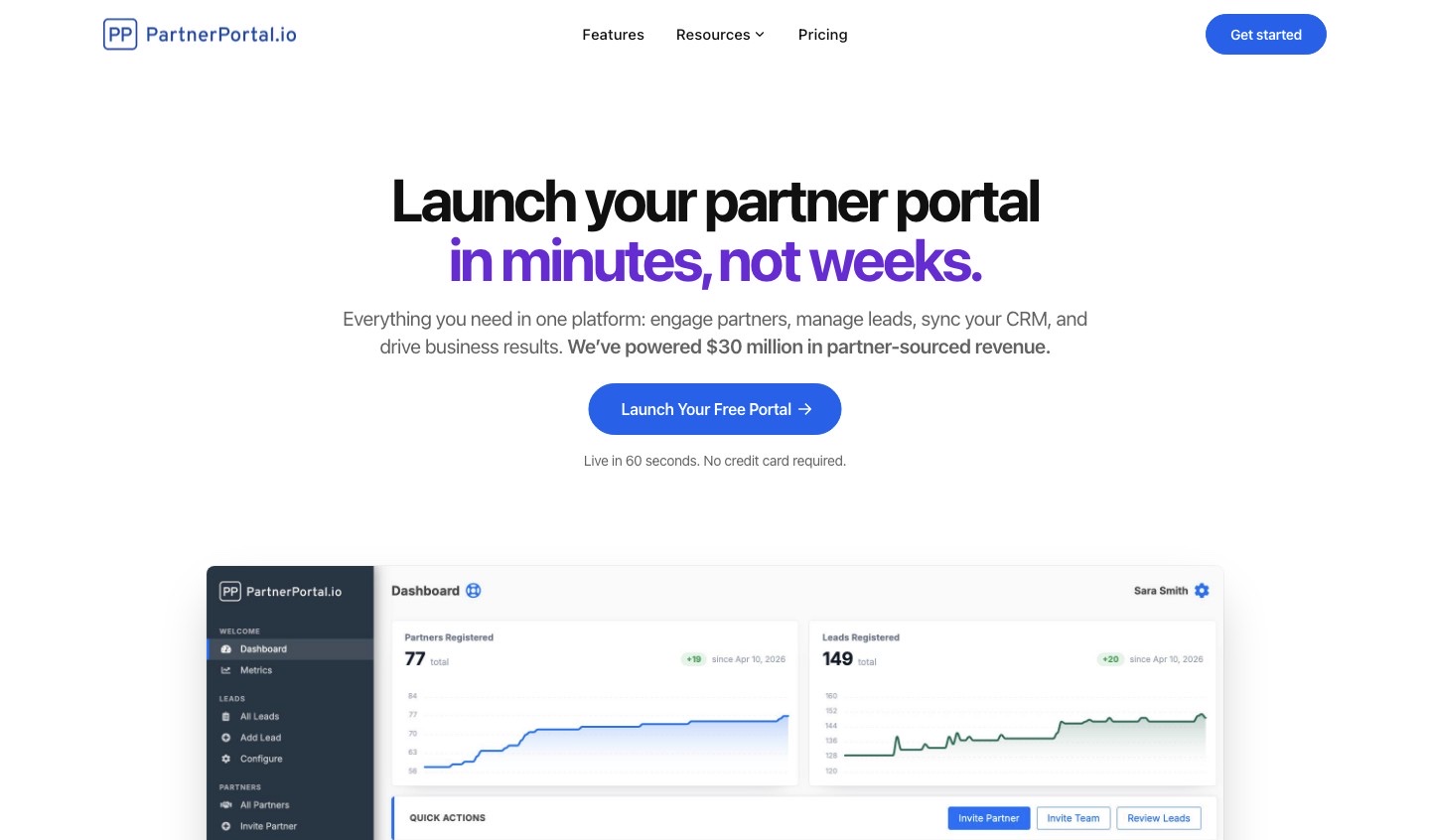
PartnerStack sells reach + payouts (138k-partner marketplace, global payment rail) at mid-market prices. PartnerPortal sells CRM breadth + free/self-serve without a network or payout percentage. Same core PRM jobs; different products. Side-by-side below.
Full disclosure: PartnerPortal publishes this comparison, and PartnerPortal is a direct PartnerStack competitor. We’ve worked to keep this fair and factual — stating what each tool does and letting you draw the conclusion — rather than steering you toward us. Where the facts favor PartnerStack, we say so.
First, a useful signal: the choice here is largely about what you’re optimizing for. If your program’s hard problems are finding partners and paying a lot of them across borders, PartnerStack’s network and payout rail are exactly what it’s built for — and you accept a mid-market price plus a percentage fee to get them. If you want broad CRM coverage, transparent low cost, and a free way to launch — especially on a CRM beyond HubSpot/Salesforce — PartnerPortal is built for that. It would be a different exercise to weigh either against an enterprise suite like Impartner or ZINFI; for that wider view, see our best PRM software roundup.
TL;DR: Both cover referral/reseller/affiliate motions from a branded portal with CRM sync. The differences that matter most: recruitment (PartnerStack’s 138,000+ marketplace vs. PartnerPortal’s none), CRM coverage (PartnerPortal native with five CRMs including Pipedrive, Zoho, and Attio; PartnerStack HubSpot/Salesforce only), payments (PartnerStack pays partners directly through a global payout rail with a percentage fee; PartnerPortal doesn’t move money — it tracks and exports commissions for finance to pay), pricing (PartnerStack custom from ~$1,000/mo + payout %; PartnerPortal free tier, then $249/$399), and training (PartnerPortal has a built-in LMS; PartnerStack is lighter). PartnerStack has by far the larger review base (~4.7/5 across 740+ on G2, with a low affiliate Trustpilot score); PartnerPortal is ~4.5/5 across ~50.
At a glance
| PartnerStack | PartnerPortal | |
|---|---|---|
| Best known for | Partner network + automated global payouts | Broad native CRM coverage + free entry point |
| Founded / HQ | 2015, Toronto (now part of AppDirect) | 5+ years in market; self-serve PRM |
| Target buyer | Mid-market & up B2B SaaS | SMB / mid-market B2B SaaS |
| Partner recruitment network | Yes — 138,000+ partners | No |
| Native CRM | HubSpot, Salesforce | HubSpot, Salesforce, Pipedrive, Zoho, Attio |
| Pays partners directly | Yes (multi-currency, single invoice) | No — tracks & exports commissions |
| Payout percentage fee | Yes (~15% network-sourced) | No |
| Built-in LMS | Lighter enablement | Yes (courses + certifications) |
| Free tier | No | Yes (permanent) |
| Starting price | Custom, ~$1,000/mo | Free, then $249/mo |
| Price ceiling | Custom (Enterprise) | $399/mo (unlimited) |
| Time to launch | Demo + quote | ~60 seconds, self-serve, no credit card |
| G2 rating | ~4.7 / 5 (740+ reviews) | ~4.5 / 5 (~50 reviews) |
Both cover the same core PRM ground, but for different scales and budgets: PartnerStack buys reach and a payments rail at a mid-market price; PartnerPortal buys CRM breadth, a free start, and low flat pricing. The sections below unpack the trade-offs.
Overview of each
PartnerStack is a partner ecosystem platform founded in Toronto in 2015 and acquired by AppDirect in 2026. It centralizes partner recruitment, onboarding, deal tracking, and — its best-known capability — automated payouts, syncing partner-sourced deals into HubSpot and Salesforce. Its signature asset is the PartnerStack Network (138,000+ active B2B partners), and it runs 600+ SaaS programs for names like Intuit, Asana, and monday.com. It’s the largest and most-reviewed product in the category. For the full breakdown, see our PartnerStack PRM overview.
PartnerPortal is a PRM for SMB and mid-market teams that want a partner portal live quickly — and free to start. It covers the same core ground (portal, lead and deal registration, commissions) with an emphasis on broad native CRM coverage (five CRMs, including Pipedrive, Zoho, and Attio), a built-in LMS with certifications, automated commission & revenue tracking (connect Stripe or QuickBooks to capture customer revenue and calculate what partners are owed), and a permanently free tier. It’s typically chosen for teams on CRMs beyond HubSpot/Salesforce, or those that want to launch without budget approval. For the wider field, see best PRM software.
On reviews, PartnerStack carries a far larger and slightly higher public base (~4.7/5 on G2 across 740+) than PartnerPortal (~4.5/5 across ~50), reflecting its decade in market — with the caveat of a low Trustpilot score from affiliates. We cover the numbers in Reviews & ratings.
Brand & market position
Both are independent SaaS-focused PRMs, but they come from different places and aim at different buyers.
- PartnerStack is the established, best-capitalized platform in the category, built around its network and payments and aimed at B2B SaaS at scale — teams whose growth depends on adding and paying partners fast. Its recent acquisition by AppDirect folds it into a larger subscription-commerce strategy.
- PartnerPortal is a self-serve PRM (5+ years in market) positioned on accessibility and CRM breadth — a partner portal you can launch in about 60 seconds, free to start, with native support for five CRMs, and it continues to ship new CRM integrations and features.
On temperament: PartnerStack optimizes for reach and payment velocity at mid-market scale; PartnerPortal optimizes for affordability, CRM breadth, and speed-to-launch for a leaner team. Where the facts favor PartnerStack — the network, the payout rail, the review base — we flag them below.
Feature comparison
Branded portal and deal registration look similar on paper. The rows that decide this matchup are the marketplace, payout engine, CRM natives, and total cost (subscription + payout %).
| Feature | PartnerStack | PartnerPortal |
|---|---|---|
| Branded partner portal | Yes | Yes |
| Partner onboarding | Yes (custom journeys) | Yes |
| Lead & deal registration | Yes (+ Slack/email AI capture) | Yes (creates CRM records) |
| Partner recruitment network | Yes (138,000+) | No |
| Pays partners directly | Yes (multi-currency, single invoice) | No — commission tracking + exports |
| Payout percentage fee | Yes | No |
| Commission rules & tiers | Yes | Yes |
| Built-in LMS & certifications | Lighter | Yes |
| Affiliate / referral / reseller | All three (affiliate-strong) | All three (referral/affiliate-first) |
| Native CRMs | HubSpot, Salesforce | HubSpot, Salesforce, Pipedrive, Zoho, Attio |
| Free tier | No | Yes |
Partner recruitment
This is PartnerStack’s clearest advantage. Its Network is a marketplace of 138,000+ active B2B partners where your program is discovered and partners apply to you — a genuine recruitment channel. PartnerPortal has no discovery network; it helps you onboard, enable, and reward partners you bring or recruit yourself. If sourcing new partners in-tool is central, PartnerStack keeps this edge outright.
Deal registration & CRM sync
Both attribute partner-sourced opportunities and route them into the CRM. PartnerStack lets partners register through the portal, inside HubSpot, or via Slack and email with AI-powered capture, syncing into HubSpot or Salesforce. PartnerPortal creates the Deal — plus supporting Person and Company records — in whichever of its five native CRMs you use when a partner-sourced lead is approved, then syncs deal updates back to the portal. If your CRM is HubSpot or Salesforce, both deliver native registration sync; if it’s Pipedrive, Zoho, or Attio, only PartnerPortal does it natively (see Integrations).
Payments & commissions
Here the facts favor PartnerStack — and the two take genuinely different approaches. PartnerStack has a mature automated global payout engine that actually pays partners — multi-currency, tax-compliance handling (W-8BEN, VAT), and a single monthly invoice — the capability its vendor reviewers praise most, and a real advantage for high-volume, tax-complex international payouts. The trade-offs: it charges a percentage fee on commissions processed (higher for network-sourced partners), and some affiliates report slow payout timing on Trustpilot. PartnerPortal doesn’t move money. Instead it automates commission and revenue tracking — connect Stripe or QuickBooks to capture charge-level customer revenue, match it to the right partner and deal, and calculate what’s owed — then runs a finance-friendly approve → export → mark-paid workflow with AP-ready exports (Ramp, BILL, QuickBooks) that your finance team pays from, with no payout percentage fee. So if paying many partners across borders in-tool is core, PartnerStack’s built-in rail is the clear fit; if you’d rather track and export commissions and disburse through your own finance/AP system at far lower cost, PartnerPortal covers it.
Partner training & enablement
PartnerPortal includes a built-in partner LMS: you create training courses of ordered lessons, control access by partner group, track completion, and award certifications automatically inside the portal. PartnerStack delivers resources and custom onboarding journeys but is lighter for structured, course-based training. If in-portal partner training and certifications matter, PartnerPortal does that natively; if enablement is mainly resource delivery, both cover it.
Ease of starting
The starting experience differs sharply. PartnerPortal is fully self-serve and free to launch — you can stand up a real branded portal in about 60 seconds, with no credit card and no sales call. PartnerStack starts with a demo and a custom quote (from ~$1,000/month), a heavier evaluation path. If the lowest-friction way to go live and evaluate matters, that favors PartnerPortal; if you want a guided enterprise-style onboarding, PartnerStack provides it.
Integrations
| Category | PartnerStack | PartnerPortal |
|---|---|---|
| Native CRM | HubSpot, Salesforce | HubSpot, Salesforce, Pipedrive, Zoho, Attio |
| Other CRM | API / general integrations | Zapier / API (fewer needed) |
| Payments / accounting | Built-in global payout engine (fee) | Commission/revenue tracking (Stripe, QuickBooks); AP-ready exports |
| Recruitment network | 138,000+ partner marketplace | — |
| Communication | Slack, email (AI capture) | Slack |
| Everything else | REST API | Zapier, API |
The headline: PartnerPortal has the broader native CRM coverage (five CRMs vs. two), the main reason to choose it if you run Pipedrive, Zoho, or Attio — with PartnerStack you’d connect those via the API and maintain the workflows yourself. PartnerStack counters with two things PartnerPortal doesn’t have: a 138,000-partner recruitment network and a mature global payout rail. Which matters more depends on whether your gap is CRM fit and cost, or reach and payments. For the CRM landscape, see best PRM for Pipedrive, Zoho, and Attio.
Pricing
The pricing models are very different, and this is often decisive.
| PartnerStack | PartnerPortal | |
|---|---|---|
| Free tier | No | Yes (permanent) |
| Entry | Custom, | Free, then $249/mo (up to 100 partners) |
| Top published plan | Custom (Enterprise) | $399/mo (unlimited partners) |
| Extra fees | % fee on commissions (~15% network) + 7% renewal uplift | None on payouts |
| Billing basis | Partner volume + payout throughput | Flat per tier |
Two things stand out factually. First, PartnerPortal is dramatically cheaper and more predictable — a free tier, then $249/month and $399/month (unlimited), with no payout fee. PartnerStack starts around $1,000/month and layers on a percentage fee on partner commissions plus a 7% renewal uplift, so on real payout volume its total cost can run many times PartnerPortal’s. Second, PartnerPortal’s highest published plan ($399/month, unlimited) sits well below PartnerStack’s entry point — PartnerPortal’s ceiling is roughly a third of where PartnerStack’s floor begins, before fees. What PartnerStack’s premium buys is the network and the payout rail; whether that’s worth it depends on how much you value them. Teams optimizing on cost should also see our most affordable PRM software roundup. Confirm current numbers with each vendor.
Reviews & ratings
Both are well-reviewed by users; the main difference is review volume and audience.
| Platform | PartnerStack | PartnerPortal |
|---|---|---|
| G2 | ~4.7 / 5 (740+ reviews) | ~4.5 / 5 (~50 reviews) |
| Other | ~2 / 5 on Trustpilot (affiliate audience) | Favorable, smaller base |
PartnerStack has one of the deepest, most positive vendor-review bases in the category, with high marks for automated payouts, ease of use, and support — a genuine advantage in social proof. The nuance: its Trustpilot score sits near 2/5 because that audience is affiliates reporting payout delays, a different group than the vendors on G2. PartnerPortal is well-rated on a smaller base, praised for ease of use, fast setup, CRM breadth, and value. As of 2026, PartnerStack has the larger and slightly higher-rated public review base; both sit in the “well-liked by users” range. Read them yourself: PartnerStack on G2 and PartnerPortal on G2.
Considerations for your program
Ask whether you need PartnerStack’s network and payout rail — if not, the economics usually favor PartnerPortal:
- You need to find partners, not just manage them. PartnerStack’s 138,000+ network is a recruitment channel; PartnerPortal has none. This favors PartnerStack.
- Your CRM is Pipedrive, Zoho, or Attio. PartnerPortal integrates natively; PartnerStack does not. This favors PartnerPortal.
- Your CRM is HubSpot or Salesforce. Both are native; this factor is closer to a wash.
- You run high-volume international partner payouts with tax complexity. PartnerStack’s mature global rail and single invoice are its standout.
- You want predictable, flat costs with no percentage on commissions. PartnerPortal charges a flat subscription and takes no cut of commissions (it doesn’t process payments); PartnerStack adds a percentage fee on commissions it pays out.
- You want a free tier or the lowest entry price. PartnerPortal has a permanently free tier and a $249/month plan; PartnerStack starts around $1,000/month with no free option.
- You want in-portal partner training. PartnerPortal has a built-in LMS with certifications; PartnerStack is lighter.
- You run affiliate programs at scale. PartnerStack’s affiliate DNA and network fit high-volume affiliate motions.
- You want the fastest, lowest-commitment start. PartnerPortal is self-serve and free to launch in about 60 seconds; PartnerStack starts with a demo and quote.
- You value the largest public review base. PartnerStack has the deeper, more established corpus.
- You need enterprise channel governance, MDF, or TCMA. Neither is built for that — look at enterprise suites in our best PRM software roundup.
Related reading
- PartnerStack PRM: Features, Pricing & Reviews — the full deep dive on PartnerStack.
- PartnerStack vs Kiflo, vs JourneyBee, and vs Introw — PartnerStack against other modern PRMs.
- Kiflo vs PartnerPortal, JourneyBee vs PartnerPortal, and Introw vs PartnerPortal — PartnerPortal’s other head-to-heads.
- Best PRM Software in 2026 and Most Affordable PRM Software — the full category, ranked.
- Partner Relationship Management Platforms: Compare the Market — the full PRM landscape and every head-to-head in one place.
- Best PRM for Pipedrive, Zoho, and Attio — where PartnerPortal is native and PartnerStack isn’t.
Need the marketplace — or just a CRM-native portal without payout fees? Try PartnerPortal free or browse CRM integrations.
Frequently asked questions
What is the main difference between PartnerStack and PartnerPortal?
Scale and model. PartnerStack is a large partner ecosystem platform built around a 138,000+ partner marketplace and an automated global payout engine, priced custom from around $1,000/month plus a percentage fee on partner commissions — aimed at mid-market and larger SaaS programs. PartnerPortal is an accessible PRM with native coverage of five CRMs (HubSpot, Salesforce, Pipedrive, Zoho, Attio), a permanently free tier, and paid plans up to $399/month. A key model difference: PartnerStack pays partners directly through its built-in payout rail, while PartnerPortal doesn't move money — it tracks commissions and exports them for your finance team to pay, so there's no payout percentage fee. PartnerStack is the bigger network-and-payments platform; PartnerPortal is the broader-CRM, lower-cost, free-to-start option — without a recruitment network or a built-in payout rail.
Are PartnerStack and PartnerPortal direct competitors?
Yes, though at different ends of the market. Both run referral, reseller, and affiliate programs from a branded portal with deal registration and CRM sync. PartnerStack targets mid-market and up, especially teams that want a partner marketplace and automated cross-border payouts and can absorb a percentage fee. PartnerPortal targets SMB and mid-market teams that want broad native CRM coverage, transparent low pricing, and a free way to start. If you've shortlisted both, the decision usually comes down to whether you need PartnerStack's network and payout rail or PartnerPortal's affordability and CRM breadth.
Which is more affordable, PartnerStack or PartnerPortal?
PartnerPortal, clearly. It has a permanently free tier and paid plans at $249/month (up to 100 partners) and $399/month (unlimited), with no payout percentage fee — PartnerPortal exports commissions for your finance team to pay rather than processing payments itself. PartnerStack is custom-priced from around $1,000/month (median contracts near $19,600/year), plus a percentage fee on the commissions it processes (commonly cited near 15% for network-sourced partners) and a 7% annual renewal uplift. On real payout volume, PartnerStack's total cost can be many times PartnerPortal's. Confirm current pricing with each vendor.
Which CRMs do PartnerStack and PartnerPortal integrate with?
PartnerPortal has broader native CRM coverage: HubSpot, Salesforce, Pipedrive, Zoho, and Attio. PartnerStack is native with HubSpot and Salesforce only, reaching other CRMs through the API or general integrations. If your CRM is Pipedrive, Zoho, or Attio, PartnerPortal syncs natively where PartnerStack does not; if you're on HubSpot or Salesforce, both are native, and PartnerStack's HubSpot depth (in-deal referral submission) is strong.
Does PartnerStack or PartnerPortal help you recruit partners?
This is PartnerStack's signature advantage. Its marketplace of 138,000+ active B2B partners lets your program be discovered and joined — a recruitment channel PartnerPortal doesn't offer. PartnerPortal helps you onboard, enable, and reward partners you bring or recruit yourself, but it has no partner-discovery network. If finding new partners in-tool is central to your plan, PartnerStack keeps that edge.
How do partner payouts differ between PartnerStack and PartnerPortal?
They work very differently. PartnerStack has a mature automated global payout engine — it actually pays partners, with multi-currency support, tax-compliance handling, and a single monthly invoice — which is its most-praised feature (though some affiliates report slow timing on Trustpilot), and it charges a percentage fee on commissions processed. PartnerPortal doesn't move money: it automatically tracks commissions and revenue (connect Stripe or QuickBooks to capture customer revenue and calculate what each partner is owed), then runs an approve → export → mark-paid workflow with AP-ready exports your finance team pays from — with no payout percentage fee. If paying many partners across borders in-tool is a core need, PartnerStack's built-in rail is a clear advantage; if you'd rather track and export commissions and pay through your own finance/AP system, PartnerPortal fits.
Does PartnerStack or PartnerPortal offer a free plan or built-in LMS?
PartnerPortal offers both: a permanently free tier (not a time-limited trial) you can launch in about 60 seconds, and a built-in partner LMS with course delivery and auto-awarded certifications inside the portal. PartnerStack has no free tier (access starts with a demo and custom quote from around $1,000/month) and is lighter on structured, course-based training. If a free start and in-portal training matter, PartnerPortal has both; PartnerStack counters with its network and payout scale.