
PartnerStack PRM: Features, Pricing & Reviews (2026)
An in-depth guide to PartnerStack — the company behind it (now part of AppDirect), its partner network, features, integrations, pricing and fees, real user reviews, and the best alternatives.
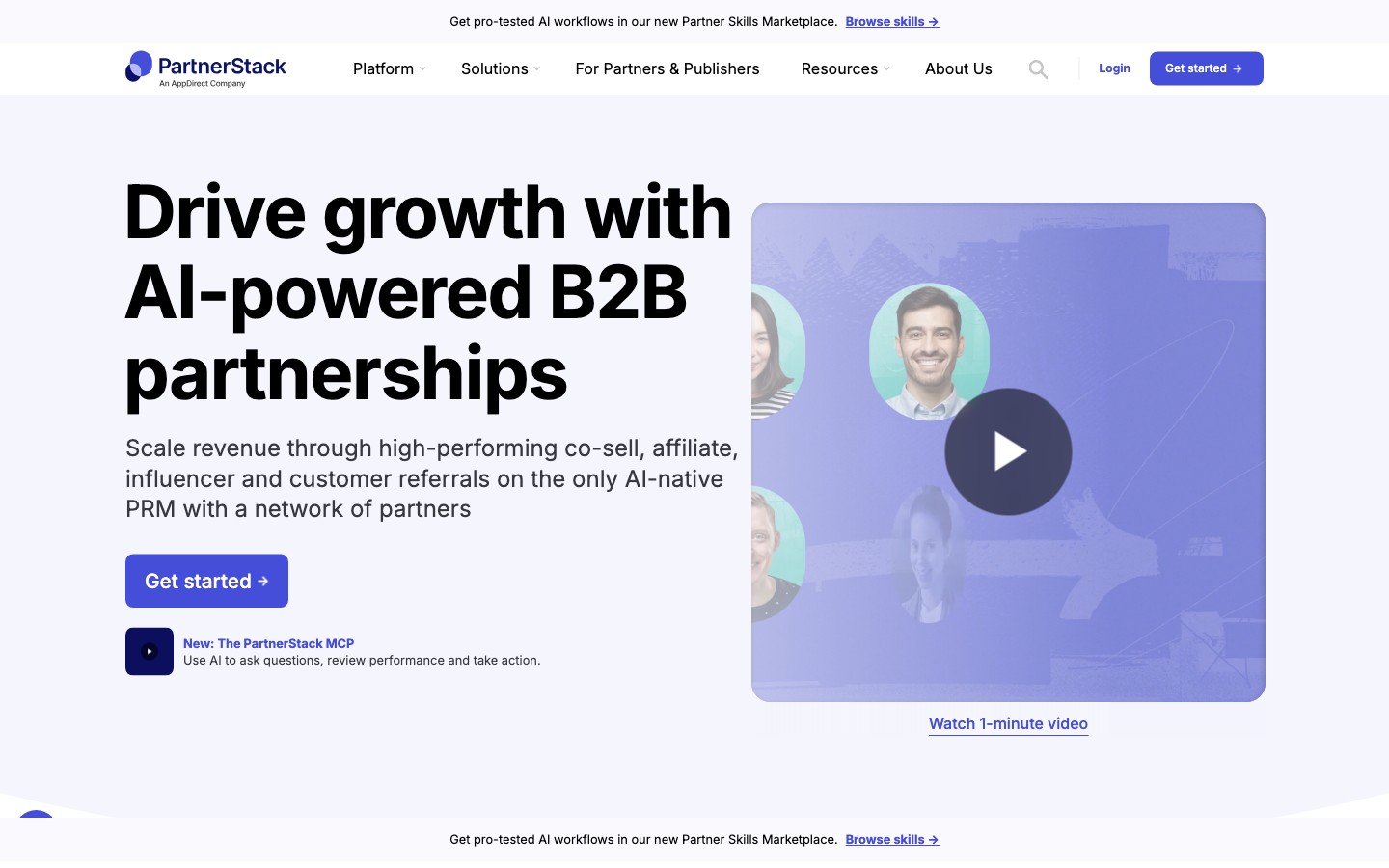
PartnerStack is a partner ecosystem platform — built for B2B SaaS companies — that centralizes partner recruitment, onboarding, deal tracking, and automated payouts, and connects your program to a marketplace of more than 138,000 active B2B partners. Founded in Toronto in 2015 through Y Combinator, it is one of the best-known and most-reviewed products in the category, and in April 2026 it was acquired by AppDirect. Focus of this page: the network-and-payouts model that makes PartnerStack feel different from a pure PRM, what the AppDirect acquisition changes for buyers, and how subscription + payout fees stack up against flatter alternatives.
Full disclosure: PartnerPortal publishes this guide, and PartnerPortal is a PartnerStack competitor. We’ve worked hard to keep this a fair, accurate overview built from PartnerStack’s own materials, public company records, its legal agreements, and verified third-party reviews — not a hit piece. Where we mention PartnerPortal, we flag it plainly.
TL;DR: PartnerStack is the largest and most established of the SaaS partner platforms, and it straddles two worlds — classic PRM (referral, reseller, and co-sell programs) and affiliate/influencer marketing. Its standout strengths are a built-in network of 138,000+ B2B partners you can recruit from, automated global payouts with tax compliance and a single monthly invoice, native HubSpot and Salesforce sync, and a very deep, positive G2 review base (~4.7/5 across 740+ reviews). Its main trade-offs: custom, demo-only pricing that starts around $1,000/month with no free tier, a percentage fee on partner commissions (typically higher for network-referred partners, commonly cited near 15%) plus a 7% annual renewal uplift, native CRM sync limited to HubSpot and Salesforce, and — as of April 2026 — it’s no longer independent, now a subsidiary of AppDirect.
What is PartnerStack?
PartnerStack is a partner ecosystem platform: software that helps a B2B SaaS company run its indirect revenue channels — affiliates, referral partners, and resellers — in one place instead of across spreadsheets, email, and a general-purpose CRM. In practice that means it handles the full lifecycle: recruiting partners (including from its own marketplace), onboarding and enabling them, tracking the leads and deals they source, and — the part it’s arguably best known for — paying them automatically, in many currencies and countries, from a single monthly invoice.
What sets PartnerStack apart from most PRMs is its dual nature. It is a genuine PRM for referral and reseller motions, but it’s also a serious affiliate and influencer marketing platform — G2 lists it in all three categories. That’s a direct reflection of its origins (it started life as partner-marketing technology) and it’s why PartnerStack shows up on both “best PRM” and “best affiliate software” shortlists. The other half of its identity is the PartnerStack Network — a marketplace where 138,000+ active B2B partners can discover and join programs, which no competitor matches at that scale.
Company background
PartnerStack is a Toronto-built company with a decade of history — and, as of 2026, a new owner. Key facts, drawn from public company records, press coverage, and PartnerStack’s own materials:
- Founded: 2015, in Toronto, Canada, through Y Combinator (Summer 2015 batch). The product evolved from earlier ideas (originally “GrowSumo”) into PartnerStack.
- Founders: Bryn Jones (CEO), Luke Swanek, Neil Chudleigh (CTO), and Jonathan Mendes. Bryn Jones still leads the company.
- Funding: roughly $38–40 million in venture capital over its life — a ~$2M seed (2016), a ~$7M Series A (2019, RRE Ventures and others), and a $29M USD Series B in May 2021 led by 3L (with Whitecap Venture Partners, HarbourVest, and RRE).
- Acquired by AppDirect (April 2026): In April 2026, AppDirect — a San Francisco-based (Canadian-founded) B2B subscription commerce platform — acquired PartnerStack in a deal reported at over $150 million, consisting primarily of AppDirect stock. PartnerStack’s ~110 employees joined AppDirect, its leadership team and Toronto operations were retained, and the company states existing programs, contacts, and contracts continue unchanged. It was AppDirect’s sixth acquisition in ten months.
- Scale: 600+ SaaS programs run on PartnerStack, drawing on a network of 138,000+ active B2B partners. Named customers include Intuit, Asana, Freshworks, Zendesk, Aircall, Intercom, Stripe, Webflow, and monday.com.
The practical takeaway: PartnerStack is the most established and best-capitalized of the SaaS partner platforms, with by far the largest partner network and review base. The most important new fact for buyers is the AppDirect acquisition. In the near term nothing changes for customers; over the longer term, PartnerStack becomes one piece of a larger subscription-commerce and marketplace strategy rather than a standalone, independently-steered PRM. Whether that’s a plus (more resources, deeper distribution) or a risk (roadmap absorbed into a bigger platform’s priorities) depends on what you’re buying it for.
How PartnerStack positions itself
PartnerStack markets itself as the “#1 partner ecosystem platform” and leans on three ideas:
- The network is the moat. PartnerStack’s central pitch is that it isn’t just software to manage partners you already have — it’s a marketplace to find new ones. Listing your program exposes it to 138,000+ active B2B partners, which PartnerStack frames as a growth engine, not just an operations tool.
- Automate the painful parts. Its second recurring message is removing the administrative burden of partnerships — especially payouts, attribution, and tax compliance — so a small team can run programs at scale. PartnerStack cites cutting partner-payout work from tens of hours a month down to a couple.
- One platform, every partner type. PartnerStack pitches a single system for affiliate, referral, and reseller/co-sell motions, so companies running more than one program type don’t need multiple tools.
Who it targets: B2B SaaS companies scaling partner programs — from teams formalizing their first program up to large, complex ecosystems with hundreds or thousands of partners. Its center of gravity is mid-market and up; the pricing and network fees make it a heavier commitment than the entry-level PRMs.
PartnerStack’s key features
Day to day, PartnerStack is judged on two things most PRMs don’t combine: recruiting via a marketplace and paying partners globally without a second finance stack. The capabilities that matter:
The PartnerStack Network (marketplace)
The PartnerStack Network is the feature nothing else in the category replicates at scale. It’s a marketplace of 138,000+ active B2B partners — affiliates, influencers, agencies, and resellers — where your program can be listed and discovered. You can search and invite partner types you’re looking for, and partners can apply to your program. For companies whose bottleneck is finding good partners (not just managing existing ones), this is PartnerStack’s single biggest draw. The trade-off is commercial: partners the network brings you carry a higher payout fee than partners you recruit yourself (see pricing).
Deal tracking & attribution
Partners submit leads and register deals through the portal, from inside HubSpot, or via Slack and email — where PartnerStack’s AI-powered capture detects and pulls the lead details automatically, creating a registered lead without manual entry. Each opportunity is attributed to the submitting partner and synced to HubSpot or Salesforce as leads, contacts, accounts, and opportunities. Your sales team works the deal in the CRM; PartnerStack pulls status updates back so partners stay informed, maintaining a full, traceable attribution record. Custom deal forms let you capture exactly the fields you need.
Automated payouts
Payouts are where PartnerStack is genuinely strong, and it’s the feature reviewers praise most. The platform automatically calculates what every partner is owed based on your reward rules and verified attribution, then pays them all at once — you receive a single monthly invoice rather than cutting individual payments. It handles global payouts across many countries and currencies with tax-compliance handling (W-8BEN, VAT, etc.), and can trigger payouts on CRM milestones (deal closed-won, a revenue threshold reached). For finance teams drowning in international partner payments and tax paperwork, this is the clearest ROI story PartnerStack tells. (The flip side — payout timing from the partner’s perspective — shows up in reviews below.)
Onboarding, enablement & the partner portal
PartnerStack gives partners a branded portal where they access resources, track their referrals and earnings, and withdraw payments. You can build custom, automated onboarding journeys per partner type, deliver training and resources, and use reporting (revenue, rewards paid, lifecycle stages) shared with both your team and your partners. It’s a mature, capable enablement layer — though for structured, course-based partner training, PartnerStack is lighter than platforms built around a full LMS.
Full feature list
Beyond the highlights above, PartnerStack includes:
- PartnerStack Network marketplace — list your program, discover and recruit from 138,000+ partners
- Support for affiliate, referral, and reseller/co-sell programs in one platform
- Branded partner portal with earnings visibility and self-service payment withdrawal
- Custom automated onboarding journeys per partner type
- Lead & deal registration with custom forms and partner-driven stage updates
- Multi-channel lead submission — portal, in-CRM (HubSpot), Slack/email with AI capture
- Partner attribution and two-way CRM sync
- Automated global payouts — single invoice, multi-currency, tax compliance, milestone triggers
- Flexible commission/reward rules and triggers
- Reporting and analytics for vendors and partners
- Role-based permissions
- Resource/asset sharing and partner communications
- Integrations with major marketing, sales, and BI tools; REST API
Integrations
Integrations are important to get right with PartnerStack, because native CRM depth is concentrated in two platforms.
| Category | Native integrations | Notes |
|---|---|---|
| CRM | HubSpot, Salesforce | Two-way, native. Partner-sourced leads, deal registrations, and payout triggers sync into the CRM; HubSpot users can submit referrals from inside a deal via the Network Connect app. |
| Other CRMs (Pipedrive, Zoho, Attio, etc.) | Not native | Reached through general integrations, Slack/email capture, or the API — not a purpose-built native sync. |
| Communication | Slack, email | AI-powered lead capture from Slack and email. |
| Marketing / sales / BI | Various | PartnerStack connects to common marketing, sales, and business-intelligence tools so the partner channel works from shared data. |
| Everything else | REST API | For custom or long-tail connections. |
The key evaluation point: if your CRM is HubSpot or Salesforce, PartnerStack’s native two-way sync is a real strength — deal flow and payouts run through the CRM your team already lives in. If your CRM is Pipedrive, Zoho, or Attio, PartnerStack has no native integration, which is a meaningful difference from PRMs built with those CRMs in mind. (For the full landscape by CRM, see our guides on the best PRM for Pipedrive, best PRM for Zoho, and best PRM for Attio.)
PartnerStack pricing & fees
PartnerStack does not publish pricing and does not offer a free plan. Access starts with a demo and a custom quote across three tiers — Launch, Growth, and Enterprise. Based on third-party data and buyer reports (PartnerStack’s own numbers are behind sales):
| Plan | Price | For |
|---|---|---|
| Launch | Custom (entry point ~$1,000/month) | Teams launching or formalizing a first partner program |
| Growth | Custom | Teams scaling partner-sourced revenue with advanced workflows |
| Enterprise | Custom | Large, high-performing, complex partner ecosystems |
The pricing details that matter most are the ones that don’t appear on a plan card:
- Entry point around $1,000/month ($12,000/year). Third-party datasets put the median contract closer to ~$19,600/year, scaling with partner volume and channel complexity.
- A percentage fee on partner commissions. On top of the subscription, PartnerStack takes a cut of the commissions it processes. This is two-tiered: a lower rate on partners you bring, and a higher rate on partners sourced through the PartnerStack Network — commonly cited around 15%. PartnerStack’s own SaaS agreement confirms a monthly fee set as a percentage of both client-sourced and network-referred partner commissions. Budget for it: on a large payout volume, this fee can rival or exceed the subscription.
- A 7% annual renewal uplift. PartnerStack’s standard SaaS agreement states that subscription fees increase 7% at each renewal unless you negotiate otherwise.
- No free tier or public trial. Everything runs through sales.
Always confirm current numbers with PartnerStack directly; pricing is custom and negotiable, and the fee structure depends on your partner mix. Teams optimizing purely on cost should also compare against our most affordable PRM software roundup, which accounts for hidden fees like payout percentages.
What users say: PartnerStack reviews
PartnerStack has one of the largest and most positive review bases in the category — but the picture depends on which audience you look at.
On G2, where the reviewers are mostly the SaaS vendors running programs, PartnerStack holds roughly 4.7 out of 5 across 740+ reviews (some comparison pages show 900+), an unusually deep corpus. It’s categorized as a Partner Ecosystem Platform, PRM, and Influencer Marketing Platform, and scores especially high on ease of use (~9.3) and quality of support (~9.3).
What vendor reviewers consistently praise:
- Automated payouts and the single invoice — the most-cited benefit, especially for international partners and tax compliance.
- Ease of use — an intuitive, visual interface and quick onboarding wizard.
- The partner network — a real source of new, active partners.
- Responsive, high-quality support.
- Managing affiliate, referral, and reseller motions in one place.
Common critiques (vendor side):
- Cost — the platform fee plus the percentage network fee makes it expensive, and hard to justify for smaller programs.
- Reporting depth and some configuration limits relative to enterprise channel suites.
- Complexity at the high end as programs and rules grow.
The important nuance: on Trustpilot, where reviewers are largely partners/affiliates getting paid (a different audience), PartnerStack sits far lower — around 2 out of 5 — with complaints concentrated on payout delays (affiliates commonly report waiting 45–60 days to be credited) and occasional account enforcement. This isn’t necessarily a contradiction: vendors love the automation and support; some partners are frustrated by payout timing. If a large share of your partners are individual affiliates for whom payout speed matters, weigh that.
Read the reviews yourself: PartnerStack on G2 and PartnerStack on Trustpilot.
Where PartnerStack is limited
No tool fits everyone. PartnerStack’s honest limits — most of which follow from it being an established, network-and-payments-centric platform aimed up-market:
- Cost and commitment. Custom pricing from ~$1,000/month, no free tier, annual contracts, a 7% renewal uplift, and a percentage fee on partner payouts. It’s a real budget line, cost-prohibitive for bootstrapped teams.
- Native CRM sync is HubSpot and Salesforce only. No native Pipedrive, Zoho, or Attio.
- Payout timing on the partner side. The automation is excellent for vendors; some affiliates report slow payouts and enforcement friction.
- Lighter on enterprise channel governance. Deep MDF/through-channel marketing, multi-tier distribution hierarchies, and a built-in LMS are stronger in dedicated enterprise suites (Impartner, ZINFI).
- No longer independent. As an AppDirect subsidiary (since April 2026), PartnerStack’s long-term roadmap is now set within a larger platform’s strategy.
- Affiliate-leaning DNA. Its strength in affiliate/influencer motions is a plus for some and overkill for a team that just wants a clean reseller/co-sell PRM.
Who PartnerStack is best for
PartnerStack is a strong fit if you’re:
- A B2B SaaS company running (or scaling) affiliate, referral, and/or reseller programs — especially more than one at once.
- Bottlenecked on finding partners, and drawn to the 138,000+ partner network as a recruitment channel.
- Spending significant time on international partner payouts and tax compliance you want automated.
- On HubSpot or Salesforce.
- Mid-market or larger, with the budget for custom pricing plus payout fees.
PartnerStack is probably not the right fit if you:
- Want a free-to-start option or the lowest total cost (the subscription plus percentage payout fee adds up fast).
- Run your CRM on Pipedrive, Zoho, or Attio and want native (not workaround) sync.
- Run a simple, single-motion program and don’t need a marketplace or affiliate depth.
- Need enterprise channel governance, heavy MDF/TCMA, or a built-in LMS for structured partner training.
- Are wary of committing to a platform that’s mid-integration into a larger parent company.
PartnerStack alternatives
The first thing to be clear about: PartnerStack is really two products in one — a PRM and a partner-discovery network of 138,000+ B2B partners. No other PRM ships with a marketplace like that. So switching away almost always means moving to a straight PRM and giving up the built-in recruitment network — you’d manage partners you already have (or recruit yourself) rather than discover new ones inside the tool. That trade-off, not features, is usually the real decision.
With that framed, the alternative depends on why you’re leaving:
- You’re mainly after the affiliate/marketplace side. Then you’re really comparing partner networks and affiliate platforms, not PRMs — impact.com, Reditus, or FirstPromoter live there.
- You want the core PRM without the network fees, the payout percentage, or the enterprise cost. Then a straight, modern PRM is the move — PartnerPortal (that’s us, disclosed), Kiflo, JourneyBee, or Introw — with enterprise suites like Impartner and ZINFI above them. You lose the discovery network, but gain flat pricing, simpler administration, and (in PartnerPortal’s case) broader native CRM coverage and a free tier.
A full PartnerStack alternatives listicle is still coming; until then, the category roundups above are the best next click.
- Best PRM software in 2026 — every major PRM ranked, PartnerStack included.
- Kiflo PRM, JourneyBee PRM, and Introw PRM — deep dives on the closest modern PRM peers.
Related reading
- Best PRM Software in 2026 — the full category comparison.
- Partner Relationship Management Platforms: Compare the Market — how the whole landscape is structured.
- Most Affordable PRM Software in 2026 — PRMs ranked by real cost, including hidden fees like payout percentages.
- Best PRM for Pipedrive, Zoho, and Attio — where PartnerStack isn’t native and which PRMs are.
- Why You Should Integrate Your CRM and PRM — why native CRM integration matters.
Mostly here for payouts and partner discovery — or ready to drop the network fee? Try PartnerPortal free or see native CRM sync.
Frequently asked questions
What is PartnerStack?
PartnerStack is a partner ecosystem platform (a category that includes partner relationship management, or PRM) built for B2B SaaS companies. It lets you recruit, onboard, track, and automatically pay affiliate, referral, and reseller partners from one place, and syncs partner-sourced deals into HubSpot and Salesforce. Its signature differentiator is a built-in marketplace of 138,000+ active B2B partners that your program can be discovered in — something no other PRM offers at that scale.
Who owns PartnerStack and where is it based?
PartnerStack is based in Toronto, Canada, and was founded in 2015 through Y Combinator by Bryn Jones (CEO), Luke Swanek, Neil Chudleigh, and Jonathan Mendes. It raised roughly $38–40 million in venture funding, including a $29M USD Series B in 2021 led by 3L. In April 2026, PartnerStack was acquired by AppDirect — a San Francisco-based B2B subscription commerce platform — in a deal reported at over $150 million, mostly in stock. PartnerStack's leadership, team, and Toronto operations were retained, and existing programs continue unchanged, but it is no longer an independent company.
How much does PartnerStack cost?
PartnerStack uses custom, demo-led pricing across three tiers (Launch, Growth, Enterprise) with no public price list and no free plan. Third-party data puts the entry point at roughly $1,000/month ($12,000/year), with a median contract around $19,600/year. On top of the subscription, PartnerStack charges a percentage-based fee on partner commissions it processes — typically higher for partners sourced through its own network (commonly cited around 15%) than for partners you bring yourself. Its standard SaaS agreement also builds in a 7% annual price increase at renewal. Confirm current pricing directly with PartnerStack.
Which CRMs does PartnerStack integrate with?
PartnerStack has native, two-way integrations with HubSpot and Salesforce, syncing partner-sourced leads, deal registrations, and payout triggers into the CRM your sales team already uses. HubSpot partners can even submit referrals from inside a HubSpot deal via the Network Connect app. PartnerStack does not offer native integrations with Pipedrive, Zoho, or Attio — those, and other tools, connect through PartnerStack's general integrations, Slack/email capture, or its API.
How does deal registration work in PartnerStack?
Partners submit leads or register deals through the PartnerStack portal, from inside HubSpot, or via Slack and email (where AI-powered capture pulls the details automatically). Each opportunity is attributed to the submitting partner and synced to HubSpot or Salesforce as leads, contacts, accounts, and opportunities. Your sales team updates the deal in the CRM, PartnerStack pulls the status back so partners stay informed, and when a deal hits a milestone the platform automatically calculates and queues the partner's payout.
Is PartnerStack any good? What do reviews say?
PartnerStack is very well-reviewed by SaaS vendors: it holds about 4.7 out of 5 on G2 across 740+ reviews — one of the largest review bases in the category — with especially high marks for ease of use and quality of support. The picture is more mixed on the partner side: PartnerStack's Trustpilot rating is around 2 out of 5, driven largely by affiliates reporting payout delays (commonly 45–60 days) and occasional account enforcement. The two data sources measure different audiences: vendors running programs, versus partners getting paid.
What are the best PartnerStack alternatives?
Worth knowing first: PartnerStack is unusual in bundling a PRM with a 138,000+ partner discovery network, and no other PRM ships with a marketplace like that — so switching usually means moving to a straight PRM and recruiting partners yourself rather than discovering them in-tool. If you're mainly after the network/affiliate side, you're comparing partner networks like impact.com, Reditus, or FirstPromoter. If you want the core PRM without the network fees or enterprise cost, modern PRMs — PartnerPortal, Kiflo, JourneyBee, and Introw — are the direct alternatives, with enterprise suites like Impartner and ZINFI above them.
Does PartnerStack have a free trial or free plan?
PartnerStack does not publish a free trial or a permanently free plan; access starts with a demo and a custom quote, with an entry point around $1,000/month. Teams that specifically want a free-to-start PRM look to alternatives — PartnerPortal, for instance, offers a permanently free tier alongside paid plans.