
PartnerStack vs JourneyBee (2026): A Side-by-Side Comparison
PartnerStack vs JourneyBee compared — an established partner network and payout engine vs. an AI-native, headless upstart. CRM coverage, AI, LMS, pricing, and reviews to help you choose.
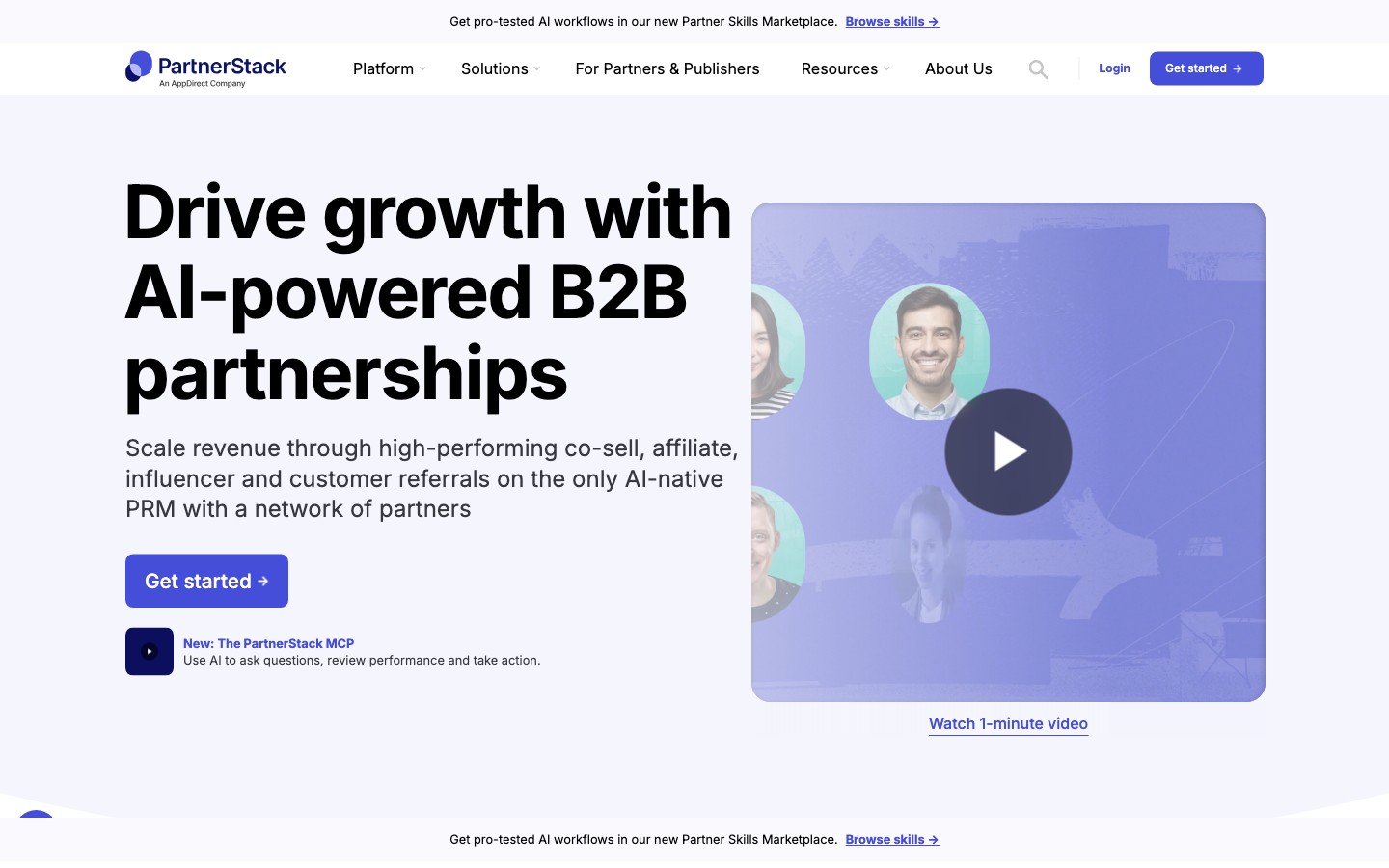
PartnerStack and JourneyBee are both pitched at modern B2B SaaS partner programs — but one is the established giant and the other is the ambitious newcomer. PartnerStack is the category’s most-reviewed platform, defined by a 138,000-partner marketplace and a mature global payout engine. JourneyBee is a 2023 startup betting on an AI-native, headless design — partners work from Slack, Teams, or email, an AI agent handles routine work, and a built-in LMS, MDF, and broad CRM coverage come in one package.
Full disclosure: PartnerPortal publishes this comparison, and PartnerPortal competes with both PartnerStack and JourneyBee. We’ve worked to keep this fair and factual — describing what each tool does and letting you draw the conclusion — rather than steering you toward us. We include a clearly labeled Where PartnerPortal fits section so our own stake is transparent, not smuggled in.
First, a useful signal: this comparison is really proven scale vs. modern ambition. PartnerStack gives you a partner marketplace, a battle-tested payout rail, and a decade of track record — the lower-risk, higher-reach choice. JourneyBee gives you agentic AI, off-portal engagement, and an all-in-one feature set (LMS, MDF, distribution) at a flat price — the more modern, more automated choice, on a small and young company. Your risk tolerance and how much you value AI vs. a recruitment network will do most of the deciding.
TL;DR: Both target modern SaaS channels, and both push deal registration off the portal (PartnerStack via Slack/email AI capture; JourneyBee via a headless Slack/Teams/email model). The differences that matter: maturity (PartnerStack: 2015, 740+ reviews, huge scale; JourneyBee: 2023, ~25 reviews, small team), recruitment (PartnerStack’s 138,000+ network vs. JourneyBee’s none), AI (JourneyBee’s Buzz agent vs. PartnerStack’s narrower AI capture), CRM breadth (JourneyBee native with Salesforce/HubSpot/Pipedrive/Attio + standalone; PartnerStack HubSpot/Salesforce only), payouts (PartnerStack’s mature global rail + single invoice vs. JourneyBee via XTRM), and cost (PartnerStack ~$1,000/mo + payout %; JourneyBee flat ~$499/mo, unlimited partners). JourneyBee also markets dual SOC 2 Type 2 + ISO 27001.
At a glance
| PartnerStack | JourneyBee | |
|---|---|---|
| Best known for | Partner network + mature global payouts | AI-native, headless PRM with LMS & MDF |
| Founded / HQ | 2015, Toronto (now part of AppDirect) | 2023, Stockholm (small, independent) |
| Partner recruitment network | Yes — 138,000+ partners | No |
| AI | Narrow (Slack/email lead capture) | Buzz agent (MCP-native, model-agnostic) |
| Off-portal registration | Yes (Slack/email capture) | Yes (headless — Slack/Teams/email) |
| Native CRM | HubSpot, Salesforce | Salesforce, HubSpot, Pipedrive, Attio (+ Zoho guide); standalone |
| Built-in LMS | Lighter enablement | Yes (courses, quizzes, badges) |
| MDF | Light | Yes |
| Partner payouts | Global rail, single invoice | Via XTRM |
| Security | Enterprise-grade (established) | SOC 2 Type 2 + ISO 27001 (advertised) |
| Pricing | Custom, ~$1,000/mo + payout % | ~$499/mo, unlimited partners |
| Free tier | No | No |
| G2 rating | ~4.7 / 5 (740+ reviews) | ~4.7 / 5 (~25 reviews) |
The ratings look similar, but the bases don’t: PartnerStack’s rests on 740+ reviews and a decade in market; JourneyBee’s on ~25 and two years. The sections below unpack what you gain and give up with each.
Overview of each
PartnerStack is the established marketplace giant opposite JourneyBee’s 2023 AI/headless bet: Toronto 2015 → AppDirect 2026, built to recruit, onboard, track, and automatically pay B2B SaaS partners into HubSpot/Salesforce. Its signature asset is the PartnerStack Network (138,000+ partners), it runs 600+ programs, and it holds one of the largest, most positive vendor-review bases in the category.
JourneyBee is an “AI-native, CRM-agnostic” PRM founded in Stockholm in 2023, built on a headless architecture — partners register deals and collaborate from Slack, Teams, or email. Beyond core PRM it includes an AI agent (Buzz), a built-in LMS with certifications, MDF, two-tier distribution, and broad native CRM coverage, with dual SOC 2 Type 2 + ISO 27001 security. It’s ambitious and modern, but young and small.
Both sit around 4.7/5 on G2 — but PartnerStack’s is a deep, established corpus (with a much lower Trustpilot score from affiliates), while JourneyBee’s is a strong but thin ~25-review base. See Reviews & ratings.
Brand & market position
PartnerStack markets itself as the “#1 partner ecosystem platform,” leaning on the network (find partners, don’t just manage them), payout automation, and running every partner type in one system. It’s the incumbent choice for SaaS at scale.
JourneyBee is explicitly anti-legacy-PRM — it frames traditional portals as static “digital rolodexes” where nothing moves unless a partner logs in, and counters with headless, off-portal, AI-native operation and plug-and-play setup “in less than a day.” It’s the modern-challenger pitch aimed at SaaS, cybersecurity, and AI companies.
The practical read: PartnerStack sells reach, payments, and proof; JourneyBee sells automation, engagement, and breadth. One asks you to value a marketplace and a mature rail; the other asks you to bet on an AI-forward roadmap from a young team.
Feature comparison
Both cover core PRM — portal, onboarding, deal registration, commissions, CRM sync — and, unusually, both move registration off the portal. The divergence is in recruitment, AI depth, payments maturity, and all-in-one breadth.
| Feature | PartnerStack | JourneyBee |
|---|---|---|
| Partner recruitment network | Yes (138,000+) | No |
| AI agent | Narrow (lead capture) | Buzz (MCP-native, agentic) |
| Off-portal registration | Yes (Slack/email) | Yes (headless Slack/Teams/email) |
| Automated global payouts | Yes (multi-currency, single invoice) | Via XTRM |
| Built-in LMS & certifications | Lighter | Yes |
| MDF management | Light | Yes |
| Reseller / two-tier distribution | Reseller/co-sell | Yes (managed by JourneyBee) |
| Native CRMs | HubSpot, Salesforce | Salesforce, HubSpot, Pipedrive, Attio (+ standalone) |
| Security certifications | Established/enterprise | SOC 2 Type 2 + ISO 27001 |
Recruitment & the network
PartnerStack’s 138,000+ partner marketplace is a real recruitment channel and its single biggest structural advantage — JourneyBee has no discovery network (it includes partner recruitment tooling and a directory, but not a two-sided marketplace). If sourcing new partners in-tool matters, PartnerStack is unmatched here; if you bring your own partners, this advantage doesn’t apply.
Off-portal selling & AI
Both let partners register deals without living in a portal, but the mechanisms differ in depth. PartnerStack captures leads from Slack and email using AI and lets HubSpot users register from inside a deal — targeted automation around registration. JourneyBee goes further philosophically: the whole platform is headless, so registration, lead sharing, and MDF requests happen in Slack, Teams, or email, and its Buzz agent (MCP-native, model-agnostic across Claude/GPT-4o/Gemini) assists with registration, lead matching, content generation, and micro-LMS creation. On AI breadth and the headless model, JourneyBee is clearly ahead; PartnerStack’s AI is narrower but sits on a far more proven platform.
Payouts & incentives
This is where PartnerStack’s maturity shows. Its automated global payout engine pays partners across many countries and currencies with tax compliance and a single monthly invoice — the capability vendors praise most. JourneyBee automates commissions (percentage, tiered, flat-fee, recurring, SPIFF) and routes payouts through XTRM, with manual tracking for outside payments, plus dedicated MDF management PartnerStack lacks depth in. For high-volume international payouts, PartnerStack’s rail is more battle-tested; JourneyBee adds MDF and flexible commission types but ties payouts to a specific gateway.
LMS, MDF & breadth
JourneyBee is the broader all-in-one. It includes a genuine built-in LMS — courses, learning paths, quizzes, graded assessments, and certifications with badges that can gate tiers, MDF, or commissions — plus MDF and two-tier distribution (a managed feature). PartnerStack is lighter on structured training and on MDF/through-channel marketing; its depth is in the network and payouts, not enablement breadth. If you want LMS + MDF + distribution in one platform, JourneyBee packs more in — with the caveat that breadth on a tiny team can mean less-hardened individual modules.
Maturity & security
The starkest contrast. PartnerStack has a decade in market, 600+ programs, and enterprise-grade operations — the low-risk pick. JourneyBee is two years old with a small team and thin review base, offset by dual SOC 2 Type 2 + ISO 27001 certifications that are notable for its age and reassure security-conscious buyers. If a long track record and large reference base are prerequisites, PartnerStack wins; if you’re comfortable betting early on an actively shipping newcomer with strong security posture, JourneyBee is a credible bet.
Integrations
| Category | PartnerStack | JourneyBee |
|---|---|---|
| Native CRM | HubSpot, Salesforce | Salesforce, HubSpot, Pipedrive, Attio |
| Other CRM | API / general integrations | Zoho (guide); standalone (no-CRM) mode; API |
| Payments / payouts | Built-in global payout engine | XTRM (integrated provider) |
| Communication | Slack, email (AI capture) | Slack, Teams, Gmail, Outlook (powers headless) |
| Everything else | REST API | REST API (API-first) |
The headline: JourneyBee has broader native CRM coverage — Salesforce, HubSpot, Pipedrive, and Attio, plus a standalone no-CRM mode — where PartnerStack is native only with HubSpot and Salesforce. If your CRM is Pipedrive or Attio, that’s a real point for JourneyBee. Two things to confirm on JourneyBee: payouts run specifically through XTRM, and some capabilities are gated to higher plans. For the CRM landscape, see best PRM for Pipedrive, Zoho, and Attio.
Pricing
Neither has a permanently free tier, and the models differ sharply.
| PartnerStack | JourneyBee | |
|---|---|---|
| Free tier | No | No |
| Entry | Custom, | ~$499/mo (Standard) — 3 users, unlimited partners |
| Higher tiers | Growth, Enterprise (custom) | Premium, Enterprise (custom) — unlimited users |
| Extra fees | % fee on commissions (~15% network) + 7% renewal uplift | Free implementation advertised |
| Billing basis | Partner volume + payout throughput | Internal-user tier (partners unlimited) |
Two things stand out. JourneyBee is cheaper and flatter — around $499/month with unlimited partners (you scale by internal users, not partner count), and it advertises free implementation. PartnerStack starts higher (~$1,000/month) and adds a percentage fee on partner commissions plus a 7% renewal uplift, so its cost scales with payout volume. One caveat: JourneyBee’s own pages cite inconsistent figures ($299–$799), so confirm current numbers. Teams optimizing on cost should also see our most affordable PRM software roundup.
Reviews & ratings
| Platform | PartnerStack | JourneyBee |
|---|---|---|
| G2 | ~4.7 / 5 (740+ reviews) | ~4.7 / 5 (~25 reviews) |
| Other | ~2 / 5 on Trustpilot (affiliate audience) | ~4.8 on Gartner Peer Insights (vendor-cited) |
The scores are close; the evidence base is not. PartnerStack’s rating reflects 740+ reviews and a decade of history (with the caveat of a low Trustpilot score from affiliates citing payout delays). JourneyBee’s reflects a strong but thin ~25-review base from a 2023 company — encouraging, but early. Reviewers praise PartnerStack’s payouts, ease of use, and support; they praise JourneyBee’s journey/automation flexibility, onboarding, fast setup, and security. Read them yourself: PartnerStack on G2 and JourneyBee on G2.
Considerations for your program
- You want proven scale and low risk. PartnerStack has a decade in market and a huge reference base; JourneyBee is a 2023 startup.
- You need to recruit partners in-tool. PartnerStack’s 138,000+ network; JourneyBee has none.
- AI automation is central. JourneyBee’s Buzz agent leads; PartnerStack’s AI is narrower.
- Your CRM is Pipedrive or Attio (or none). JourneyBee is native (and runs standalone); PartnerStack is HubSpot/Salesforce only.
- You pay many partners across borders. PartnerStack’s mature global rail and single invoice; JourneyBee routes through XTRM.
- You want built-in LMS, MDF, and distribution in one platform. JourneyBee packs more in; PartnerStack is lighter there.
- You want the lower, flatter price. JourneyBee (~$499/mo, unlimited partners) undercuts PartnerStack’s ~$1,000/mo-plus-percentage model.
- Documented security certifications matter. JourneyBee markets dual SOC 2 Type 2 + ISO 27001; PartnerStack is enterprise-established — confirm current attestations.
- You want a free tier. Neither has one — that’s where an alternative like PartnerPortal comes in.
Where PartnerPortal fits
Since we publish this comparison, here’s our stake, plainly: PartnerPortal overlaps with both and is most compelling if you want JourneyBee-style CRM breadth and a built-in LMS with more accessibility, minus PartnerStack’s network economics.
- Versus JourneyBee, PartnerPortal matches the broad native CRM coverage (HubSpot, Salesforce, Pipedrive, Zoho, Attio) and built-in LMS with certifications, adds a permanently free tier and automated commission & revenue tracking (Stripe/QuickBooks), and offers a longer track record — while JourneyBee leans harder into AI (Buzz), the headless model, and MDF.
- Versus PartnerStack, PartnerPortal gives you the core PRM without a percentage payout fee and at a lower entry price, with broader CRM coverage. The honest trade-off: no 138,000-partner recruitment network.
Between PartnerStack’s marketplace economics and JourneyBee’s young AI stack, PartnerPortal is the lower-commitment modern PRM: free start, broad CRM (incl. Zoho), no payout %, less AI/headless ambition.
Related reading
- PartnerStack PRM: Features, Pricing & Reviews — the full deep dive on PartnerStack.
- JourneyBee PRM: Features, Pricing & Reviews — the full deep dive on JourneyBee.
- PartnerStack vs Kiflo and PartnerStack vs Impartner — PartnerStack against other parts of the market.
- Best PRM Software in 2026 and Most Affordable PRM Software — the full category, ranked.
- Partner Relationship Management Platforms: Compare the Market — the full PRM landscape and every head-to-head in one place.
- Best PRM for Pipedrive, Zoho, and Attio — native-vs-workaround by CRM.
Marketplace fees vs AI youth — or a free-tier PRM? Start PartnerPortal free or review CRM sync.
Frequently asked questions
What is the main difference between PartnerStack and JourneyBee?
Maturity and philosophy. PartnerStack is the established heavyweight — a 138,000+ partner marketplace, an automated global payout engine, and one of the largest review bases in the category, aimed at mid-market and larger SaaS programs. JourneyBee is a young, AI-native challenger (founded 2023) built on a headless architecture: partners register deals from Slack, Teams, or email, an AI agent called Buzz automates routine work, and it packs in a built-in LMS, MDF, and broad native CRM coverage. PartnerStack is proven reach and payments; JourneyBee is modern automation and breadth on a small, new base.
Are PartnerStack and JourneyBee direct competitors?
They compete for modern B2B SaaS partner programs, but from opposite positions. PartnerStack is the safe, scaled incumbent with a recruitment network and mature payouts; JourneyBee is the ambitious newcomer betting on AI, off-portal engagement, and an all-in-one feature set (LMS, MDF, distribution). A team that prizes proven scale and a partner marketplace leans PartnerStack; a team that prizes AI automation, broad CRM support, and modern UX — and is comfortable with a 2023 startup — leans JourneyBee.
Which is more affordable, PartnerStack or JourneyBee?
JourneyBee is cheaper and more predictable. It publishes an entry Standard plan around $499/month with unlimited partners (you're billed by internal-user tier, not per partner), and advertises free implementation — though its own pages cite inconsistent figures ($299–$799). PartnerStack is custom-priced from around $1,000/month plus a percentage fee on the commissions it processes and a 7% annual renewal uplift, so its total cost scales with payout volume. Neither has a permanently free tier; confirm current pricing with each vendor.
Which CRMs do PartnerStack and JourneyBee integrate with?
JourneyBee has broader native CRM coverage. It offers native two-way sync with Salesforce, HubSpot, Pipedrive, and Attio (with a Zoho guide) and can run standalone with no CRM. PartnerStack is native with HubSpot and Salesforce only, reaching others via API or general integrations. If your CRM is Pipedrive or Attio, JourneyBee syncs natively where PartnerStack does not; if you're on HubSpot or Salesforce, both are native and PartnerStack's HubSpot depth is strong.
Which has stronger AI, PartnerStack or JourneyBee?
JourneyBee leads on AI. Its Buzz agent is built on the Model Context Protocol (MCP) and is model-agnostic (Claude, GPT-4o, Gemini), assisting with deal registration, lead routing, content generation, and turning docs into micro-LMS units. PartnerStack uses AI more narrowly — notably AI-powered lead capture from Slack and email — rather than a general agent. If a broad, agentic AI layer is central to your plans, that favors JourneyBee.
Which handles partner payouts better, PartnerStack or JourneyBee?
PartnerStack has the more mature payout rail: automated global payouts across many countries and currencies, tax-compliance handling, and a single monthly invoice — its most-praised feature (though some affiliates report slow timing on Trustpilot). JourneyBee automates commissions and routes payouts through a specific provider, XTRM (recipients must register with it), with a manual-tracking option for outside payments. For high-volume international payouts, PartnerStack is deeper; JourneyBee's model is newer and gateway-specific.
What is a good alternative to both PartnerStack and JourneyBee?
PartnerPortal is an alternative to both (and the publisher of this comparison, stated plainly). Like JourneyBee it offers broad native CRM coverage (HubSpot, Salesforce, Pipedrive, Zoho, Attio) and a built-in LMS with certifications, plus a permanently free tier and automated commission and revenue tracking (via Stripe/QuickBooks); versus PartnerStack it drops the payout percentage and lowers the entry price (PartnerPortal tracks and exports commissions rather than processing payments itself), without including PartnerStack's recruitment network or JourneyBee's heavy AI/off-portal model.