
Salesforce PRM (Partner Cloud): Features, Pricing & Reviews (2026)
An in-depth guide to Salesforce PRM — now Salesforce Partner Cloud: what it is, how it works on Experience Cloud, the real cost beyond the $25/member sticker, honest reviews, and the best alternatives if you do not run Salesforce.
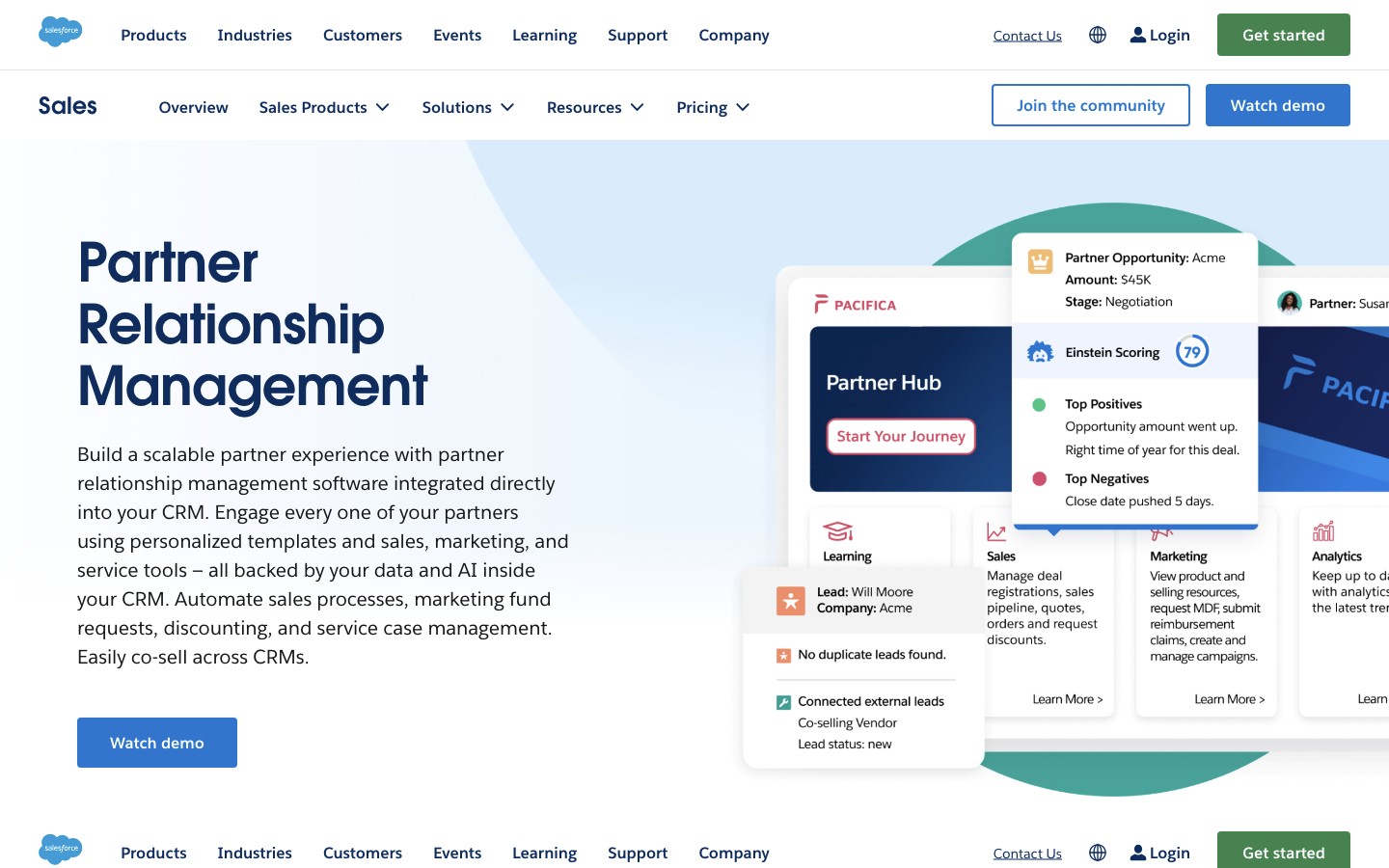
Salesforce PRM is Salesforce’s partner relationship management product — a branded, self-service partner portal and channel-workflow layer built natively on the Salesforce platform (Experience Cloud, sitting on Sales Cloud). It lets channel partners register deals, take leads, complete training, grab marketing assets, and track their pipeline, while your internal team manages all of that partner activity inside the same CRM they already use. Salesforce now markets it as Salesforce Partner Cloud, but the capability — and what buyers still search for — is PRM. The defining fact about it: it is not a standalone tool. It runs on, requires, and only makes sense on top of Salesforce.
Full disclosure: PartnerPortal publishes this guide, and PartnerPortal is a Salesforce PRM alternative. We’ve worked to keep this a fair, accurate overview built from Salesforce’s own documentation and pricing, public company records, and verified third-party reviews — not a hit piece. Where we mention PartnerPortal, we flag it plainly.
TL;DR: Salesforce PRM (now Partner Cloud) is the native-to-Salesforce way to run a partner program — a partner portal on Experience Cloud with deal registration, lead distribution, channel analytics, and, on the higher tier, partner enablement, incentives, and AI (Einstein and Agentforce). Its great strength is that partners and your internal team share one system of record: no syncing a bolt-on portal back to your CRM every night. Its trade-offs are equally clear — it requires an underlying Sales Cloud Enterprise (or higher) license, the advertised $25–$50/member/month is only a fraction of the real cost (implementation, admin/dev expertise, and maintenance dominate), and it carries a steep learning curve that usually means an implementation partner. It reviews around 4.3/5 on G2 across 230+ reviews. If you already live in Salesforce and have the resources to build it, it’s the obvious choice; if you don’t run Salesforce, it’s the wrong tool.
What is Salesforce PRM?
Salesforce PRM is the partner-facing extension of Salesforce’s CRM. Where Sales Cloud manages your internal reps’ pipeline, PRM opens a controlled slice of that same platform to external channel partners through a branded portal, so resellers, distributors, and referral partners can self-serve: register a deal, accept a routed lead, complete onboarding and training, pull co-branded marketing assets, request market development funds, and watch their own pipeline and payouts.
The distinguishing idea is one system of record. Most PRMs are separate applications that must integrate with — and continuously sync back to — your CRM. Salesforce PRM has nothing to sync: the partner portal and your internal CRM are the same database, the same objects (leads, opportunities, accounts), the same reporting engine. For a Salesforce-centric company, that eliminates an entire class of integration headaches and gives leadership a single, real-time view of partner-sourced pipeline alongside direct pipeline.
The catch is the flip side of that same fact. Because it is Salesforce, it inherits Salesforce’s economics and complexity: you need an underlying Sales Cloud org, Salesforce admin/developer skills, and — in practice — an implementation project to turn the raw platform into a working partner program.
Salesforce PRM, Partner Cloud, Partner Community & Partner Central
Salesforce’s naming here trips up nearly every buyer, so it’s worth being precise. These are not competing products — they’re layers and labels for the same thing:
- Salesforce PRM — the long-standing, generic name for Salesforce’s partner relationship management capability. Still the dominant search term.
- Salesforce Partner Cloud — the current umbrella brand Salesforce markets the offering under, positioned as a complete “partner ecosystem management” platform.
- Partner Community — the license type that grants external partner users access to CRM data (leads, opportunities, accounts) through Experience Cloud.
- Partner Central — the out-of-the-box Experience Cloud site template purpose-built for channel-sales portals (deal registration, lead distribution, MDF, training, co-branded collateral).
- Experience Cloud — the underlying Salesforce platform (formerly Community Cloud) for building any branded external site; PRM is the partner-specific configuration of it.
The practical takeaway: if you’re comparing “Salesforce PRM,” “Partner Cloud,” or “Partner Community,” you’re comparing one approach — running your partner program natively on Salesforce. The differences are packaging and licensing, not fundamentally different products.
Company background
Salesforce needs little introduction, but the relevant facts frame what PRM is and isn’t:
- Salesforce, Inc. was founded in 1999 by Marc Benioff and is headquartered in San Francisco. It is the largest CRM vendor in the world (NYSE: CRM), with tens of billions in annual revenue and a vast ecosystem of consulting partners, ISVs, and the AppExchange.
- PRM is a product line, not the company’s focus. Partner management is one capability among hundreds across Sales Cloud, Service Cloud, Marketing Cloud, Data Cloud, Slack, Tableau, and now Agentforce. That breadth is a strength (everything connects) and a caution (partner management competes for roadmap attention against much larger product lines).
- Experience Cloud heritage. The portal technology under PRM has evolved through several names — Salesforce Communities, then Community Cloud, now Experience Cloud — and continues to move toward modern Lightning Web Runtime (LWR) sites and, increasingly, AI-agent-driven experiences.
- Partner-led by design. Salesforce’s own go-to-market runs heavily through implementation partners, which is why most PRM deployments are built with an SI rather than configured solo.
The practical takeaway: you’re buying from the category’s biggest, most stable vendor with effectively unlimited platform depth — but you’re buying a configurable platform capability, not a turnkey partner app, and the surrounding ecosystem (partners, admins, developers) is part of the real purchase.
How Salesforce positions its PRM
Salesforce positions Partner Cloud as the “complete partner ecosystem management platform, backed by the Salesforce CRM” — the way to manage every stage of the partner journey, from recruiting and enablement through co-selling and incentives, on one unified platform. Its messaging leans on:
- Native to your CRM. The headline pitch: partner activity and internal pipeline live in one system of record, not a bolted-on portal synced back nightly. This is the single most-repeated selling point.
- Drag-and-drop, brandable experiences. Experience Cloud templates let you build partner portals that look like an extension of your brand and pull in any CRM data or automation.
- AI-powered. Einstein deal scoring, next-best-action, and Pipeline Inspection, plus Agentforce autonomous agents that can handle routine partner-portal tasks — positioned as a major 2026 differentiator.
- One platform, many clouds. Because it’s Salesforce, PRM connects to Service Cloud (partner self-service), CPQ/Commerce (partner ordering and quoting), Marketing Cloud, and Loyalty/Rebate Management for incentives.
Who it targets: mid-market and enterprise companies that already run Salesforce and want their channel program on the same platform — technology, manufacturing, financial services, and other Salesforce-heavy sectors with structured, multi-tier partner ecosystems.
Salesforce PRM’s key features
Salesforce PRM covers the full channel-management surface, with depth that scales as far as your configuration (and budget) will take it. The capabilities that define it:
Partner portal & experience
Built on Experience Cloud, the partner portal is a branded, secure, self-service site where partners log in with SSO and do everything in one place. The Partner Central template gives channel programs a purpose-built starting point; drag-and-drop tools and (increasingly) LWR sites let admins pull in any CRM data, automation, or Flow. Delegated administration lets partner-org admins manage their own users, and tiered access, account hierarchies, and sharing sets control exactly what each partner sees.
Deal registration & lead management
This is the core channel-sales workflow, and it’s where being native pays off: partners register deals and accept routed leads directly against your CRM’s standard Lead and Opportunity objects, with no sync lag. Sales teams see partner-sourced pipeline in the same views as direct pipeline. Pipeline Inspection and shared, real-time dashboards give partners visibility into which deals to focus on, and Partner Connect lets teams co-sell across separate CRMs while keeping data integrity between partner and vendor.
Enablement, incentives & loyalty
On the higher Partner Ecosystem Management tier, Salesforce adds Partner Tracks — outcome-based enablement journeys that guide and motivate partners through onboarding and certification — plus incentive programs built on Salesforce’s Loyalty and Rebate Management, so you can run credits, referrals, rebates, and structured incentives inside the partner experience. Account Plans for Partners support joint planning. Partner self-service (knowledge, cases, bots, live agents) comes via Service Cloud for Partners.
AI: Einstein & Agentforce
Salesforce leans hard on AI here. Einstein supplies opportunity scoring, next-best-action recommendations, and Pipeline Inspection so partners can prioritize the deals most likely to close. In 2026, Agentforce — Salesforce’s autonomous AI agents — can be embedded in partner portals to triage deal registrations, answer partner questions, and take routine actions, part of Salesforce’s broader push from “a site you visit” toward “an agent you converse with.”
Channel marketing & MDF
PRM includes channel-marketing tooling: preset campaigns, co-branding tools, and content libraries (via Salesforce CMS) so partners can market faster, plus market development fund (MDF) request and claim workflows — surfaced through objects like PartnerFundRequest and PartnerFundClaim — with automated approvals that connect marketing spend to CRM outcomes.
Full feature list
Beyond the highlights above, Salesforce PRM / Partner Cloud includes:
- Branded partner portal on Experience Cloud with SSO and the Partner Central template
- Delegated administration, tiered partner access, account hierarchies, and role-based permissions
- Deal registration and lead distribution/routing against native Lead/Opportunity objects
- Partner Connect — cross-CRM co-selling and deal sync
- Pipeline Inspection and shared CRM dashboards/reports for partners
- Partner Tracks enablement journeys, onboarding, and certification (PEM tier)
- Incentives via Loyalty & Rebate Management; B2B Referral Management (PEM tier)
- Account Plans for Partners (PEM tier)
- MDF request/claim workflows with automated approvals
- Channel marketing — preset campaigns, co-branding, Salesforce CMS content libraries
- Partner self-service via Service Cloud for Partners (knowledge, cases, bots)
- Einstein AI (opportunity scoring, next-best-action) and Agentforce agents
- Channel analytics and custom reporting on the Salesforce platform
- Extensibility — custom objects, APIs, Flow automation, AppExchange add-ons
Integrations
Salesforce PRM’s integration story is unusual, because the CRM is Salesforce itself. There’s nothing to connect on your side — the portal and your CRM are one platform. That’s the strength and the constraint:
| Category | Native support | Notes |
|---|---|---|
| Your CRM | Salesforce (required) | PRM is Salesforce. It runs on a Sales Cloud Enterprise Edition (or higher) org and uses standard Salesforce objects — the tightest possible “integration” because it’s the same system. |
| Partner-side CRMs | Partner Connect | Co-sell and sync deals with partners who run their own separate CRMs, keeping data integrity across organizations. |
| Other CRMs (HubSpot, Pipedrive, Zoho, Attio) | Not applicable | There is no native HubSpot/Pipedrive/Zoho/Attio integration because the product is the Salesforce platform. Running Salesforce PRM means running Salesforce. |
| Other Salesforce clouds | Native | Service Cloud (partner self-service), CPQ/Commerce (partner ordering), Marketing Cloud, Loyalty & Rebate Management, Slack, Data Cloud — all connect natively. |
| Everything else | AppExchange & APIs | The Salesforce ecosystem’s APIs, MuleSoft, and thousands of AppExchange apps extend it further. |
The key evaluation point: if Salesforce is already your CRM, this is the tightest integration on the market — because it isn’t an integration at all. If your CRM is HubSpot, Pipedrive, Zoho, or Attio, Salesforce PRM effectively asks you to adopt Salesforce, which is a different and much larger decision. In that case, look at PRMs built to sit on top of your existing CRM (see our guides to the best PRM for Pipedrive, best PRM for Zoho, and best PRM for Attio).
Salesforce PRM pricing
Salesforce is one of the few PRMs to publish per-user list pricing — but that transparency is deceptive, because the sticker price is a small part of the real cost. As of 2026, the two partner licensing editions are:
| Edition | List price | What’s included |
|---|---|---|
| Partner Relationship Management | $25/member/month (billed annually) | Experience Cloud portal, deal management, channel analytics — the core PRM |
| Partner Ecosystem Management (PEM) | $50/member/month (billed annually) | Everything in PRM plus partner enablement (Partner Tracks), incentives/loyalty, B2B referrals, and account plans |
Both editions also offer login-based pricing (priced per login rather than per named member) for programs with many infrequent partner users. But the license fee is only the visible tip:
- You need an underlying Sales Cloud org. PRM requires Sales Cloud Enterprise Edition or above for your internal team — a separate, per-user license (commonly $165/user/month for Enterprise) before any partner licenses are added.
- Implementation is a project, not a signup. Because the portal is configured on the platform, most companies engage a Salesforce implementation partner. Build costs commonly run from the low five figures to well into six figures depending on scope and customization.
- Ongoing admin/developer cost. Keeping a Salesforce PRM running well requires in-house admin (and often developer) time or a retained partner — an ongoing line item lightweight PRMs don’t carry.
- Add-on clouds cost extra. Service Cloud for Partners, CPQ/Commerce, Loyalty & Rebate Management, and premium Einstein/Agentforce capabilities are separately licensed.
The honest read: the “$25/member” headline makes Salesforce PRM look inexpensive, but all-in cost for a real mid-sized program typically lands in the high five to six figures a year once the base CRM, implementation, and maintenance are counted. Teams weighing cost should compare against our most affordable PRM software roundup, where standalone PRMs with published, all-in pricing sit far lower. Always confirm current numbers directly with Salesforce.
What users say: Salesforce PRM reviews
Salesforce PRM is well-reviewed for an enterprise platform. On G2, Salesforce Partner Relationship Management holds roughly 4.3 out of 5 across 230+ reviews.
What reviewers consistently praise:
- Native Salesforce integration — the single most-cited strength: partners and internal teams on one system of record, real-time and sync-free.
- Reporting and dashboards — Salesforce’s reporting engine scores highly (around 9.0 on G2); channel analytics are deep and customizable.
- Role-based permissions — granular, enterprise-grade control over what partners and internal users can see and do.
- Scalability and extensibility — it scales to large, multi-tier ecosystems, and custom objects, Flow, and AppExchange extend it almost without limit.
Common critiques:
- Cost — the true, all-in cost (base CRM + implementation + maintenance) is high, and reviewers say so.
- Implementation complexity — standing it up is a project; many note it needs a partner or seasoned admin.
- Steep learning curve — it assumes Salesforce fluency; teams without it struggle.
- Support — quality-of-support scores (around 8.3) trail more focused PRM vendors whose whole business is partner management.
Read the reviews yourself: Salesforce PRM on G2.
Where Salesforce PRM is limited
No tool fits everyone. Salesforce PRM’s honest limits:
- Salesforce-only. It requires — and effectively is — Salesforce. No native path if your CRM is HubSpot, Pipedrive, Zoho, or Attio.
- The real cost is high and multi-line. Per-member licenses are the smallest piece; base CRM, implementation, and ongoing admin dominate.
- Complex to implement and run. Expect an implementation partner and ongoing Salesforce expertise; it’s not a self-serve setup.
- Steep learning curve. Admins and partners without Salesforce familiarity face a real ramp.
- Overkill for lean programs. A first or small partner program rarely needs (or can justify) this much platform.
Who Salesforce PRM is best for
Salesforce PRM is a strong fit if you’re:
- Already standardized on Salesforce and want partner activity in the same system of record as direct sales.
- A mid-market or enterprise company with structured, multi-tier channels and the budget and Salesforce resources to build and maintain a configured platform.
- In need of deep reporting, granular permissions, and heavy customization, and you value one platform across sales, service, and marketing.
- Investing in Salesforce AI (Einstein, Agentforce) and want partner workflows to ride the same roadmap.
Salesforce PRM is probably not the right fit if you:
- Run your CRM on HubSpot, Pipedrive, Zoho, or Attio and don’t want to adopt Salesforce.
- Are launching a first or lean partner program and want the lowest cost, published all-in pricing, or a fast, self-serve setup.
- Lack in-house Salesforce expertise and don’t want to fund an implementation partner.
- Want a tool that’s purpose-built for partner management rather than a platform capability you configure.
Salesforce PRM alternatives
Teams look past Salesforce PRM for one of two reasons — and they point at different shortlists:
- You’re committed to Salesforce but want deeper channel features. The native product is capable, but specialized enterprise PRMs layer richer partner-management depth on top of a Salesforce org: Impartner, Channelscaler (Allbound), ZINFI, and Magentrix are the usual peers, each with strong Salesforce integration and channel features Salesforce’s own PRM doesn’t ship out of the box.
- The platform is too heavy, too costly, or you don’t run Salesforce. If the real issue is time-to-launch, cost, or CRM fit, step to a modern standalone PRM: PartnerPortal (that’s us, disclosed), Kiflo, or JourneyBee. These launch in days rather than a quarter, publish their pricing, and connect natively to CRMs Salesforce PRM can’t touch. PartnerPortal specifically adds native HubSpot, Salesforce, Pipedrive, Zoho, and Attio support, a permanently free tier, and a top plan priced at or below what rivals charge to start — with no implementation project.
For the wider landscape:
- Best PRM software in 2026 — every major PRM ranked, Salesforce PRM included.
- Impartner PRM and Channelscaler PRM — deep dives on the closest enterprise, Salesforce-friendly peers.
- Kiflo PRM, JourneyBee PRM, and Introw PRM — deep dives on the lighter-weight standalone alternatives.
Related reading
- Partner Relationship Management Platforms: Compare the Market — how the whole PRM landscape is structured.
- Best PRM Software in 2026 — the full category comparison.
- Most Affordable PRM Software in 2026 — PRMs ranked by real cost, including hidden fees.
- Best PRM for Pipedrive, Zoho, and Attio — the right PRM when your CRM isn’t Salesforce.
Not on Salesforce, or want a partner program live this week instead of next quarter? Start a free PartnerPortal portal or browse native CRM integrations.
Frequently asked questions
What is Salesforce PRM (Partner Cloud)?
Salesforce PRM is Salesforce's partner relationship management product — a partner-facing portal and channel-workflow layer built natively on the Salesforce platform (Experience Cloud on top of Sales Cloud). It gives channel partners a branded, self-service portal to register deals, pick up leads, complete training, access marketing assets, and see their pipeline, while your internal team works that partner activity in the same CRM as the rest of the business. Salesforce now markets the product as Salesforce Partner Cloud; the underlying capability is still partner relationship management. It is not a standalone app — it runs on, and requires, Salesforce.
Is Salesforce PRM the same as Partner Cloud, Partner Community, or Partner Central?
Effectively yes — they are different names and layers for the same idea. Salesforce Partner Cloud is the current umbrella brand for Salesforce's partner-management offering. Partner Community is the license that gives external partner users access to CRM data. Partner Central is the out-of-the-box Experience Cloud site template for channel-sales portals. Older material calls the whole thing Salesforce PRM. If you are evaluating any of these, you are evaluating the same native-to-Salesforce approach to running a partner program.
How much does Salesforce PRM cost?
Salesforce publishes two partner licensing editions: Partner Relationship Management at $25 per member per month and Partner Ecosystem Management (PEM) at $50 per member per month, both billed annually, with login-based pricing available as an alternative for infrequent partner users. But that per-member figure is not the real cost. Salesforce PRM requires an underlying Sales Cloud Enterprise Edition (or higher) org for your internal team, and because the portal is highly configurable it almost always involves an implementation partner and ongoing admin/developer work. Real all-in cost for a mid-sized program typically runs well into five or six figures a year once licenses, implementation, and maintenance are counted.
Do I need Salesforce to use Salesforce PRM?
Yes. Salesforce PRM / Partner Cloud is not a standalone product — it is a layer on the Salesforce platform and requires a Sales Cloud Enterprise Edition org (or above) as its foundation. That is the whole point of it: your partner portal shares one system of record with your internal sales, service, and marketing. If you do not already run Salesforce (or are not prepared to adopt it), a purpose-built standalone PRM that connects to your existing CRM will be far faster and cheaper to stand up.
Which CRMs does Salesforce PRM work with?
Salesforce PRM's CRM is Salesforce itself — that is its native and only system of record. There is no native integration for HubSpot, Pipedrive, Zoho, or Attio, because the product is the Salesforce platform. Partner Connect can sync and co-sell deals across partners who run their own separate CRMs, but your side of the program lives in Salesforce. If your company runs a non-Salesforce CRM, Salesforce PRM is the wrong fit; choose a PRM that integrates natively with your CRM instead.
Is Salesforce PRM any good? What do reviews say?
It reviews well for what it is. On G2, Salesforce Partner Relationship Management holds roughly 4.3 out of 5 across 230+ reviews. Reviewers praise the deep native Salesforce integration (one system of record for partners and internal teams), strong reporting and dashboards, granular role-based permissions, and enterprise scalability. The consistent criticisms are cost, implementation complexity, and a steep learning curve — you generally need Salesforce expertise (in-house or a partner) to configure and maintain it, and support scores trail more focused PRM vendors.
What are the best Salesforce PRM alternatives?
It depends on why it does not fit. If you are committed to Salesforce and want deeper channel features than the native product, enterprise PRMs that integrate tightly with Salesforce — Impartner, Channelscaler (Allbound), ZINFI, and Magentrix — are the usual peers. If the real problem is that Salesforce PRM is too heavy, too expensive, or you do not run Salesforce at all, a standalone modern PRM such as PartnerPortal, Kiflo, or JourneyBee launches in a fraction of the time, publishes its pricing, and connects natively to CRMs like HubSpot, Pipedrive, Zoho, and Attio — no Salesforce license or implementation project required.