
JourneyBee PRM: Features, Pricing & Reviews (2026)
An in-depth guide to JourneyBee PRM — the AI-native, CRM-agnostic platform: its features, CRM integrations, pricing, real user reviews, and the best alternatives.
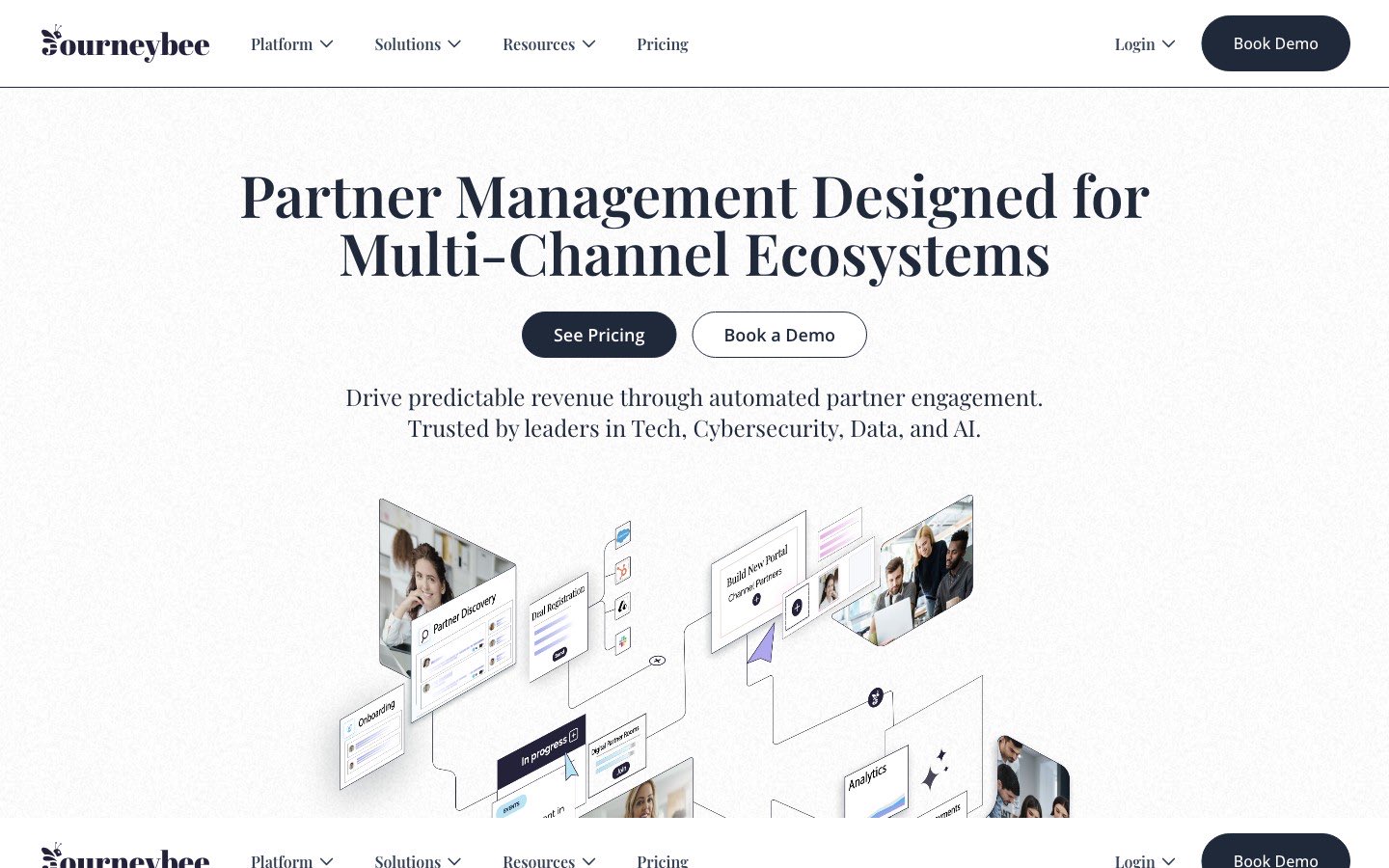
JourneyBee is a modern partner relationship management (PRM) platform — built for B2B SaaS, cybersecurity, and AI companies — that centralizes partner onboarding, a branded partner portal, deal registration, commissions, training, and co-marketing, and syncs it all into your CRM. Founded in Stockholm in 2023, it markets itself as the “AI-native, CRM-agnostic” PRM, built around a headless architecture that lets partners work from Slack, Teams, or email instead of logging into yet another portal. This page focuses on that off-portal/AI pitch, the built-in LMS with quizzes, MDF and two-tier distribution, XTRM payouts, and the maturity trade-offs of a 2023 bootstrapped product.
Full disclosure: PartnerPortal publishes this guide, and PartnerPortal is a JourneyBee competitor. We’ve worked hard to keep this a fair, accurate overview built from JourneyBee’s own materials, its help center, public company records, and verified third-party reviews — not a hit piece. Where we mention PartnerPortal, we flag it plainly.
TL;DR: JourneyBee is one of the most ambitious of the modern SMB/mid-market PRMs. Its differentiators are a genuine AI focus (the Buzz agent, AI-assisted LMS), a headless / “off-portal” model that pushes deal registration into Slack, Teams, and email, broad native CRM coverage (Salesforce, HubSpot, Pipedrive, Attio), a built-in partner LMS with certifications, MDF and two-tier distributor management, and dual SOC 2 Type 2 + ISO 27001 security. Pricing is flat with unlimited partners on every plan (entry around $499/month). The main trade-off is maturity: JourneyBee is a very young, small company (founded 2023) with a thin public review base (~4.7/5 across ~25 G2 reviews), so it’s less proven at scale than longer-established platforms.
What is JourneyBee?
JourneyBee is the Stockholm-built, AI-and-headless PRM aimed at SaaS, cybersecurity, and AI companies that hate portal fatigue. The product still includes a branded, customizable partner portal, but the design thesis is that partners should register deals, share leads, and request MDF from Slack, Microsoft Teams, or email — with the portal as one surface among several.
That headless bet sits next to a surprisingly full mid-market feature set for a 2023 product: built-in LMS with quizzes and certifications, MDF, two-tier distribution, and Buzz (its AI agent). The trade-off evaluators keep coming back to is maturity — thin public review volume, inconsistent published pricing, and XTRM as the payout rail — not missing core modules.
Company background
JourneyBee is an independent, early-stage startup based in Stockholm, Sweden. Key facts, drawn from public records and JourneyBee’s own materials:
- Founded: 2023 — JourneyBee is a genuinely new entrant, not a repositioned legacy tool.
- Headquarters: Stockholm, Sweden, with co-founders and team members also based in Poland.
- Founders: Fredrik Mellander (CEO), who built and scaled partner ecosystems at high-growth companies such as Teamtailor before founding JourneyBee, alongside co-founders Haydn and Zuzanna.
- Team size: very small — public sources put it in the single digits to low teens.
- Funding: public sources report no external funding (bootstrapped). Treat this as a directional signal rather than a confirmed financial statement.
- Security: notably for a company this young, JourneyBee holds dual SOC 2 Type 2 and ISO 27001 certifications, and markets itself as one of only a handful of PRM vendors with both.
The practical takeaway: JourneyBee is an ambitious, fast-moving, security-conscious young product with a small founding team. For buyers who want to bet on a modern, AI-forward roadmap, that’s appealing; for those who need a long track record and a large reference base, the youth and size are the main things to weigh.
How JourneyBee positions itself
JourneyBee’s messaging is consistently anti-legacy-PRM. It frames traditional PRMs (and Salesforce PRM in particular) as static “digital rolodexes” — monolithic systems where, if a partner doesn’t log in, the data doesn’t move. JourneyBee’s counter-positioning has a few pillars:
- Headless, off-portal by design. Rather than forcing partners into a website, JourneyBee delivers deal registration, lead sharing, and MDF requests where partners already work — Slack, Teams, and email — while keeping a modern portal UI for deeper tasks. The pitch is to fight “portal fatigue” and drive daily partner engagement.
- AI-native. JourneyBee leans harder into AI than most PRMs, centered on its Buzz agent (below). It describes itself as building “the world’s first AI-native, CRM-agnostic PRM.”
- CRM-agnostic or standalone. It offers deep two-way sync with several CRMs but can also run entirely on its own as a system of record — useful for teams without a CRM or with partners a CRM wasn’t built to serve.
- Plug & play. JourneyBee emphasizes setup “in less than a day,” with its engine auto-mapping CRM objects, versus the multi-week “build” phases associated with enterprise PRM.
Who it targets: modern B2B SaaS, cybersecurity, and AI companies that see their partner channel as a high-velocity revenue engine and want automation, personalization, and engagement rather than a filing cabinet.
JourneyBee’s key features
JourneyBee covers the core PRM feature set and layers several less-common capabilities on top. The highlights that define it day-to-day:
Personalized portals & onboarding
JourneyBee’s calling card is hyper-personalized partner portals. A drag-and-drop editor lets you build tailored portal templates for different partner types (resellers, integration partners, and so on), which can be embedded into your own software or your CRM. Onboarding is delivered as an adaptive journey — the system curates the steps and resources each partner sees, so a new partner ramps on only what’s relevant. Reviewers consistently call out onboarding and “journey” flexibility as strengths.
Deal registration & off-portal selling
Deal and lead registration is core PRM functionality, and it’s where JourneyBee’s headless model is most visible. Partners register deals and share leads either in the portal or directly from Slack, Teams, or email — the functionality is decoupled from the interface. Each opportunity is attributed to the submitting partner and, through JourneyBee’s two-way CRM sync, kept in lockstep with your sales team’s system of record. Deal settings are configurable (deal expiration, whether partners can edit deal values, what they can see). Digital deal rooms (“Aligned” rooms) let partners and your team collaborate on a live proposal, share documents, and move a co-sell opportunity forward in one shared space.
Buzz AI & automation
Buzz is JourneyBee’s agentic AI assistant, built on the Model Context Protocol (MCP) and described as model-agnostic — able to draw on models such as Claude, GPT-4o, or Gemini depending on the task, rather than being locked to one provider. JourneyBee positions Buzz as a “24/7 autonomous channel manager” that can help with deal registration, lead routing/matching, building portal and room content (“Build with Buzz”), answering partner questions, and turning product docs into micro-LMS training on new features. Underneath, a rules-based automation engine ties events together — e.g., a completed certification automatically upgrades a partner’s tier, which unlocks a higher commission rate and new marketing assets, and pings their channel manager to schedule a QBR.
Partner LMS & certifications
JourneyBee includes a genuine built-in partner LMS — not just certification tracking. You build courses and learning paths with video and interactive content, group them into onboarding tracks or technical certifications with dependencies, and add quizzes and graded final assessments with configurable passing scores and attempt limits. Partners who pass earn a formal certification and a shareable digital badge. Because the LMS is native to the platform, you can tie certifications directly to deal registration, tier upgrades, and unlocking MDF or higher commissions on completion — and even use generative AI to spin up “micro-LMS” units from product documentation.
Commissions, incentives & MDF
JourneyBee automates partner commissions with a rules-based engine: percentage-based revenue share, tiered commissions, flat-fee referral bonuses, recurring affiliate commissions, and performance bonuses. When a deal is marked closed-won in your CRM, JourneyBee calculates the payout by tier and rules and generates a payment record; payouts run through its integrated provider, XTRM (a manual-payment-tracking module also exists for payments made outside the platform). Rewards can be paid to the partner company (commission) or to an individual person (SPIFF). On top of commissions, JourneyBee offers MDF (market development funds) management — tiered budgets, customizable approval workflows, claims, and closed-loop ROI attribution pulled back from your CRM.
Full feature list
Beyond the highlights above, JourneyBee includes:
- Branded, embeddable partner portal with a drag-and-drop template editor (white-label, custom domain)
- Adaptive partner onboarding journeys and automated workflows
- Partner directory and partner recruitment
- Lead sharing and deal registration, on- or off-portal (Slack, Teams, email)
- Digital sales rooms (deal rooms) and co-marketing campaign rooms
- Buzz AI agent (MCP-native, model-agnostic) for deal reg, lead matching, content, and support
- Built-in partner LMS with courses, learning paths, quizzes, assessments, and certifications with digital badges
- Commission automation with revenue share, tiered, flat-fee, recurring, and SPIFF (individual) payouts
- Partner payouts via XTRM, plus manual payment tracking
- MDF management with tiered budgets, approval workflows, and ROI attribution
- Two-tier distributor management (distributor oversees a network of resellers)
- Real-time CRM and product-usage data sync; partner scoring and multi-touch attribution
- Announcements, direct messaging, and updates (works standalone, no CRM required)
- Reporting, analytics, and KPIs
- Multi-tenant accounts (higher tiers) and role-based access
- Dual SOC 2 Type 2 + ISO 27001 security
Integrations
Integrations are central to JourneyBee’s story, since it positions itself as CRM-agnostic and API-first.
| Category | Native integrations | Notes |
|---|---|---|
| CRM | Salesforce, HubSpot, Pipedrive, Attio | Deep, two-way (bi-directional) sync. Broader native CRM coverage than most SMB PRMs. |
| Other CRMs | Zoho (integration guide available); others via API | A Zoho integration is documented in the help center; the API supports further connections. |
| No CRM | Standalone mode | JourneyBee can run entirely on its own as a system of record for partner deals. |
| Communication | Slack, Microsoft Teams, Gmail, Outlook | Powers the “off-portal” registration and collaboration model. |
| Payments | XTRM | Integrated partner-payout provider; recipients register with XTRM to receive payouts. |
| Everything else | REST API | API-first design for custom and long-tail connections. |
The key evaluation point: JourneyBee’s native CRM breadth is a genuine strength — Salesforce, HubSpot, Pipedrive, and Attio all get two-way sync (with Zoho documented as well), where many SMB PRMs are native with only HubSpot and Salesforce. If your CRM is Pipedrive or Attio, that’s meaningful. Two things to confirm for your setup: partner payouts run through XTRM specifically (rather than paying directly from Stripe/PayPal), and some capabilities are gated to paid plans. (For the full landscape by CRM, see our guides on the best PRM for Pipedrive, best PRM for Zoho, and best PRM for Attio.)
JourneyBee pricing
JourneyBee is one of the PRMs that publishes pricing, and its model has a distinctive twist: unlimited partners on every plan. You’re billed by internal-user tier, not by partner count, so growing your ecosystem doesn’t raise your bill — JourneyBee frames this as avoiding the per-partner “success tax” of some competitors.
| Plan | Price | Includes |
|---|---|---|
| Standard | ~$499/month | Up to 3 internal users, unlimited partners, all integrations, white-label & security |
| Premium | Custom / higher | Everything in Standard, plus unlimited users, deeper automations, and multi-tenant accounts |
| Enterprise | Custom | Everything in Premium, plus priority support, a dedicated success manager, and custom integrations |
A few pricing details worth understanding:
- Priced by internal users, not partners. Every tier includes unlimited partners; you scale by how many of your own people need access.
- Published figures vary by page. JourneyBee’s own pages cite different anchors — the pricing page shows an entry around $499/month (also quoted as €499), while other pages reference $299 entry and $799 starting points, and a “most popular” tier around $1,000–$1,500/month. Confirm current numbers directly.
- Free implementation and integrations are advertised as included, which reduces the hidden setup/onboarding fees common with enterprise PRM.
Always confirm current numbers on JourneyBee’s own pricing page; PRM pricing changes and the published tiers are inconsistent across their site. Teams optimizing purely for cost should also compare against our most affordable PRM software roundup.
What users say: JourneyBee reviews
JourneyBee is well-rated, but its review base is young and thin — a direct consequence of being a 2023 startup. The most substantial signal is G2, where it holds roughly 4.7 out of 5 across about 25 reviews. JourneyBee also advertises a 4.8 rating on Gartner Peer Insights, and has a small number of reviews on the HubSpot marketplace; coverage on TrustRadius and SourceForge is minimal. Treat the ratings as encouraging but early.
What reviewers consistently praise:
- Journey and automation flexibility — the personalized onboarding/journey model is a standout theme.
- Improved partner onboarding and engagement versus static portals.
- Fast implementation — live in days, consistent with the “plug & play” pitch.
- Responsive, hands-on support from a small, motivated team.
- Security posture — dual SOC 2 Type 2 + ISO 27001 is called out by more security-conscious buyers.
Common caveats:
- Youth and size. JourneyBee is new (2023) and small, with a much smaller installed base and review corpus than established PRMs — the biggest single consideration for risk-averse buyers.
- Breadth vs. depth. It’s an ambitious platform (AI, LMS, MDF, distribution, deal rooms) for a tiny team; depth in any one module may be less battle-tested than a specialist tool.
- Feature gating and managed features. Some capabilities (for example, distributor/two-tier management) are “managed by JourneyBee” and must be enabled by their team rather than self-served.
Read the reviews yourself: JourneyBee on G2 and the JourneyBee HubSpot marketplace listing.
Where JourneyBee is limited
No tool fits everyone. JourneyBee’s honest limits — most of which follow from it being a very new, small company:
- Track record and scale. Founded in 2023 with a small team and a thin review base, it’s less proven at scale than longer-established platforms.
- Ambition vs. maturity. The feature surface is wide (AI, LMS, MDF, distribution); some modules will be newer and less hardened than dedicated point tools.
- Payouts via XTRM. Partner payouts flow through a specific provider (XTRM), and recipients must register with it — worth checking against your finance/payment preferences.
- Managed / gated features. Distributor (two-tier) management is enabled by JourneyBee rather than self-serve, and some integrations require higher plans.
- Pricing clarity. Entry pricing (~$499/month) is higher than the cheapest SMB tools, and the published figures are inconsistent across JourneyBee’s own pages.
Maturity, pricing opacity, and XTRM lock-in are the usual exit themes — expanded on our JourneyBee alternatives guide.
Who JourneyBee is best for
JourneyBee is a strong fit if you’re:
- A modern B2B SaaS, cybersecurity, or AI company treating your channel as a growth engine.
- Running a diverse ecosystem — resellers, distributors, ISVs, SIs, agencies, MSPs/MSSPs — not just one motion.
- Keen on AI automation and off-portal engagement (Slack/Teams/email) to fight portal fatigue.
- In need of a built-in partner LMS with certifications, MDF, and/or two-tier distribution in one platform.
- On Pipedrive or Attio (or wanting CRM-agnostic/standalone flexibility) and want native two-way sync.
- Reassured by strong security certifications (SOC 2 Type 2 + ISO 27001).
JourneyBee is probably not the right fit if you:
- Want the lowest possible entry price or a permanently free tier.
- Need a long, proven track record and a large reference base before you commit.
- Run a simple, single-motion referral program that doesn’t need the AI/LMS/deal-room breadth (it may be more platform than you need).
- Require partner payouts through a specific gateway other than XTRM.
JourneyBee alternatives
Leaving JourneyBee usually means you’re trading AI / headless ambition for maturity, price transparency, or payout flexibility — not looking for a totally different product category. Closest peers: PartnerPortal, Kiflo, and Introw (with PartnerStack / Impartner / ZINFI up-market).
PartnerPortal (that’s us — stated plainly) is the most common like-for-like contrast: overlapping CRM breadth (HubSpot, Salesforce, Pipedrive, Zoho, Attio) and a built-in LMS, plus a free tier, lower paid entry, and multi-currency payouts that don’t require XTRM. JourneyBee keeps the edge on Buzz AI, off-portal Slack/Teams flows, MDF, two-tier distribution depth, and SOC 2 Type 2 + ISO 27001. Choose based on whether AI/headless and MDF outweigh tenure and pricing clarity.
For the full head-to-head and the wider field, see:
- JourneyBee alternatives — the full list of alternatives and how they compare.
- JourneyBee vs PartnerPortal — the direct, feature-by-feature comparison.
- Kiflo PRM — a deep dive on another close, SMB-focused competitor.
- Best PRM software in 2026 — every major PRM ranked, not just JourneyBee’s closest peers.
Related reading
- Best PRM Software in 2026 — the full category comparison.
- Partner Relationship Management Platforms: Compare the Market — how the whole landscape is structured.
- Most Affordable PRM Software in 2026 — PRMs ranked by real cost, including hidden fees.
- Best PRM for Pipedrive, Zoho, and Attio — native-vs-Zapier by CRM.
- Why You Should Integrate Your CRM and PRM — why native CRM integration matters.
Comparing JourneyBee’s AI/headless pitch to a longer-running PRM? Try PartnerPortal free or review CRM integrations.
Frequently asked questions
What is JourneyBee?
JourneyBee is a modern partner relationship management (PRM) platform for B2B SaaS, cybersecurity, and AI companies. It positions itself as an 'AI-native, CRM-agnostic' PRM built around a headless architecture: partners can register deals and collaborate from Slack, Microsoft Teams, or email without logging into a portal. Beyond core PRM (branded portals, deal registration, commissions), it includes a built-in partner LMS with certifications, MDF management, digital sales rooms, two-tier distributor management, and an agentic AI assistant called Buzz. It offers native two-way sync with Salesforce, HubSpot, Pipedrive, and Attio, and can also run standalone without a CRM.
Who owns JourneyBee and where is it based?
JourneyBee is an independent software startup headquartered in Stockholm, Sweden, founded in 2023. It was co-founded by Fredrik Mellander (CEO), who previously built partner ecosystems at high-growth companies like Teamtailor, alongside co-founders based in Poland. It is a small, early-stage team that public sources report as bootstrapped with no external funding. Despite its size, JourneyBee holds dual SOC 2 Type 2 and ISO 27001 security certifications.
How much does JourneyBee cost?
JourneyBee publishes pricing, and its entry Standard plan is around $499/month for up to 3 internal users with unlimited partners, all integrations, and white-label. Higher tiers (Premium and Enterprise) add unlimited users, deeper automations, multi-tenant accounts, priority support, a dedicated success manager, and custom integrations. Its defining pricing choice is unlimited partners on every plan — you're billed by internal user tier, not per partner. Note that different JourneyBee pages cite different entry anchors (figures from $299 to $799 appear), so confirm current pricing on their site.
Which CRMs does JourneyBee integrate with?
JourneyBee offers native, two-way integrations with Salesforce, HubSpot, Pipedrive, and Attio (with a Zoho integration also available per its help center). This is broader native CRM coverage than most SMB PRMs. JourneyBee can also operate as a standalone system with no CRM at all, acting as its own system of record for partner deals. It further connects to Slack, Microsoft Teams, Gmail, and Outlook for off-portal workflows, and uses XTRM as its integrated partner-payout provider.
Does JourneyBee have AI features?
Yes — AI is central to JourneyBee's positioning. Its Buzz AI agent is built on the Model Context Protocol (MCP) and is model-agnostic (able to draw on models like Claude, GPT-4o, or Gemini depending on the task). Buzz assists with deal registration, lead routing and matching, generating portal and training content ('Build with Buzz'), and turning product documentation into modular micro-LMS units and quizzes. This heavier AI investment is one of the clearest ways JourneyBee differentiates from more traditional PRMs.
Does JourneyBee have a partner LMS and certifications?
Yes. JourneyBee includes a built-in partner LMS: you build courses and learning paths with video and interactive content, add quizzes and graded final assessments, set passing scores and attempt limits, and track partner progress. Partners who pass earn a formal certification and a shareable digital badge. Because the LMS is integrated into the wider platform, certifications can be tied to deal registration, tier upgrades, and unlocking MDF or higher commission rates on completion.
Is JourneyBee any good? What do reviews say?
JourneyBee is well-rated but has a young, thin review base. It holds roughly 4.7 out of 5 on G2 across about 25 reviews, and advertises a 4.8 rating on Gartner Peer Insights. Reviewers praise its journey/automation flexibility, improved partner onboarding, fast implementation, and responsive support, and note its dual SOC 2 Type 2 + ISO 27001 security. The main caveats are simply that it's a new, small company (founded 2023) with a much smaller installed base and review corpus than longer-established PRMs.
What are the best JourneyBee alternatives?
The closest alternatives are other modern SMB/mid-market PRMs — PartnerPortal, Kiflo, and Introw — with larger platforms like PartnerStack and enterprise suites such as Impartner and ZINFI above them. PartnerPortal is a direct alternative that shares JourneyBee's broad native CRM coverage (HubSpot, Salesforce, Pipedrive, Attio, plus Zoho) and built-in LMS/certifications, while adding a permanently free tier and a lower entry price. See our dedicated JourneyBee alternatives guide for a full comparison.