
Magentrix vs PartnerPortal (2026): A Side-by-Side Comparison
Magentrix vs PartnerPortal compared — a deeply customizable, CRM-native portal platform vs. a turnkey, broad-CRM PRM. Customization, CRM coverage, LMS, pricing, and reviews to help you choose.
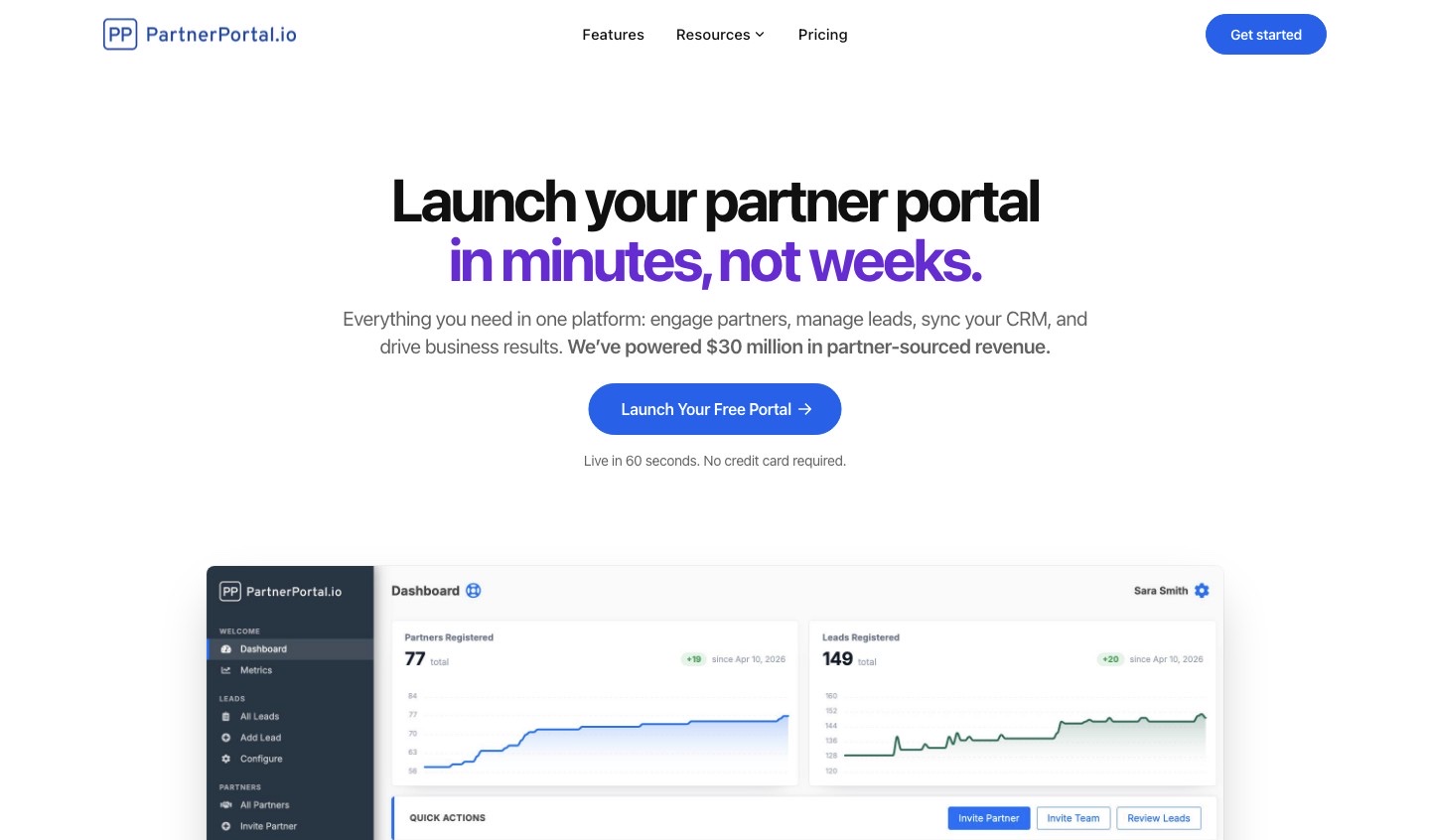
Magentrix is a no-code PaaS that mirrors Salesforce/Dynamics schemas into a moldable portal (plus LMS and MDF). PartnerPortal is turnkey self-serve — five native CRMs, free tier, almost nothing to administer. Opposite operating models for mid-market programs; pick based on whether you want to build or just launch.
Full disclosure: PartnerPortal publishes this comparison, and PartnerPortal is a direct Magentrix competitor. We’ve worked to keep this fair and factual — stating what each tool does and letting you draw the conclusion — rather than steering you toward us. Where the facts favor Magentrix, we say so.
First, a useful signal: the choice usually comes down to turnkey speed vs. deep customization. If you’re a Salesforce or Dynamics shop with an admin or ops resource and you want the portal to mirror your CRM schema — custom objects, layouts, workflows — plus a built-in LMS and MDF, Magentrix is built for that. If you want a partner program running quickly at a low, transparent price with broad CRM coverage, PartnerPortal is built for that. Both are capable mid-market tools with a built-in LMS; they differ in how much you configure versus how fast you launch.
TL;DR: Magentrix is the deeply customizable, CRM-native option — no-code customization, schema mirroring for Salesforce/Dynamics plus HubSpot, a built-in LMS, and MDF, at a higher price (~$1,500–$3,000/mo, partly per-user) with an admin learning curve, rated ~4.6/5. PartnerPortal is the turnkey, broad-CRM option — five native CRMs (HubSpot, Salesforce, Pipedrive, Zoho, Attio), a permanently free tier then a transparent, published $249/$399/mo, and a built-in LMS, launchable in ~60 seconds, rated ~4.5/5 across ~50 (it also automates commission and revenue tracking via Stripe/QuickBooks). Both have an LMS; Magentrix wins on customization and Dynamics, PartnerPortal on ease of use, transparent pricing, speed, and Pipedrive/Attio coverage.
At a glance
| Magentrix | PartnerPortal | |
|---|---|---|
| Best known for | Deep customization; CRM schema mirroring | Broad native CRM coverage + free entry point |
| Founded / HQ | ~2012, Ontario, Canada | 5+ years in market, self-serve PRM |
| Philosophy | Configurable PaaS-style portal | Turnkey & simple |
| Customization | Deep (no-code objects, layouts, workflows) | Guided / lighter |
| Built-in LMS | Yes | Yes (courses, lessons, completion) |
| MDF | Yes | No |
| Commissions | Standard | Commission + revenue tracking (Stripe/QuickBooks) |
| Native CRM | Salesforce, Dynamics 365, HubSpot | HubSpot, SF, Pipedrive, Zoho, Attio |
| Licensing | Partly per user | Flat per tier |
| Free tier | No (free trial) | Yes (permanent) |
| Pricing | ~$1,500–$3,000/mo | Free, then $249–$399/mo |
| G2 rating | ~4.6 / 5 | ~4.5 / 5 (~50 reviews) |
The table frames the trade: Magentrix’s customization, CRM fidelity, and Dynamics coverage against PartnerPortal’s ease of use, speed, transparent pricing, and broad consumer-CRM coverage — with a built-in LMS on both sides. The sections below unpack it.
Overview of each
Magentrix is a portal and PRM platform founded around 2012 in Ontario, Canada, built on a highly configurable, PaaS-style foundation. Its distinguishing trait is deep CRM integration by mirroring your CRM’s data model (objects and fields) inside a customizable, no-code portal, with a built-in LMS, MDF, and partner community features. For the full breakdown, see our Magentrix PRM overview.
PartnerPortal is a PRM for SMB and mid-market teams that want a partner portal live quickly — and free to start. It covers the core ground (portal, lead and deal registration, commissions) with an emphasis on ease of use, broad native CRM coverage (five CRMs, including Pipedrive, Zoho, and Attio), a permanently free tier, and transparent published pricing — plus a built-in LMS and automated commission and revenue tracking (connect Stripe or QuickBooks to capture customer revenue and calculate what partners are owed, then approve → export → mark paid). For the wider field, see best PRM software.
Both are well-rated (Magentrix ~4.6/5; PartnerPortal ~4.5/5 across ~50). See Reviews & ratings.
Brand & market position
- Magentrix positions as a customizable partner platform — “engage, enable, and empower partners” with a portal that reflects your CRM and your process. It appeals to Salesforce/Dynamics-centric mid-market teams that value configurability and are willing to invest in setup.
- PartnerPortal positions as one of the first self-serve PRMs — fast, self-serve launch, broad native CRM integration, and affordability — targeting SMB and mid-market B2B SaaS teams that want to go live quickly and cheaply.
The practical read: Magentrix sells customization and CRM fidelity; PartnerPortal sells turnkey speed, breadth, and price. Same rough segment, opposite build philosophy.
Feature comparison
Both cover core PRM and both include an LMS; the divergence is customization, CRM model, MDF, commission tracking, and setup.
| Feature | Magentrix | PartnerPortal |
|---|---|---|
| Out-of-the-box setup | Configurable (more setup) | Fast / turnkey (~60 seconds) |
| Customization | Deep (no-code, schema-level) | Guided / lighter |
| CRM schema mirroring | Yes | No |
| Built-in LMS | Yes | Yes (courses, lessons, completion) |
| MDF / co-op funds | Yes | No |
| Commissions / revenue | Standard | Commission + revenue tracking (Stripe/QuickBooks); AP-ready exports |
| Free tier | No (free trial) | Yes (permanent) |
| Native CRMs | Salesforce, Dynamics 365, HubSpot | HubSpot, SF, Pipedrive, Zoho, Attio |
Turnkey vs. customizable
The central difference. Magentrix gives you a customization canvas — you can shape objects, page layouts, and workflows to match your process, which is powerful but takes time and usually an admin. PartnerPortal gives you a clean, opinionated product you can configure and launch fast — most teams are live in minutes without a specialist. If you want to mold the portal to a bespoke process, Magentrix; if you want to launch quickly and keep it simple, PartnerPortal.
CRM model & schema mirroring
Both integrate with Salesforce and HubSpot, but Magentrix goes deeper with schema mirroring — reflecting your CRM’s objects and fields inside the portal so partner-facing data closely tracks the CRM, and adding native Dynamics 365. PartnerPortal offers native two-way sync across five CRMs — adding Pipedrive, Zoho, and Attio — with self-serve setup, but not schema-level mirroring or Dynamics. If tight CRM data fidelity (or Dynamics) matters, Magentrix; if broad native coverage across common SMB CRMs matters, PartnerPortal.
Training & commissions
A point of parity and a point of difference. On training, both include a built-in LMS — Magentrix as part of its platform, PartnerPortal with courses, ordered lessons, completion tracking, and auto-awarded certifications — so this is roughly a wash. On commissions, PartnerPortal automates commission and revenue tracking — connect Stripe or QuickBooks to capture customer revenue and calculate what partners are owed, with a finance-friendly approve → export → mark-paid workflow and AP-ready exports (it doesn’t send funds itself) — where Magentrix offers more standard incentive tracking. On LMS, they’re comparable; on automated revenue-based commission tracking, PartnerPortal is more built-out.
MDF & channel marketing
A Magentrix strength PartnerPortal doesn’t match. Magentrix includes MDF/co-op fund management for structured channel marketing. PartnerPortal has no MDF — it focuses on portal, registration, LMS, and commission/revenue tracking. If MDF is part of your program, Magentrix has it; if not, PartnerPortal’s simpler scope is a fit.
Setup & administration
PartnerPortal is low-maintenance — self-serve setup, transparent pricing, minimal admin overhead, free to start. Magentrix is more hands-on — its configurability comes with a learning curve, and getting the most from it typically means an admin configuring the platform and possibly some implementation. Speed and simplicity favor PartnerPortal; depth and control favor Magentrix.
Integrations
| Category | Magentrix | PartnerPortal |
|---|---|---|
| Native CRM | Salesforce, Dynamics 365, HubSpot | HubSpot, Salesforce, Pipedrive, Zoho, Attio |
| CRM depth | Schema mirroring (objects/fields) | Two-way sync (five CRMs) |
| Other CRM | Via API | Via Zapier / API |
| Billing / accounting | Standard | Stripe, QuickBooks (revenue tracking) |
| Communication | Standard | Slack |
| Everything else | API | Zapier, API |
Both are native with Salesforce and HubSpot; Magentrix adds Dynamics 365 and the deeper schema-mirroring model, while PartnerPortal adds Pipedrive, Zoho, and Attio with self-serve setup. The CRM question is directional: Dynamics or schema-level fidelity → Magentrix; Pipedrive/Zoho/Attio breadth → PartnerPortal. For the CRM landscape, see best PRM for Pipedrive, Zoho, and Attio.
Pricing
PartnerPortal is lower and more transparent; Magentrix is higher and partly per-user.
| Magentrix | PartnerPortal | |
|---|---|---|
| Free tier | No (free trial) | Yes (permanent) |
| Entry | ~$1,500/mo (commonly cited) | Free, then $249/mo (up to 100 partners) |
| Higher tiers | ~$3,000/mo+ with modules | $399/mo (unlimited) |
| Billing basis | Partly per user | Flat per tier |
| Notable | Implementation for heavier customization | ~60-second self-serve launch |
PartnerPortal starts far lower — a free tier, then $249/$399/month. Magentrix is typically higher (commonly cited around $1,500–$3,000/month), priced partly per user, with implementation for heavier customization. If budget and transparency matter, PartnerPortal; Magentrix’s cost reflects its customization, LMS, and CRM depth. See our most affordable PRM software roundup.
Reviews & ratings
| Platform | Magentrix | PartnerPortal |
|---|---|---|
| G2 | ~4.6 / 5 | ~4.5 / 5 (~50 reviews) |
| Profile | Customization-focused mid-market | SMB/mid-market, smaller base |
Both are well-rated. Magentrix reviewers praise its customization, CRM integration, built-in LMS, and portal flexibility, with critiques around the admin learning curve, setup effort, and UI dated in places. PartnerPortal reviewers praise ease of use, fast setup, broad CRM coverage, value, and responsive support, with critiques around a smaller review base and lighter customization/MDF. Read them yourself: Magentrix on G2 and PartnerPortal on G2.
Considerations for your program
Build-it (Magentrix) vs. ship-it (PartnerPortal) — CRM and admin appetite decide it:
- You want deep customization and to mirror your CRM schema. Magentrix.
- You want fast, turnkey setup at a low, transparent price. PartnerPortal.
- Your CRM is Dynamics. Magentrix is native; PartnerPortal isn’t.
- Your CRM is Pipedrive, Zoho, or Attio. PartnerPortal is native; Magentrix isn’t. (Both cover Salesforce and HubSpot.)
- In-platform training/LMS matters. Both include a built-in LMS — roughly a wash.
- MDF matters. Magentrix has it; PartnerPortal doesn’t.
- You want automated commission and revenue tracking (Stripe/QuickBooks) with AP-ready exports. PartnerPortal does this natively; note that neither product sends funds itself — both hand disbursement to finance.
- You have (or lack) an admin to configure the platform. Have one → Magentrix’s power pays off; lack one → PartnerPortal’s simplicity.
- You want a free start. PartnerPortal has a permanent free tier; Magentrix offers a trial.
Related reading
- Magentrix PRM: Features, Pricing & Reviews — the full deep dive on Magentrix.
- Kiflo vs Magentrix, PartnerStack vs Magentrix, and JourneyBee vs Magentrix — other contrasts with the customizable-platform approach.
- Best PRM Software in 2026 — every major PRM, including enterprise options.
- Partner Relationship Management Platforms: Compare the Market — the full PRM landscape and every head-to-head in one place.
- Most Affordable PRM Software in 2026 — PRMs ranked by real cost.
- Best PRM for Pipedrive, Zoho, and Attio — native CRM coverage compared.
Want Magentrix flexibility without administering a PaaS? Try PartnerPortal free or see which CRMs sync natively.
Frequently asked questions
What is the main difference between Magentrix and PartnerPortal?
Customization vs. turnkey simplicity. Magentrix is a highly customizable, CRM-native portal platform (founded ~2012) that mirrors your Salesforce or Dynamics data model and lets you configure objects, layouts, and workflows in a no-code environment, with a built-in LMS and MDF — at a higher price and with an administrative learning curve. PartnerPortal is a turnkey SMB/mid-market PRM known for ease of use, broad native CRM coverage (five CRMs), a permanently free tier, and transparent published pricing, launchable in about 60 seconds; it also automates commission and revenue tracking via native Stripe and QuickBooks integrations (it does not itself send funds). Magentrix optimizes for configurability and CRM fidelity; PartnerPortal optimizes for ease of use, speed, price, and breadth.
Are Magentrix and PartnerPortal direct competitors?
They compete for mid-market B2B programs but appeal to different buyers. Magentrix suits teams — often Salesforce or Dynamics shops with an admin or ops resource — that want a deeply customized portal mirroring their CRM schema. PartnerPortal suits teams that want a turnkey PRM running quickly at a low, transparent price with broad CRM coverage. If you value deep configuration and CRM data fidelity, Magentrix; if you value out-of-the-box speed and affordability, PartnerPortal.
Which is more affordable, Magentrix or PartnerPortal?
PartnerPortal. It offers a permanently free tier and paid plans at $249/month (up to 100 partners) and $399/month (unlimited). Magentrix pricing is typically higher — commonly cited around $1,500–$3,000/month depending on modules and users, and priced partly per user rather than per partner — with implementation for heavier customization. For a cost-sensitive team, PartnerPortal starts far lower; confirm current pricing with each vendor.
Which CRMs do Magentrix and PartnerPortal integrate with?
Both are native with Salesforce and HubSpot; Magentrix adds native Microsoft Dynamics 365 and is known for deep, bi-directional CRM 'schema mirroring' that reflects your CRM's objects and fields inside the portal. PartnerPortal adds native Pipedrive, Zoho, and Attio to Salesforce and HubSpot. So both cover Salesforce and HubSpot; Magentrix adds Dynamics with schema-level depth, while PartnerPortal adds Pipedrive, Zoho, and Attio with self-serve setup.
Do both Magentrix and PartnerPortal have a built-in LMS?
Yes — this is a point of parity. Both include a built-in LMS for partner onboarding, training, and certification. Magentrix's LMS is part of its customizable platform; PartnerPortal's LMS lets you build courses of ordered lessons, control access by partner group, track completion, and auto-award certifications inside the portal. If in-platform training is important, both deliver it natively, so the decision comes down to customization, CRM coverage, price, and setup effort rather than the LMS itself.
Which is easier to set up, Magentrix or PartnerPortal?
PartnerPortal. It's fully self-serve and free to launch — you can stand up a branded portal in about 60 seconds with no credit card. Magentrix is more configurable but carries a steeper administrative learning curve; its power comes from customization, which takes time and often an admin to configure objects, layouts, and workflows. If speed and simplicity matter most, PartnerPortal; if you want deep customization and have the resource to build it, Magentrix.
Is PartnerPortal a good Magentrix alternative?
For teams that want a turnkey PRM without Magentrix's cost, setup effort, and learning curve, yes — PartnerPortal offers a free tier, lower and fully published pricing, easier and faster launch, broad native CRM coverage (including Pipedrive and Attio), a built-in LMS, and automated commission and revenue tracking. But if you specifically need Magentrix's deep, schema-level customization or native Dynamics 365, PartnerPortal favors a clean out-of-the-box experience over that kind of configurability. It's a strong alternative for accessibility; Magentrix remains deeper for customization.
Does PartnerPortal support Microsoft Dynamics like Magentrix?
No. Magentrix natively supports Microsoft Dynamics 365 (alongside Salesforce and HubSpot) with deep schema mirroring. PartnerPortal's five native CRMs are HubSpot, Salesforce, Pipedrive, Zoho, and Attio — it does not natively integrate with Dynamics 365. If Dynamics is your CRM, Magentrix is native where PartnerPortal would require a Zapier or API workaround.