
Magentrix PRM: Features, Pricing & Reviews (2026)
An in-depth guide to Magentrix PRM — the no-code, Salesforce-native partner portal platform: the company behind it, features and CRM integrations, pricing, real user reviews, and the best alternatives.
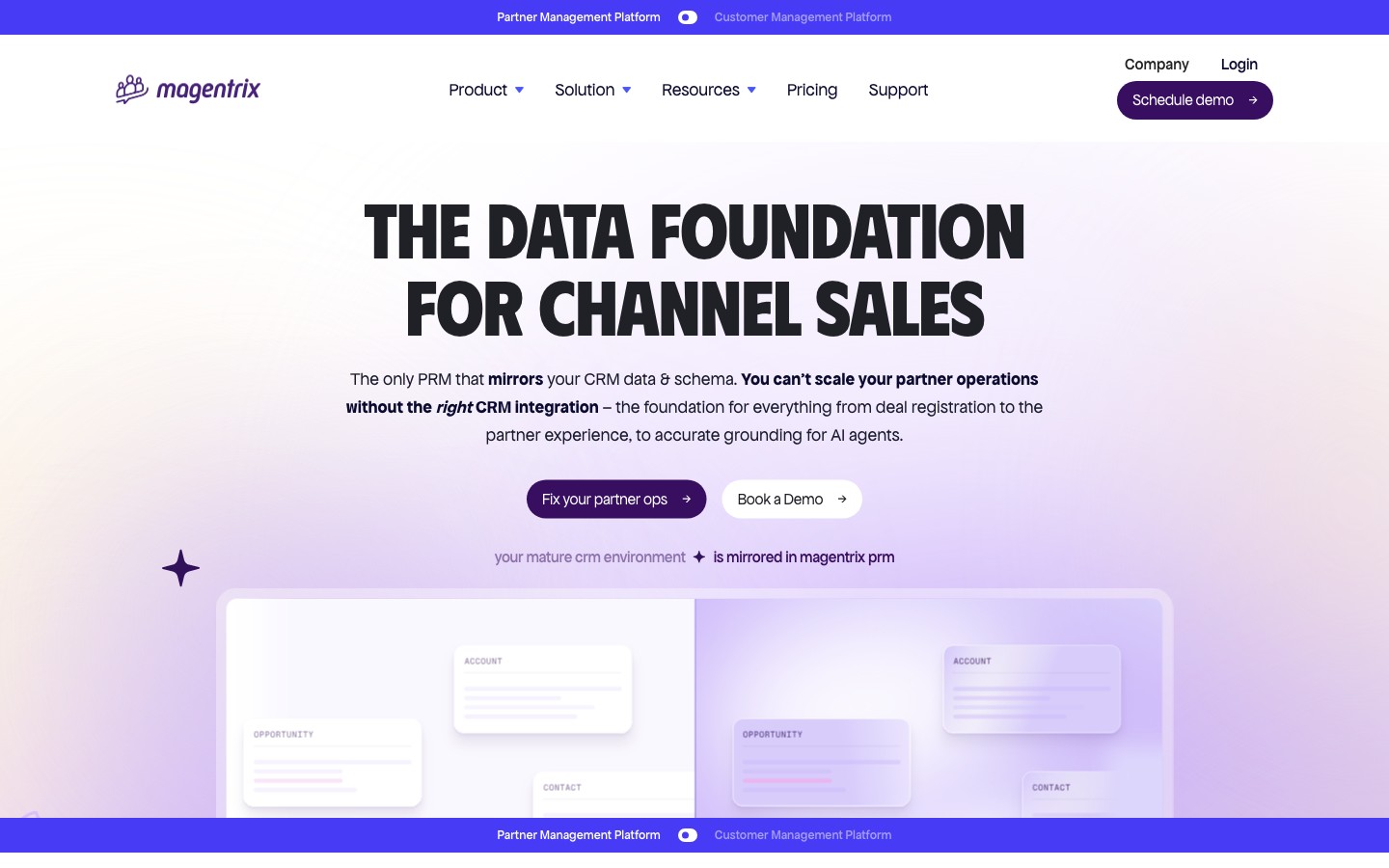
Magentrix is a partner relationship management (PRM) and portal platform — built for companies that want a highly customizable, branded partner portal without heavy development — that covers partner onboarding, deal registration, lead distribution, a built-in LMS, MDF, and content management, tied tightly to Salesforce, Microsoft Dynamics, or HubSpot. Founded in the Toronto area in 2012 and still independent and bootstrapped, Magentrix is distinctive for two reasons: it’s built on a no-code platform-as-a-service, and it mirrors your CRM schema directly rather than mapping fields. This page unpacks that architecture, what the LMS/MDF stack actually includes, published mid-market pricing, and the trade-offs of a deeply configurable portal versus a faster, opinionated PRM.
Full disclosure: PartnerPortal publishes this guide, and PartnerPortal is a Magentrix competitor. We’ve worked hard to keep this a fair, accurate overview built from Magentrix’s own materials, public company records, and verified third-party reviews — not a hit piece. Where we mention PartnerPortal, we flag it plainly.
TL;DR: Magentrix is a flexible, Salesforce-centric PRM aimed mostly at mid-market companies that want a portal they can shape to their exact program and largely self-manage. Its strengths are a no-code, highly extensible platform (PaaS with an IDE, CLI, and API-first REST API), a genuinely different CRM architecture — it mirrors your Salesforce/Dynamics schema instead of field mapping, so syncs don’t break when your data model changes — a built-in LMS with certifications, strong security (ISO 27001, SOC 2 Type II), and highly rated support (~4.6/5 on G2 across 115+ reviews). Its main trade-offs: native CRM support is Salesforce, Dynamics, and HubSpot only (no Pipedrive, Zoho, or Attio), it’s a premium price (published at $1,500–$3,000/month, no free tier), reviewers note a steep admin learning curve and limited reporting, and its per-user licensing can charge for partners who rarely log in.
What is Magentrix?
Magentrix is less “another fixed PRM app” and more a no-code platform for branded portals — partner programs first, with a sibling customer-success portal on the same stack. You shape pages, workflows, and partner experiences without code for most needs; when you outgrow that, Magentrix exposes developer tools (IDE, CLI) and an API-first design so the portal can keep flexing.
Two technical choices define it for buyers. First, CRM schema mirroring (Salesforce and Dynamics heritage, HubSpot supported): instead of maintaining fragile field maps, Magentrix reflects your CRM’s data model into the portal. Second, a bootstrapped, engineering-led company (ex-OpenText founders) that has sold customization and self-management as the product since 2012 — not professional-services lock-in. If your evaluation hinges on “can we mold this to our exact Salesforce program?”, Magentrix is usually on the shortlist for that reason alone.
Company background
Magentrix is another of the category’s independent, bootstrapped players. Key facts, drawn from public company records and Magentrix’s own materials:
- Founded: 2012, and headquartered in the Toronto area (Vaughan / Thornhill, Ontario, Canada).
- Founders: Vahid Fotovat (CEO) and Sam Arjmandi (CTO), both former OpenText developers — an engineering-led founding team, which shows in the platform’s technical depth and extensibility.
- Funding: bootstrapped — Magentrix states it has raised no outside capital and has been profitable since day one, unusual in a VC-heavy category.
- Scale: 35+ employees, 500+ customers launched, and 300,000+ active users across partner and customer portals worldwide.
The practical takeaway: Magentrix is an independent, engineering-driven, profitable company with a substantial installed base for its size. For buyers who value a technically deep, customizable platform from a stable, self-funded vendor, that’s appealing. As with the other bootstrapped players, weigh the smaller team against the category’s largest vendors if you need a big partner ecosystem or an extensive third-party integration marketplace.
How Magentrix positions itself
Magentrix’s positioning centers on being flexible, no-code, and self-manageable — a portal you can shape to your program and run yourself, rather than one that requires the vendor’s professional services for every change. Its messaging leans on:
- 100% no-code. Magentrix announced full no-code status in 2024, claiming a portal that once took 40–60 hours of professional services can now be configured in as little as minutes — a direct attack on the setup cost and delay of traditional enterprise PRMs.
- Architecturally different CRM integration. Instead of field mapping, Magentrix mirrors your CRM schema, which it argues is more robust for complex Salesforce/Dynamics environments (no broken syncs when the schema changes).
- Extensible PaaS. For teams that outgrow no-code, Magentrix offers developer tools (IDE, CLI) and an API-first design — “three ways to integrate” — so the platform can flex and scale.
- Security and independence. ISO 27001, SOC 2 Type II, Canadian Tier III hosting, and a bootstrapped, profitable track record.
Who it targets: mid-market companies (the bulk of its reviews come from mid-market) — often on Salesforce or Microsoft Dynamics — that want a customizable, self-managed partner (or customer) portal with real depth, and are comfortable investing in configuration to get it exactly right.
Magentrix’s key features
Magentrix covers the core PRM feature set and layers its no-code, extensible platform underneath. The capabilities that define it:
No-code portal & PaaS extensibility
Magentrix’s foundation is a no-code portal builder on top of a platform-as-a-service. You configure branding, pages, workflows, and partner-facing experiences without code, and — because it’s a PaaS — you can extend it with developer tools (an IDE and CLI) and an API-first REST API when your needs go beyond the standard configuration. This is the heart of Magentrix’s pitch: most PRMs are fixed applications with shallow APIs, whereas Magentrix is a platform you can mold. Reviewers repeatedly echo this — “if we can imagine it, we can usually build it inside the platform.”
CRM schema mirroring
This is Magentrix’s most genuinely differentiated feature. Most PRMs connect to a CRM through field mapping — you manually map PRM fields to CRM fields, and those mappings can break when the CRM schema changes. Magentrix instead mirrors your CRM schema directly (Salesforce and Dynamics), so the partner portal reflects your exact data model — no field mapping, no maintenance, no broken syncs. For organizations with complex, heavily customized Salesforce environments, this architecture is a real advantage and a common reason technical buyers choose Magentrix.
Deal registration & lead distribution
Magentrix handles the core channel-sales workflows: deal registration (partners register opportunities, attributed and protected from channel conflict), lead distribution and sharing, opportunity management, and deal collaboration — all synced to the connected CRM so your sales team works partner-sourced pipeline from Salesforce, Dynamics, or HubSpot. Because of the schema-mirroring approach, that partner and deal data stays aligned with your CRM’s objects rather than living in a separate, mapped store.
Enablement, LMS & MDF
Magentrix is strong on enablement. It includes a fully integrated LMS — lessons, courses, quizzes, and certifications — so you can onboard and train partners inside the portal, not in a separate system. It also offers content/resource management, a knowledge base, MDF and co-branding, partner-experience (PX) segmentation to tailor what different partner groups see, and a translation studio for multi-language portals. Together these make Magentrix a genuine end-to-end partner enablement platform, which is part of why it competes up-market despite its mid-market price.
Full feature list
Beyond the highlights above, Magentrix includes:
- No-code portal builder on an extensible PaaS (IDE, CLI, API-first REST API)
- CRM schema mirroring for Salesforce and Dynamics (standard objects on Essentials; custom objects, fields, and managed packages on higher tiers)
- Partner onboarding, segmentation, and partner-experience (PX) targeting
- Deal registration, lead distribution/sharing, opportunity management, deal collaboration
- Built-in LMS — courses, lessons, quizzes, certifications
- Content / resource management and knowledge base
- MDF and co-branding
- Custom workflows for partner operations
- Translation studio (multi-language portals)
- Reporting, analytics, and audit trails
- Security: ISO 27001, SOC 2 Type II, AES-256 at rest, TLS in transit, per-tenant data isolation, Canadian Tier III hosting
- A separate customer-portal / customer-success product on the same platform
Integrations
CRM integration is Magentrix’s signature strength — deep on the platforms it supports, though the list is focused.
| Category | Native integrations | Notes |
|---|---|---|
| CRM | Salesforce, Microsoft Dynamics, HubSpot | Salesforce and Dynamics use schema mirroring (not field mapping); standard objects on Essentials, custom objects/managed packages on Advanced and Unlimited. HubSpot focuses on contacts and deals. |
| Other CRMs (Pipedrive, Zoho, Attio, etc.) | Not native | The API-first platform can connect to other systems, but there’s no purpose-built native sync. |
| Extensibility | REST API, IDE, CLI | ”Three ways to integrate” — API-first by design, deeper than most PRMs’ shallow APIs. |
The key evaluation point: if you run Salesforce or Microsoft Dynamics, Magentrix’s integration is among the most robust in the category — the schema-mirroring architecture is a real differentiator for complex, customized CRM environments. HubSpot support is solid but more focused (contacts and deals). Note that partner users must have Account and Contact records in the connected CRM. If your CRM is Pipedrive, Zoho, or Attio, Magentrix has no native integration, so you’d rely on the API. (For the full landscape by CRM, see our guides on the best PRM for Pipedrive, best PRM for Zoho, and best PRM for Attio.)
Magentrix pricing
Magentrix is one of the PRMs that publishes pricing for its partner portal, though it has no free tier or trial. As of 2026:
| Plan | Price | Includes |
|---|---|---|
| Essentials | $1,500/month | 100 partner users or 10 partner accounts (unlimited users); Salesforce/Dynamics standard objects & fields; core PRM & portal |
| Advanced | $3,000/month | 150 partner users or 20 partner accounts; adds custom objects, fields & managed packages, LMS, MDF, PX segmentation, extensibility |
| Unlimited | Custom | Unlimited partners and users; everything in Advanced for mature partner operations |
A few pricing details worth understanding:
- Per-user or per-organization. You choose either per-partner-user or per-partner-organization pricing; each tier includes a set allocation, and cost scales as you add users or accounts.
- Billing. Pricing is based on annual contracts (with multi-year discounts); monthly billing adds a 10% surcharge, and quarterly is available at no extra charge.
- Capabilities scale by tier. Custom CRM objects, managed packages, the LMS, MDF, and extensibility sit on Advanced and Unlimited, not Essentials.
- A licensing nuance to watch: because licensing is user- or account-based, you may pay for partner users who rarely or never log in — a point some reviewers raise. Model your active-partner reality before sizing a tier.
- Onboarding/customization is quoted separately based on project scope.
Always confirm current numbers on Magentrix’s own pricing page; PRM pricing changes and depends on user/account count. Teams optimizing purely on cost should also compare against our most affordable PRM software roundup.
What users say: Magentrix reviews
Magentrix is well-reviewed, especially by mid-market teams. On G2, it holds roughly 4.6 out of 5 across 115+ reviews (the large majority from mid-market companies).
What reviewers consistently praise:
- Salesforce integration — the most-cited strength; partner data and the portal stay tightly aligned with the CRM.
- Flexibility and customization — “if we can imagine it, we can usually build it,” with the platform tailored closely to a program’s needs.
- Exceptional, responsive support — named individuals and success managers who “get things done quickly” come up repeatedly.
- Built-in LMS and multi-language (the translation studio) as valued parts of the portal.
- Value for the cost relative to heavier enterprise platforms.
Common critiques:
- Admin learning curve — the flip side of flexibility; the admin interface can be complex, and some workflows aren’t self-explanatory.
- Reporting depth — several reviewers want better built-in reporting (e.g., unique logins, page visits) without custom work.
- Licensing cost — paying for partner users who rarely log in is a recurring complaint under user-based licensing.
- Configuration/turnaround — occasional project delays and a wish for clearer answers during setup.
Read the reviews yourself: Magentrix on G2.
Where Magentrix is limited
No tool fits everyone. Magentrix’s honest limits:
- Native CRM is Salesforce, Dynamics, and HubSpot only — no native Pipedrive, Zoho, or Attio.
- Premium price, no free tier. Published at $1,500–$3,000/month and up; a real commitment, especially for a first partner program.
- Admin learning curve. The customizability that power users love makes the admin side harder to master for lean teams.
- Reporting is lighter than some buyers want out of the box.
- User-based licensing can mean paying for inactive partner seats.
- Smaller vendor and ecosystem than the category’s largest players, with a more focused integration list.
Who Magentrix is best for
Magentrix is a strong fit if you’re:
- A mid-market company on Salesforce or Microsoft Dynamics, especially with a complex, customized CRM where schema mirroring pays off.
- Wanting a highly customizable, self-managed portal you can shape to your exact program.
- In need of built-in partner training/LMS, certifications, MDF, and content enablement in one platform.
- Comfortable investing in configuration to get depth and flexibility.
- Also interested in a customer portal on the same platform.
Magentrix is probably not the right fit if you:
- Run your CRM on Pipedrive, Zoho, or Attio and want native sync.
- Want a free tier, the lowest entry price, or a fast, hands-off setup.
- Have a small, non-technical team that would struggle with the admin learning curve.
- Need advanced reporting out of the box.
- Have many inactive partners and don’t want to pay per-seat for them.
Magentrix alternatives
Teams usually leave Magentrix when the configurability itself becomes the problem — or when they want that same Salesforce-depth from a different vendor:
- Stay in the Salesforce/Dynamics-centric tier. If schema-level CRM fidelity and a moldable portal still matter, but Magentrix isn’t the pick, shortlists typically include Salesforce PRM, Channeltivity, Impartner, and Allbound/Channelscaler.
- Trade customization for speed and price. If you don’t want to administer a PaaS-style portal — or mid-market Magentrix pricing exceeds what a lean program needs — move to a modern PRM: PartnerPortal (that’s us, disclosed), Kiflo, or JourneyBee. PartnerPortal’s contrast is the clearest on CRM breadth (native Pipedrive, Zoho, and Attio alongside HubSpot/Salesforce) and a permanently free tier.
See our Magentrix alternatives guide for the full field. Also:
- Best PRM software in 2026 — every major PRM ranked, Magentrix included.
- Kiflo PRM, JourneyBee PRM, and Introw PRM — deep dives on the lighter-weight alternatives.
Related reading
- Best PRM Software in 2026 — the full category comparison.
- Partner Relationship Management Platforms: Compare the Market — how the whole landscape is structured.
- Most Affordable PRM Software in 2026 — PRMs ranked by real cost, including hidden fees.
- Best PRM for Pipedrive, Zoho, and Attio — where Magentrix isn’t native and which PRMs are.
- Why You Should Integrate Your CRM and PRM — why native CRM integration matters.
Want a partner portal without the PaaS admin load? Try PartnerPortal free or see which CRMs sync natively.
Frequently asked questions
What is Magentrix PRM?
Magentrix is a partner relationship management (PRM) and portal platform built for companies — often on Salesforce or Microsoft Dynamics — that want a highly customizable, branded partner portal without heavy development. It covers partner onboarding, deal registration, lead distribution, a built-in LMS with training and certifications, MDF, and content management. What sets it apart is that it's built on a no-code platform-as-a-service (PaaS) and mirrors your CRM schema directly, so the portal reflects your data model without field-by-field mapping. Magentrix also offers a separate customer-portal product.
Who owns Magentrix and where is it based?
Magentrix is an independent, bootstrapped company headquartered in the Toronto area (Vaughan/Thornhill, Ontario, Canada). It was founded in 2012 by Vahid Fotovat (CEO) and Sam Arjmandi (CTO), both former OpenText developers, and has never raised outside capital — it describes itself as profitable since day one, with 35+ employees, 500+ customers launched, and 300,000+ active users. That independence and Salesforce-heavy engineering DNA are central to its identity.
How much does Magentrix cost?
Magentrix publishes partner-portal pricing: an Essentials tier at $1,500/month, an Advanced tier at $3,000/month, and a custom Unlimited tier, all based on annual contracts (monthly billing adds a 10% surcharge). You can choose per-partner-user or per-partner-organization pricing — Essentials includes 100 partner users or 10 partner accounts, Advanced includes 150 users or 20 accounts, and Unlimited removes the caps. Custom objects, managed packages, the LMS, and MDF sit on the higher tiers. There's no free tier or trial. Confirm current pricing with Magentrix.
Which CRMs does Magentrix integrate with?
Magentrix integrates natively with Salesforce, Microsoft Dynamics, and HubSpot. Its Salesforce and Dynamics integrations are its signature strength: rather than field mapping, Magentrix mirrors the CRM schema directly (standard objects on Essentials; custom objects, fields, and managed packages on Advanced and Unlimited), so the portal stays in sync as your schema changes. HubSpot support focuses on contacts and deals. Partner users must have Account and Contact records in the connected CRM. There's no native Pipedrive, Zoho, or Attio integration, though the API-first platform can connect to other systems.
What makes Magentrix architecturally different from other PRMs?
Two things. First, it's 100% no-code: Magentrix says a portal that used to take 40–60 hours of professional services can now be configured in minutes, so customers self-manage the platform. Second, it mirrors your CRM schema instead of using field mapping, which most PRMs rely on — meaning fewer broken syncs when your Salesforce or Dynamics data model changes, a real advantage for complex CRM environments. It's also built on an extensible PaaS with an IDE, CLI, and API-first REST API, plus ISO 27001 and SOC 2 Type II security.
Does Magentrix have a partner LMS and training?
Yes. Magentrix includes a fully integrated eLearning environment for partner onboarding and enablement — lessons, courses, quizzes, and certifications — so you can train and certify partners inside the portal. Training and certification capabilities are part of the higher tiers. Combined with content management and deal registration, this makes Magentrix a genuine end-to-end partner enablement platform rather than a portal-plus-deal-registration tool.
Is Magentrix any good? What do reviews say?
Magentrix is well-reviewed, holding about 4.6 out of 5 on G2 across 115+ reviews, mostly from mid-market companies. Reviewers consistently praise its deep Salesforce integration, exceptional flexibility and customization, a built-in LMS, multi-language support, and outstanding, responsive customer support. The most common critiques are a steep learning curve on the admin side, reporting that some users find limited, and a licensing model that can charge for partner users even if they rarely log in.
What are the best Magentrix alternatives?
It depends on why Magentrix doesn't fit. If you want a comparable Salesforce-centric or enterprise platform, the direct peers are Salesforce PRM, Channeltivity, Impartner, and Allbound. If Magentrix is more platform or cost than your program needs, lighter, more affordable modern PRMs such as PartnerPortal, Kiflo, and JourneyBee set up faster and cost less while covering the essentials — and PartnerPortal adds a free tier and native support for more CRMs (including Pipedrive, Zoho, and Attio).