
Impartner vs PartnerPortal (2026): A Side-by-Side Comparison
Impartner vs PartnerPortal compared — an enterprise TCMA heavyweight vs. an accessible SMB PRM. CRM coverage, features, governance, pricing, and reviews to help you choose the right fit.
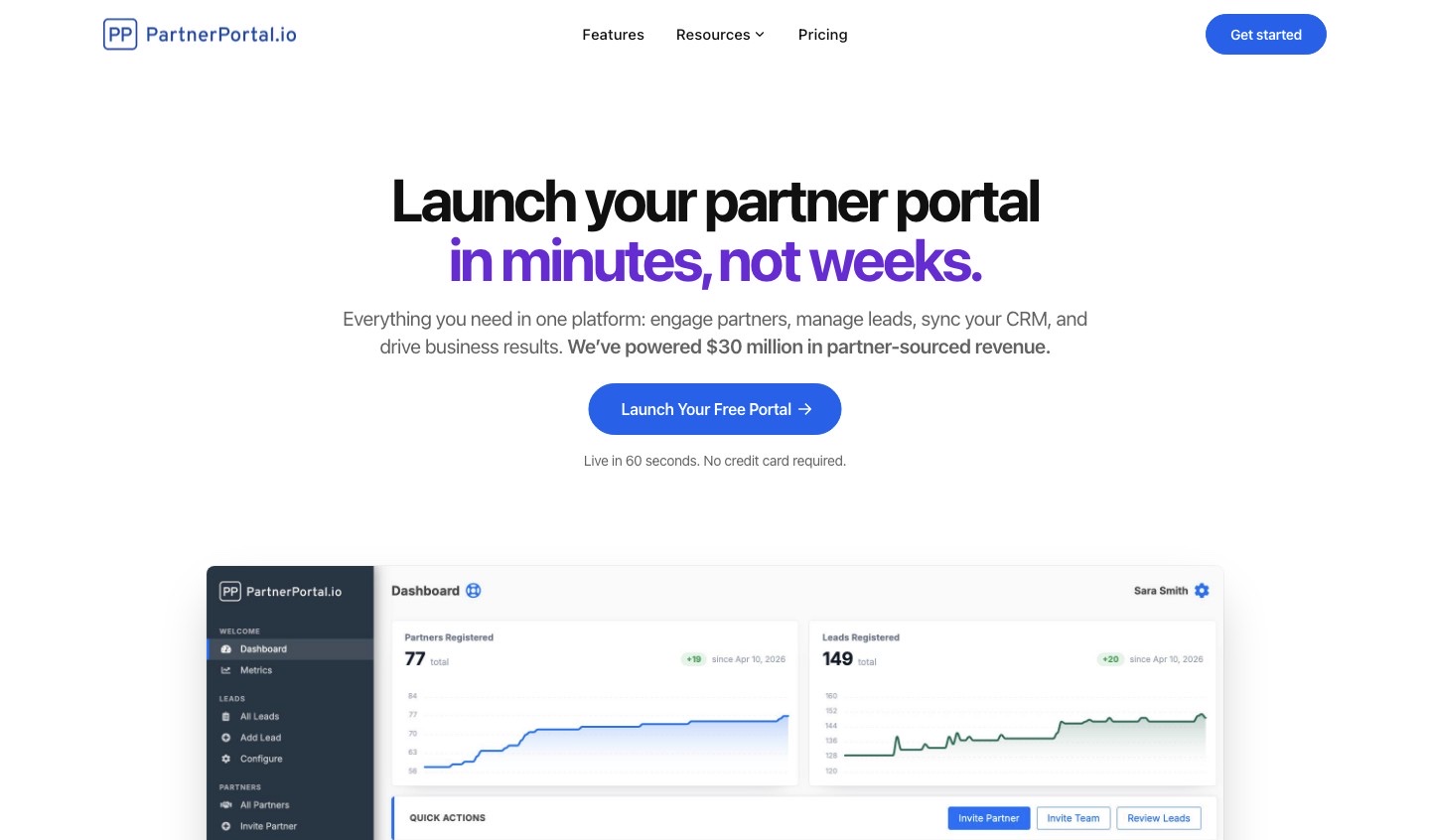
Impartner is enterprise channel orchestration — TCMA, MDF, compliance, BI, custom contracts at $30k–$150k+/yr. PartnerPortal is the self-serve opposite: five native CRMs, free tier, portal live in about a minute. Same category label; almost never the same shortlist once budget and program size are honest. Comparison below for teams still weighing both.
Full disclosure: PartnerPortal publishes this comparison, and PartnerPortal is a competitor of Impartner. We’ve worked to keep this fair and factual — stating what each tool does and letting you draw the conclusion — rather than steering you toward us. Where the facts favor Impartner, we say so — and on enterprise depth, they clearly do.
First, an honest signal: for most teams this isn’t a close call — it’s a weight-class question. If you’re a mid-market or enterprise organization with a large, complex channel that needs TCMA, MDF, governance, and dedicated administration, Impartner is built for you and PartnerPortal will hit a ceiling. If you’re an SMB or scaling SaaS company that wants to stand up a partner program in minutes at a transparent price, PartnerPortal is built for you and Impartner will be far too much platform and cost. The interesting decision is usually how much platform you actually need — so we’ve written this to make that call clear.
TL;DR: Impartner is an enterprise channel-management suite — PRM plus MDF, TCMA, program compliance, and BI — with deep native Salesforce and Dynamics 365, sold via custom enterprise contracts (typically $30k–$150k+/yr) with scoped implementation, rated ~4.5/5 across 400+. PartnerPortal is an accessible SMB/mid-market PRM — easy to use, five native CRMs (HubSpot, Salesforce, Pipedrive, Zoho, Attio), a permanently free tier then a transparent, published $249/$399/mo, and a built-in LMS, launchable in ~60 seconds, rated ~4.5/5 across ~50 (it also automates commission and revenue tracking via Stripe/QuickBooks). Different buyers, different budgets: Impartner for enterprise depth and governance, PartnerPortal for ease of use, price transparency, and CRM breadth.
At a glance
| Impartner | PartnerPortal | |
|---|---|---|
| Best known for | Enterprise channel management (TCMA/MDF) | Broad native CRM coverage + free entry point |
| Founded / HQ | 1997/2015 chapter, South Jordan, UT (PE-backed) | 5+ years in market, self-serve PRM |
| Target buyer | Mid-market to enterprise channels | SMB / mid-market B2B SaaS |
| Scope | PRM + MDF + TCMA + compliance + BI | Portal + registration + LMS + commission/revenue tracking |
| MDF / TCMA | Yes (core modules) | No |
| Built-in LMS | Via modules | Yes (courses, lessons, completion) |
| Commissions | Via modules | Commission + revenue tracking (Stripe/QuickBooks) |
| Native CRM | Salesforce, Dynamics 365 | HubSpot, SF, Pipedrive, Zoho, Attio |
| Setup | Scoped implementation, weeks–months | Self-serve, ~60 seconds |
| Free tier | No | Yes (permanent) |
| Pricing | Custom (~$30k–$150k+/yr) | Free, then $249–$399/mo |
| G2 rating | ~4.5 / 5 (400+ reviews) | ~4.5 / 5 (~50 reviews) |
The table makes the gap obvious: Impartner’s enterprise scope and governance against PartnerPortal’s ease of use, transparent pricing, CRM breadth, and built-in LMS. The sections below unpack it.
Overview of each
Impartner is an enterprise channel-management platform with roots to 1997 (as Treehouse Interactive) and a current chapter from 2015 under CEO Joe Wang, based in South Jordan, Utah, private-equity-backed, and one of the category’s largest pure-play vendors. Its suite spans PRM, MDF/co-op, TCMA (through-channel marketing automation), program compliance, and channel business intelligence, delivered with enterprise governance, deep configuration, and professional services. For the full breakdown, see our Impartner PRM overview.
PartnerPortal is a PRM for SMB and mid-market teams that want a partner portal live quickly — and free to start. It covers the core ground (portal, lead and deal registration, commissions) with an emphasis on ease of use, broad native CRM coverage (five CRMs, including Pipedrive, Zoho, and Attio), a permanently free tier, and transparent published pricing — plus a built-in LMS and automated commission and revenue tracking (connect Stripe or QuickBooks to capture customer revenue and calculate what partners are owed, then approve → export → mark paid). For the wider field, see best PRM software.
The review picture reflects the segments: Impartner ~4.5/5 across 400+ enterprise reviews; PartnerPortal ~4.5/5 across ~50. See Reviews & ratings.
Brand & market position
- Impartner positions as the enterprise standard for channel management — “the industry’s most complete, award-winning channel management platform” — targeting mid-market and enterprise organizations with large, multi-tier channels that need marketing automation, funds management, and governance at scale.
- PartnerPortal positions as one of the first self-serve PRMs — fast, self-serve launch, broad native CRM integration, and affordability — targeting SMB and mid-market B2B SaaS teams that want to go live quickly and cheaply.
The practical read: these brands aren’t competing for the same buyer. Impartner sells enterprise depth and control; PartnerPortal sells ease of use, transparent pricing, and CRM breadth.
Feature comparison
Both have a partner portal and deal registration, but Impartner’s scope extends well past core PRM, while PartnerPortal focuses on doing the core plus LMS and commission/revenue tracking affordably.
| Feature | Impartner | PartnerPortal |
|---|---|---|
| Partner portal & deal registration | Yes (deeply configurable) | Yes |
| MDF / co-op funds | Yes | No |
| TCMA (through-channel marketing) | Yes | No |
| Program compliance & tiering | Yes (advanced governance) | Basic tiers/segmentation |
| Built-in LMS | Via modules | Yes (courses, lessons, completion) |
| Commissions / revenue | Via modules | Commission + revenue tracking (Stripe/QuickBooks) |
| Business intelligence | Advanced channel BI | Standard reporting |
| Setup | Scoped implementation | Self-serve, ~60 seconds |
| Free tier | No | Yes (permanent) |
| Native CRMs | Salesforce, Dynamics 365 | HubSpot, SF, Pipedrive, Zoho, Attio |
Weight class & who it’s for
The core difference. Impartner is sized for mid-market and enterprise — organizations with large partner counts, multiple tiers, and dedicated channel teams. PartnerPortal is sized for SMB and mid-market — a team launching or scaling a program without enterprise overhead. Choosing between them is mostly about where your program is today and where it’s going, not a feature-by-feature toss-up.
Channel suite vs. focused PRM
Impartner is a suite — its value is the combination of PRM with MDF, TCMA, compliance, and BI under one governed platform. PartnerPortal is a focused PRM — a portal, deal registration, a built-in LMS, and commission/revenue tracking, done simply and affordably. If you need the whole through-channel motion in one enterprise platform, Impartner; if you need core PRM plus training without the suite, PartnerPortal.
MDF & through-channel marketing
A clear Impartner strength PartnerPortal doesn’t match. Impartner offers MDF/co-op fund management and TCMA — partners execute co-branded, automated marketing under your brand, with fund requests, claims, and ROI tracking. PartnerPortal has neither. If MDF and through-channel marketing are central to your channel strategy, this alone can decide it in Impartner’s favor.
LMS, ease of use & fast launch
Where the direction reverses. PartnerPortal is easy to use out of the box — a built-in LMS (courses, ordered lessons, completion tracking, auto-awarded certifications) at its paid tiers, and a self-serve, free launch in about 60 seconds with transparent pricing. It also automates commission and revenue tracking by connecting Stripe or QuickBooks to capture customer revenue and calculate commissions owed (with AP-ready exports; it does not send funds itself), where Impartner delivers training and incentives through configured modules as part of an enterprise deployment. For an out-of-the-box LMS, low-friction setup, and a fast free start, PartnerPortal is the more direct fit; on incentive breadth (MDF, funds, claims) Impartner is deeper.
Setup, administration & governance
PartnerPortal is self-serve — configure and launch in minutes, administer without specialists, transparent pricing up front. Impartner is an enterprise deployment — scoped implementation, professional services, and admin training, in exchange for deep configurability, role-based governance, and program compliance that large channels require. Speed and simplicity favor PartnerPortal; depth and control favor Impartner.
Integrations
| Category | Impartner | PartnerPortal |
|---|---|---|
| Native CRM | Salesforce, Dynamics 365 | HubSpot, Salesforce, Pipedrive, Zoho, Attio |
| Other CRM | Via API / iPaaS | Via Zapier / API |
| Billing / accounting | Via modules / integrations | Stripe, QuickBooks (revenue tracking) |
| Communication | Enterprise integrations | Slack |
| Everything else | API, iPaaS, professional services | Zapier, API |
The CRM story is a split: Impartner is native with Salesforce and Dynamics 365 (strong for enterprises on Microsoft), while PartnerPortal is native with five CRMs including HubSpot, Pipedrive, Zoho, and Attio with self-serve setup. Both cover Salesforce; Dynamics → Impartner; HubSpot/Pipedrive/Zoho/Attio → PartnerPortal. Impartner’s integrations are enterprise-grade and often professionally implemented; PartnerPortal’s are self-serve. For the CRM landscape, see best PRM for Pipedrive, Zoho, and Attio.
Pricing
Two different worlds.
| Impartner | PartnerPortal | |
|---|---|---|
| Model | Custom, demo-led enterprise contract | Published, flat per tier |
| Free tier | No | Yes (permanent) |
| Entry | Custom (typically from ~$30k/yr) | Free, then $249/mo (up to 100 partners) |
| Higher tiers | Six figures with full modules/services | $399/mo (unlimited) |
| Extra costs | Implementation, TCMA/MDF modules, services | None |
PartnerPortal is dramatically cheaper and transparent — a free tier, then $249/$399/month. Impartner publishes no pricing; it’s a custom enterprise contract typically running from roughly $30,000/year into six figures depending on modules and services. If budget and predictability matter, PartnerPortal; Impartner’s cost reflects enterprise scope, governance, and support. See our most affordable PRM software roundup.
Reviews & ratings
| Platform | Impartner | PartnerPortal |
|---|---|---|
| G2 | ~4.5 / 5 (400+ reviews) | ~4.5 / 5 (~50 reviews) |
| Profile | Enterprise-heavy, large review base | SMB/mid-market, smaller base |
Both are well-rated for their segments. Impartner reviewers praise its breadth, configurability, TCMA/MDF, and enterprise scalability, with critiques around complexity, implementation time and cost, and administrative overhead. PartnerPortal reviewers praise ease of use, fast setup, broad CRM coverage, value, and responsive support, with critiques around a smaller review base and lighter enterprise/MDF tooling. Read them yourself: Impartner on G2 and PartnerPortal on G2.
Considerations for your program
Enterprise TCMA vs. self-serve economics — the decision is usually about amount of platform, not feature checklists:
- You’re an SMB or scaling SaaS team. PartnerPortal’s price and speed fit; Impartner is likely overkill.
- MDF and through-channel marketing are central. Impartner has them; PartnerPortal doesn’t.
- You want ease of use, a free start, and transparent published pricing. PartnerPortal; Impartner is sales-led and quote-based.
- Your CRM is Dynamics. Impartner is native; PartnerPortal isn’t. HubSpot, Pipedrive, Zoho, or Attio? PartnerPortal is native; Impartner isn’t (both cover Salesforce).
- You want a built-in LMS out of the box. PartnerPortal includes one at its paid tiers.
- You want automated commission and revenue tracking (Stripe/QuickBooks) with AP-ready exports. PartnerPortal does this natively; note that neither product sends funds itself — both hand disbursement to finance.
- You need advanced program compliance, tiering, and channel BI. Impartner.
- You want the fastest, lowest-commitment launch. PartnerPortal is self-serve and free in ~60 seconds.
- You need something between a lean PRM and an enterprise suite. See mid-market options like Channeltivity, Channelscaler, or Magentrix.
Related reading
- Impartner PRM: Features, Pricing & Reviews — the full deep dive on Impartner.
- Kiflo vs Impartner, PartnerStack vs Impartner, and JourneyBee vs Impartner — other lean-vs-enterprise contrasts.
- Best PRM Software in 2026 — every major PRM, including enterprise options.
- Partner Relationship Management Platforms: Compare the Market — the full PRM landscape and every head-to-head in one place.
- Most Affordable PRM Software in 2026 — PRMs ranked by real cost.
- Best PRM for Pipedrive, Zoho, and Attio — native CRM coverage compared.
Sure Impartner is more than you need? Launch PartnerPortal free or check CRM integrations.
Frequently asked questions
What is the main difference between Impartner and PartnerPortal?
Weight class. Impartner is an enterprise-grade, PE-backed channel-management suite covering the full through-channel motion — PRM, MDF, TCMA (through-channel marketing automation), program compliance, and business intelligence — sold as a custom, demo-led contract typically in the tens of thousands per year and up. PartnerPortal is an accessible SMB/mid-market PRM known for ease of use, broad native CRM coverage (five CRMs), a permanently free tier, and transparent published pricing, launchable in about 60 seconds; it also automates commission and revenue tracking via native Stripe and QuickBooks integrations (it does not itself send funds). Impartner is a deep, governed enterprise platform; PartnerPortal is easy, affordable, and self-serve.
Are Impartner and PartnerPortal direct competitors?
Not really — they serve different segments and rarely lose deals to each other. Impartner targets mid-market to enterprise organizations with large, complex channels that need TCMA, MDF, governance, and dedicated administration. PartnerPortal targets SMB and mid-market teams that want fast, affordable setup and broad CRM coverage. A global enterprise channel will outgrow PartnerPortal; a lean SaaS team will find Impartner far too heavy and expensive. They appear on the same shortlist mainly when a company is deciding how much platform it actually needs.
Which is more affordable, Impartner or PartnerPortal?
PartnerPortal, dramatically. It offers a permanently free tier and paid plans at $249/month (up to 100 partners) and $399/month (unlimited). Impartner does not publish pricing; it's a custom, demo-led enterprise contract that typically runs from roughly $30,000/year into six figures depending on modules (PRM, TCMA, MDF), partner volume, and services. For a cost-sensitive team, PartnerPortal is far cheaper; Impartner's price reflects enterprise scope and governance.
Which CRMs do Impartner and PartnerPortal integrate with?
Impartner has native, deep integrations with Salesforce and Microsoft Dynamics 365, and connects to others via API and iPaaS, often professionally implemented. PartnerPortal is native with five CRMs — HubSpot, Salesforce, Pipedrive, Zoho, and Attio. So both cover Salesforce natively; Impartner adds Dynamics 365, while PartnerPortal adds HubSpot, Pipedrive, Zoho, and Attio with self-serve setup. If you run Dynamics, Impartner is native; if you run HubSpot, Pipedrive, Zoho, or Attio, PartnerPortal is native.
Does PartnerPortal have MDF and through-channel marketing like Impartner?
No, not at Impartner's depth. Impartner offers full MDF/co-op management and TCMA (through-channel marketing automation) — automated, partner-executed marketing under your brand — as core enterprise modules. PartnerPortal focuses on a partner portal, deal registration, a built-in LMS, and automated commission and revenue tracking (via Stripe/QuickBooks); it doesn't offer enterprise TCMA or deep MDF. If through-channel marketing and MDF are central to your channel, that's an Impartner strength PartnerPortal doesn't match.
Which is faster to set up, Impartner or PartnerPortal?
PartnerPortal, by far. It's fully self-serve and free to launch — you can stand up a branded portal in about 60 seconds with no credit card and no sales call. Impartner is an enterprise platform that typically involves a scoped implementation, professional services, and admin training measured in weeks to months. If speed and simplicity are priorities, PartnerPortal; if you need deep configuration, governance, and enterprise controls and can invest in rollout, Impartner.
Is PartnerPortal a good Impartner alternative?
For teams that find Impartner too heavy or expensive, yes — PartnerPortal offers a free tier, far lower and fully published pricing, easier self-serve setup, broad native CRM coverage, and a built-in LMS, plus automated commission and revenue tracking. But if you genuinely need enterprise TCMA, MDF, program compliance, and channel BI at scale, PartnerPortal deliberately doesn't try to match those; you'd stay with an enterprise platform. It's an excellent alternative when Impartner is more platform than you need.
What is a good alternative if Impartner is too heavy but PartnerPortal is too light?
If you need more than a lean PRM but less than a full enterprise suite, look at mid-market channel platforms like Channeltivity or Channelscaler, or a customizable platform like Magentrix. PartnerPortal itself covers a lot of that middle ground affordably — broad CRM, LMS, commission/revenue tracking — but if MDF, distributor management, or deep customization are must-haves, those mid-market options sit between PartnerPortal and Impartner.