
JourneyBee vs Impartner (2026): A Side-by-Side Comparison
JourneyBee vs Impartner compared — a modern, affordable AI-native PRM vs. the enterprise channel heavyweight. CRM coverage, TCMA/MDF, AI, pricing, and reviews to help you choose.
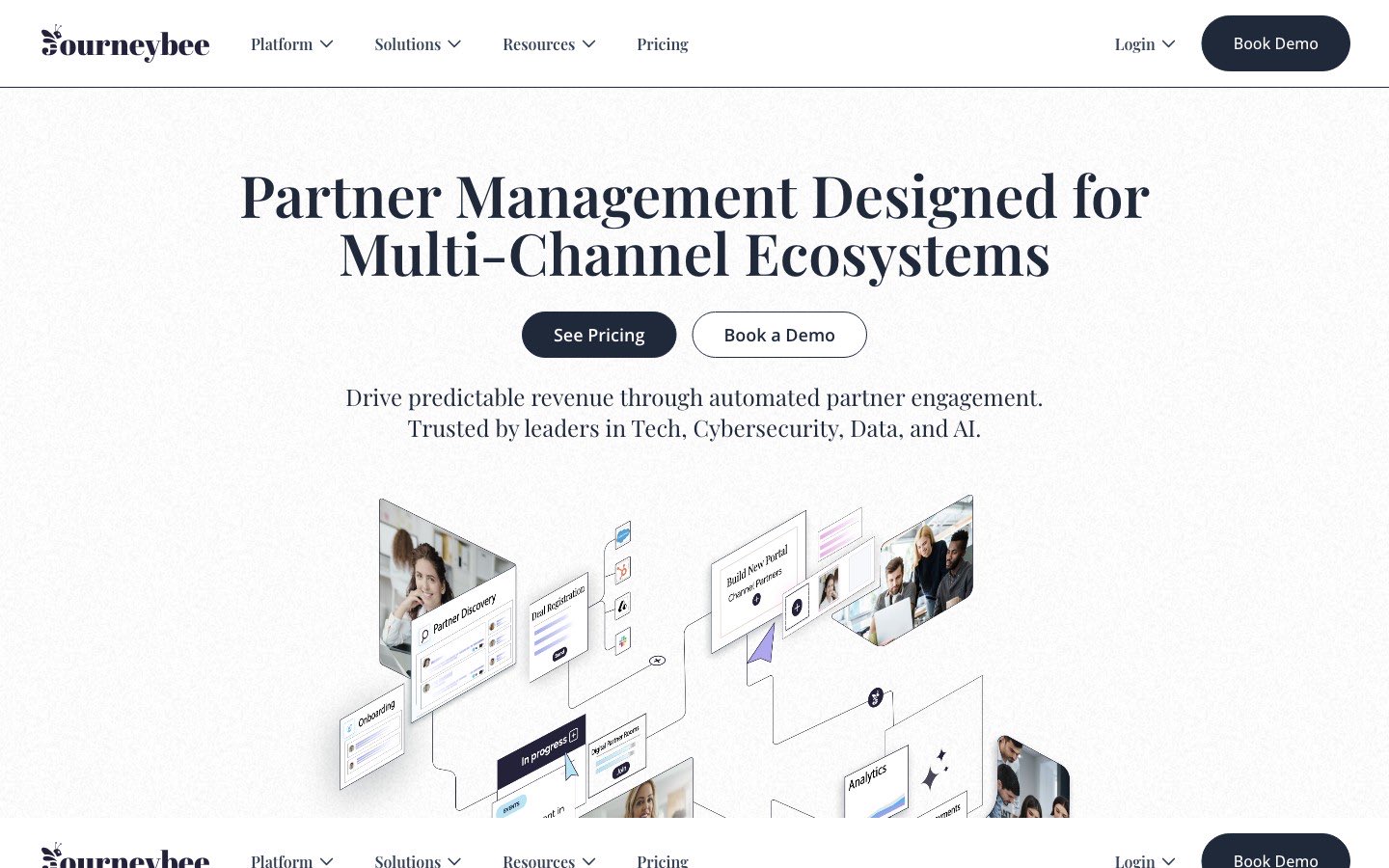
JourneyBee and Impartner aren’t really the same kind of tool — they sit at opposite ends of the market. JourneyBee is a modern, affordable, AI-native PRM (founded 2023) built on a headless architecture, with an AI agent, a built-in LMS, MDF, and broad CRM coverage — made for fast setup and lean teams. Impartner is the enterprise channel heavyweight, in market for decades, with deep through-channel marketing (TCMA), enterprise MDF, multi-tier governance, and best-in-class Salesforce and Dynamics integration, at custom enterprise pricing.
Full disclosure: PartnerPortal publishes this comparison, and PartnerPortal competes with both JourneyBee and Impartner. We’ve worked to keep this fair and factual — describing what each tool does and letting you draw the conclusion — rather than steering you toward us. We include a clearly labeled Where PartnerPortal fits section so our own stake is transparent, not smuggled in.
First, a useful signal: the honest starting point is that these two rarely belong on the same shortlist. If you’re a startup or SMB-to-mid-market SaaS team that wants AI, low cost, and fast setup, JourneyBee is built for you and Impartner will feel like too much. If you’re a mid-market-to-enterprise organization with a large, complex, often global channel that needs TCMA, MDF, and governance, Impartner is built for you and JourneyBee will feel too young and too light. Most buyers know which sentence describes them.
TL;DR: JourneyBee is the lightweight AI PRM (Buzz, headless, Pipedrive/Attio, LMS, MDF, dual SOC 2 + ISO, ~$499/mo), rated ~4.7/5 across ~25. Impartner brings enterprise depth — a full TCMA suite, enterprise MDF, multi-tier governance, Impartner PX and PXStudio, and best-in-class Salesforce/Dynamics integration — proven over decades (~4.5/5 across 500+ reviews, a repeat G2 Leader) — but it’s expensive (typically $30K–$150K+/year, no public price), complex, and sales-led. JourneyBee is agility and cost; Impartner is depth and governance.
At a glance
| JourneyBee | Impartner | |
|---|---|---|
| Best known for | AI-native, affordable, headless PRM | Enterprise PRM + TCMA/MDF depth |
| Founded / HQ | 2023, Stockholm (bootstrapped) | 1997 (as Treehouse), South Jordan, UT (PE-backed) |
| Target buyer | Startup / SMB / mid-market SaaS | Mid-market to enterprise, complex channels |
| AI | Buzz agent (MCP, model-agnostic) | AI/analytics across enterprise platform |
| Through-channel marketing (TCMA) | Light (MDF) | Full TCMA suite |
| Native CRM | Salesforce, HubSpot, Pipedrive, Attio (+ Zoho) | Salesforce, Dynamics 365, HubSpot |
| Governance / multi-tier | Two-tier (managed) | Deep enterprise governance |
| Built-in LMS | Yes | Yes (module) |
| Pricing | ~$499/mo, unlimited partners | ~$30K–$150K+/yr (custom) |
| Free tier | No | No |
| G2 rating | ~4.7 / 5 (~25 reviews) | ~4.5 / 5 (500+ reviews) |
The table shows two different weight classes: JourneyBee’s modern agility and low cost against Impartner’s enterprise depth, governance, and proven scale. The sections below unpack it.
Overview of each
JourneyBee is the lightweight challenger in an unfair weight fight: Stockholm 2023, AI-native/headless, Buzz + LMS + MDF + dual SOC 2/ISO, ~$499/mo — aimed at modern SaaS, not Impartner’s enterprise channel governance.
Impartner is an enterprise-grade PRM founded in 1997 (as Treehouse Interactive), based in South Jordan, Utah, and PE/growth-equity-backed (having raised on the order of $145–180M). It runs large, complex, global channel programs end to end — core PRM plus TCMA, MDF, an LMS, and Impartner PX — and is a repeat G2 Leader in enterprise PRM and Through-Channel Marketing.
The review bases reflect the gap: Impartner’s ~4.5/5 across 500+ and decades of enterprise deployments vs. JourneyBee’s ~4.7/5 across ~25 since 2023. See Reviews & ratings.
Brand & market position
JourneyBee is anti-enterprise-complexity in brand: AI/headless SMB PRM — Impartner is the legacy-weight suite JourneyBee defines itself against.
Impartner markets itself as the “#1 rated partner management platform” and a “partner revenue orchestration” platform — end-to-end enterprise depth (recruit, onboard, enable, market, sell, reward, analyze), highly configurable via PXStudio and Orchestration Studio, for dedicated channel-operations teams at mid-market-to-enterprise scale.
The practical read: JourneyBee sells agility and low cost; Impartner sells enterprise depth, governance, and scale. They optimize for opposite buyers.
Feature comparison
Both cover core PRM and both include an LMS and MDF, but Impartner’s depth and governance operate at a different scale, while JourneyBee leads on AI, breadth of CRM, and price.
| Feature | JourneyBee | Impartner |
|---|---|---|
| AI agent | Buzz (MCP, model-agnostic) | AI/analytics across platform |
| Off-portal registration | Yes (Slack/Teams/email) | Portal (Impartner PX) |
| Through-channel marketing (TCMA) | Light (MDF) | Full TCMA suite |
| MDF | Yes | Yes (enterprise-grade) |
| Multi-tier governance | Two-tier (managed) | Deep enterprise governance |
| Built-in LMS | Yes | Yes (module) |
| Configurability | Plug-and-play | PXStudio, Orchestration Studio iPaaS |
| Native CRMs | SF, HubSpot, Pipedrive, Attio | SF, Dynamics 365, HubSpot |
| Reference base | ~25 reviews (2023) | 500+ reviews (decades) |
Scale & buyer
The defining difference. Impartner is built for hundreds to thousands of partners across global, multi-tier channels, run by a dedicated channel-ops team with budget for a full implementation. JourneyBee is built for modern SaaS teams — often lean — that want to launch fast and cheap. Match this to your organization honestly: JourneyBee is right-sized for a growing program; Impartner for an established enterprise channel.
Through-channel marketing & MDF
This is Impartner’s signature depth. It includes a full TCMA suite — co-branded content, campaign management, marketing syndication partners run under your brand — plus enterprise MDF (allocate, request, approve, track ROI). Notably, Impartner’s TCMA can even be bought without the core PRM. JourneyBee includes MDF but not an enterprise TCMA suite. If through-channel marketing at scale is central, Impartner is purpose-built; if you mainly need MDF alongside a modern PRM, JourneyBee covers it far more cheaply.
AI & off-portal engagement
Here JourneyBee leads. Buzz runs registration, lead matching, content/LMS gen, and support across Claude/GPT-4o/Gemini; partners stay in Slack/Teams/email. Impartner has no equivalent agentic layer — its power is TCMA/governance instead. Impartner has added AI and analytics across its platform, but its core strength is depth and configurability, not an agentic AI layer. If agentic AI and off-portal engagement are priorities, JourneyBee is ahead.
Setup, governance & configurability
The flip side of Impartner’s depth is effort. Impartner is highly configurable — PXStudio (portal dashboards) and Orchestration Studio (native iPaaS) — but reviewers cite implementation complexity and a learning curve; it’s an enterprise deployment. JourneyBee emphasizes plug-and-play setup “in less than a day.” If you have channel-ops staff and need governance, Impartner’s configurability pays off; if you want speed with a lean team, JourneyBee.
CRM coverage
Their native coverage diverges at the edges. Impartner uniquely covers Microsoft Dynamics 365 (plus Salesforce, HubSpot) with deep, enterprise-grade sync. JourneyBee’s CRM edge vs Impartner is Pipedrive and Attio (plus Salesforce/HubSpot) — Impartner is Salesforce-centric enterprise, not SMB CRM breadth. Both cover Salesforce and HubSpot. Dynamics points to Impartner; Pipedrive/Attio points to JourneyBee.
Integrations
| Category | JourneyBee | Impartner |
|---|---|---|
| Native CRM | Salesforce, HubSpot, Pipedrive, Attio | Salesforce, Dynamics 365, HubSpot |
| Other CRM | Zoho (guide); standalone | Orchestration Studio iPaaS / API |
| AI | Buzz (MCP, model-agnostic) | AI/analytics across platform |
| Account mapping | Partner scoring/attribution | Crossbeam |
| Communication | Slack, Teams, Gmail, Outlook | — |
| Everything else | REST API | Orchestration Studio (iPaaS), API |
The headline: Impartner has the deeper enterprise CRM story (especially Dynamics 365 and its native iPaaS), while JourneyBee has broader modern coverage (Pipedrive, Attio, standalone) plus AI and off-portal comms. Neither is native with the other’s exclusive CRMs. For the CRM landscape, see best PRM for Pipedrive, Zoho, and Attio.
Pricing
The gap here is an order of magnitude.
| JourneyBee | Impartner | |
|---|---|---|
| Free tier | No | No |
| Entry | ~$499/mo (Standard) — unlimited partners | ~$2,000/mo base (Emerge) |
| Typical | Premium, Enterprise (custom) | ~$30K–$60K/yr core PRM |
| With modules | Free implementation advertised | ~$30K–$150K+/yr (TCMA/MDF/LMS) |
| Billing basis | Internal-user tier (partners unlimited) | Partner accounts + modules |
JourneyBee is dramatically cheaper — a flat ~$499/month with unlimited partners. Impartner doesn’t publish pricing; deployments commonly run $30K–$150K+/year once TCMA/MDF and LMS modules are added, plus implementation. This isn’t a close call on cost — it reflects the weight-class difference. What Impartner’s spend buys is enterprise depth, governance, and proven scale; whether that’s worth it depends on whether you need them. See our most affordable PRM software roundup, and confirm current numbers with each vendor.
Reviews & ratings
| Platform | JourneyBee | Impartner |
|---|---|---|
| G2 | ~4.7 / 5 (~25 reviews) | ~4.5 / 5 (500+ reviews) |
| Other | ~4.8 Gartner Peer Insights (vendor-cited) | Repeat G2 Enterprise/Mid-Market Leader |
Impartner’s rating rests on a large, established enterprise base (500+ reviews, ~91% would recommend), praising depth, Salesforce integration, configurability, and support, with critiques around cost, implementation complexity, and learning curve. JourneyBee’s thin ~25-review trail praises setup speed and security; Impartner’s hundreds of enterprise reviews tell a depth-and-cost story instead. Read them yourself: JourneyBee on G2 and Impartner on G2.
Considerations for your program
- You’re a startup or lean SMB/mid-market team. JourneyBee is right-sized and affordable; Impartner is likely too much.
- You run a large, complex, global channel needing governance and TCMA. Impartner is purpose-built; JourneyBee is too light.
- Buzz/headless adoption beats enterprise marketing suites for your motion. JourneyBee; Impartner if TCMA/compliance is mandatory.
- Your CRM is Dynamics 365. Impartner is native and deep; JourneyBee isn’t.
- Your CRM is Pipedrive or Attio (or none). JourneyBee is native and runs standalone; Impartner isn’t.
- You want the lowest cost and fastest setup. JourneyBee by a wide margin.
- You need enterprise MDF/TCMA and multi-tier governance. Impartner.
- Documented security certifications matter. JourneyBee markets dual SOC 2 Type 2 + ISO 27001; Impartner is enterprise-established.
- You want a middle path — broad CRM, free tier, modern but proven. That points to an alternative like PartnerPortal.
Where PartnerPortal fits
Since we publish this comparison, here’s our stake, plainly: PartnerPortal sits between these two — more than a bare-bones tool, without enterprise cost or complexity — and is most compelling if you don’t need Impartner’s enterprise depth but want broad CRM coverage and a free start.
- Versus JourneyBee, PartnerPortal matches CRM breadth and LMS, adds a free tier and Stripe/QuickBooks commission tracking, and skips the MCP-agent roadmap — the calmer modern option when Impartner is too heavy.
- Versus Impartner, PartnerPortal is far lighter and cheaper for teams that don’t need enterprise TCMA/MDF governance — though it doesn’t match Impartner’s enterprise depth, TCMA suite, or Dynamics integration.
If you’re leaning enterprise and JourneyBee is too light, the comparable platforms to Impartner are Channeltivity, ZINFI, Channelscaler (formerly Allbound), and Salesforce PRM. If JourneyBee feels young and Impartner feels enormous, PartnerPortal is the proven-enough middle: free tier, five CRMs, LMS, Stripe/QuickBooks commissions — no Buzz AI, no TCMA.
Related reading
- JourneyBee PRM: Features, Pricing & Reviews — the full deep dive on JourneyBee.
- Impartner PRM: Features, Pricing & Reviews — the full deep dive on Impartner.
- PartnerStack vs Impartner and JourneyBee vs Channeltivity — other relevant head-to-heads.
- Best PRM Software in 2026 and Most Affordable PRM Software — the full category, ranked.
- Partner Relationship Management Platforms: Compare the Market — the full PRM landscape and every head-to-head in one place.
- Best PRM for Pipedrive, Zoho, and Attio — native CRM coverage compared.
Too young or too heavy? Launch PartnerPortal free or check integrations.
Frequently asked questions
What is the main difference between JourneyBee and Impartner?
Weight class. JourneyBee is a modern, affordable, AI-native PRM (founded 2023) built on a headless architecture, with an AI agent, a built-in LMS, MDF, and broad native CRM coverage — designed for fast setup and lean teams. Impartner is the enterprise channel heavyweight (in market since the late 1990s) with deep through-channel marketing (TCMA), enterprise MDF, multi-tier governance, best-in-class Salesforce and Dynamics integration, and custom enterprise pricing. JourneyBee is agility and low cost; Impartner is enterprise depth, governance, and scale.
Are JourneyBee and Impartner direct competitors?
Not really — they serve opposite ends of the market. JourneyBee suits startups and SMB-to-mid-market SaaS teams that want AI, off-portal engagement, and a low price. Impartner suits mid-market-to-enterprise organizations with large, complex, often global channels that need TCMA, MDF, and governance and can support a full implementation. A lean team choosing between them usually finds Impartner is more platform (and cost) than needed, while an enterprise finds JourneyBee too young and light for its governance needs.
Which is more affordable, JourneyBee or Impartner?
JourneyBee, by a wide margin. It publishes an entry plan around $499/month with unlimited partners and advertises free implementation. Impartner doesn't publish pricing; third-party data puts its base package around $2,000/month, with core PRM deployments commonly $30,000–$60,000/year and total contracts frequently $30,000–$150,000+/year once TCMA/MDF and LMS modules are added, plus implementation. Neither has a free tier, but JourneyBee is an order of magnitude cheaper. Confirm current pricing with each vendor.
Which CRMs do JourneyBee and Impartner integrate with?
Impartner has deeper enterprise CRM integration: native, real-time, bi-directional sync with Salesforce, Microsoft Dynamics 365, and HubSpot (it markets itself as the preferred PRM for Dynamics). JourneyBee is native with Salesforce, HubSpot, Pipedrive, and Attio (plus a Zoho guide) and can run standalone. So JourneyBee uniquely covers Pipedrive and Attio, while Impartner uniquely covers Dynamics 365; both cover Salesforce and HubSpot. Neither is native with the other's exclusive CRMs.
Which has stronger AI, JourneyBee or Impartner?
JourneyBee is the more AI-native of the two. Its Buzz agent is built on the Model Context Protocol and is model-agnostic (Claude, GPT-4o, Gemini), assisting with deal registration, lead matching, content and LMS generation, and support. Impartner has added AI and analytics capabilities across its enterprise platform, but its core strength is depth and configurability rather than an agentic AI layer. If agentic AI is a priority, that favors JourneyBee; if enterprise breadth is, that favors Impartner.
Is JourneyBee an enterprise replacement for Impartner?
For most large, complex channel programs, no. JourneyBee includes MDF, an LMS, and two-tier distribution, but it's a young, small vendor without Impartner's enterprise TCMA suite, deep governance, decades of scale, or large reference base. It's a strong fit for modern SMB-to-mid-market programs, and it can suit an enterprise willing to bet on a newer, AI-forward platform — but if you need proven enterprise channel governance and through-channel marketing, Impartner is purpose-built for that and JourneyBee is not a like-for-like replacement.
What is a good alternative to both JourneyBee and Impartner?
It depends on which way you're leaning. If Impartner is too heavy, lighter modern PRMs — PartnerPortal (the publisher of this comparison, stated plainly), plus Kiflo and Introw — launch faster and cost far less. If JourneyBee is too light for an enterprise channel, comparable enterprise platforms include Channeltivity, ZINFI, Channelscaler (formerly Allbound), and Salesforce PRM. PartnerPortal specifically adds broad native CRM coverage (HubSpot, Salesforce, Pipedrive, Zoho, Attio), a built-in LMS, and a free tier.