
Euler PRM: Features, Pricing & Reviews (2026)
An in-depth guide to Euler (eulerapp.com) — the AI-native partner relationship management platform: the company behind it, its off-portal "operating system" model, bidirectional CRM sync, payments depth, pricing, reviews, and the best alternatives.
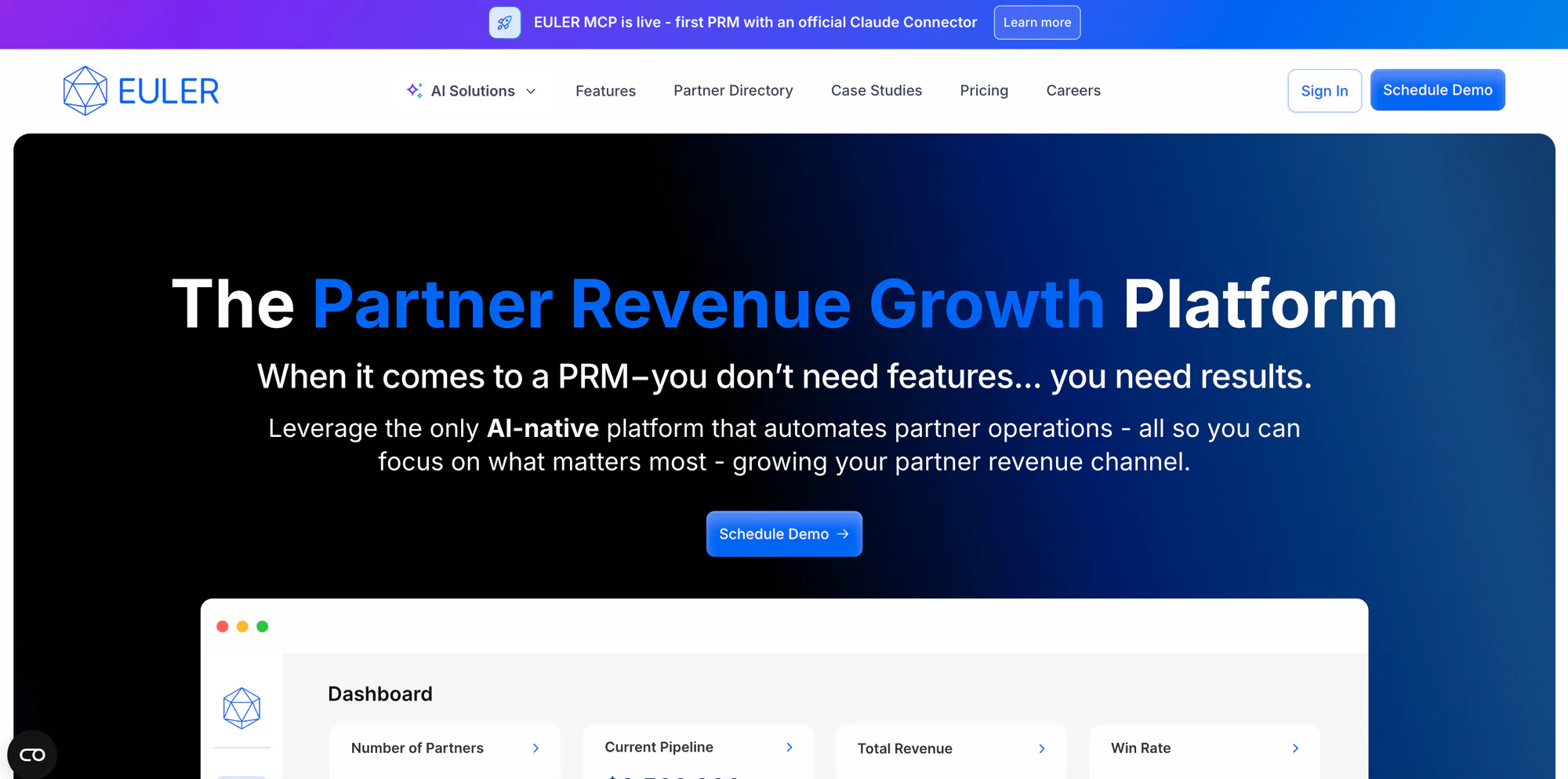
Euler is an AI-native partner relationship management (PRM) platform — it bills itself as “the partner revenue growth platform” and, more tellingly, a “partnership operating system” rather than a portal. The distinction is the whole point: instead of expecting partners to log into a portal, Euler meets partners where they already work — email, Slack, Microsoft Teams, a browser extension — and automates the operational spine of a partner program: referral and deal registration, bidirectional CRM sync, onboarding with e-sign contracts, commissions and payouts, enablement, and reporting. It’s one of the newest tools in the category (founded 2023) and one of the most aggressively AI-forward. Below: the company, what actually makes it distinct, its CRM and payments depth, pricing reality, the state of its reviews, and the best alternatives.
Full disclosure: PartnerPortal publishes this guide, and PartnerPortal is a Euler alternative. We’ve worked to keep this a fair, accurate overview built from Euler’s own materials, public sources, and verified third-party feedback — not a hit piece. Where we mention PartnerPortal, we flag it plainly.
TL;DR: Euler (eulerapp.com) is a modern, AI-native PRM built around two ideas most legacy tools miss — that partners won’t reliably log into a portal, and that CRM attribution and payouts are where programs actually break. So it pushes activity to email, Slack, Teams, and a Chrome extension, syncs bidirectionally with Salesforce, HubSpot, and Pipedrive (mapping to any object/field), and handles complex commissions and global payouts with per-deal breakdowns. Its strengths are off-portal engagement, genuine two-way CRM sync (including native Pipedrive), AI automation (e.g., registering deals from forwarded emails, plus an AI assistant partners can query in natural language), and fast time-to-value. Its trade-offs: it’s young (2023) with a shorter track record and thin public review base, pricing isn’t published (third-party estimates ~$1,000–$1,520/month, no free tier), and it’s lighter on heavy enterprise machinery (deep TCMA, multi-tier distributor programs) than the large platforms. Native CRM covers Salesforce, HubSpot, and Pipedrive — not Zoho or Attio.
What is Euler?
Euler is a PRM for lean, modern partnership teams — the software a company uses to run referrals, resellers, agencies, and other partners without a big channel-ops department behind it. It centralizes partner applications, onboarding, deal and referral registration, commissions, enablement, and reporting, and wires all of it into your CRM and billing systems so partner activity turns into measurable, attributed revenue.
Its founding insight is that partnership teams have historically been starved of purpose-built tooling: sales has a CRM, product has analytics, marketing has martech — but partnerships were left stitching spreadsheets and portals together. Euler’s answer is an “operating system for partnerships” that automates the workflows those teams actually run, and does it AI-first.
The honest framing: Euler is a capable, modern, automation-heavy PRM that punches above its size on CRM integration, payments, and AI. It is also new — so the trade-off versus an established vendor is track record and enterprise breadth, not modern design.
What makes Euler different
Most of this guide’s sections mirror how we cover any PRM, but Euler earns a dedicated one because two design choices genuinely set it apart:
- It assumes partners won’t log into a portal. This is the big one. Rather than build a content portal and hope for visits, Euler pushes referrals, deal updates, content, and notifications through email, Slack, Microsoft Teams, and a Chrome extension — and even offers an AI assistant partners can query (or submit referrals to) in natural language. Engagement happens in the partner’s existing workflow, which is where adoption actually lives.
- It’s AI-native, not AI-bolted-on. Euler was built around AI from the start. DealFlow AI, for example, lets you forward a referral or deal-registration email to Euler and have it registered automatically — no form, no manual entry. Its AI assistant (exposed even via an MCP connector) can summarize a partnership, surface commissions owed, and register referrals conversationally.
Together these make Euler less a “portal you administer” and more an automation layer over your partner program — the clearest philosophical break from the enterprise suites elsewhere in this hub.
Company background
Key facts, drawn from Euler’s own materials and public sources:
- Founded 2023 by Greg Portnoy — a partnerships practitioner who built Euler out of the operational pain of running a real, sizable partner program — with co-founders Dave Link and Giovana Bergara.
- Practitioner-first product. Euler emphasizes that features were prioritized with feedback from active partner leaders, aimed at solving real operational headaches (attribution, onboarding, payouts, engagement) rather than shipping “glossy dashboards.”
- Young and fast-moving. As a 2023 startup, Euler is one of the newest vendors in this comparison. That means a modern, rapidly evolving product — and a shorter track record, smaller install base, and thinner public-review history than established players.
- AI as identity. More than most, Euler leans into being “the only AI-native platform” for partner operations — its roadmap and messaging center on automation and AI agents.
The practical takeaway: Euler is a modern, founder-led, AI-first challenger built by someone who lived the problem. For teams that value that design philosophy, it’s compelling. For teams that need proven scale, references, and enterprise depth today, its youth is the thing to weigh.
How Euler positions itself
Euler positions itself as “the partner revenue growth platform” and an AI-native PRM / partnership operating system — built to turn partner activity into measurable revenue with minimal manual work. Its messaging leans on:
- Automate the work, don’t just host content. Euler frames legacy PRMs as portals you hope partners visit, versus an operating system that actively manages the lifecycle and pushes work to where partners are.
- Meet partners where they work. Off-portal engagement (email, Slack, Teams, browser extension) is central to the pitch — reduce friction, increase adoption.
- CRM- and revenue-first. Deep, bidirectional CRM sync and real attribution are positioned as the foundation, with commissions/payouts closing the loop from activity to paid.
- Small team, big leverage. Euler explicitly targets under-resourced partnership teams (“scale results without scaling the work”), pitching AI as the way one person can run a serious program.
Who it targets: SaaS and tech companies with lean partnership teams — referral, agency, reseller, and co-sell programs — that want automation, attribution, and payouts without standing up a heavyweight channel platform.
Euler’s key features
Euler covers the core PRM surface, with standout depth in CRM sync, payments, and AI-driven automation. The capabilities that define it:
Off-portal partner engagement
Euler’s signature. Partners get referrals, deal-status updates, content, and notifications via email, Slack, and Microsoft Teams, and can register deals from a Chrome extension without leaving their workflow. A partner-facing AI assistant lets them ask about their pipeline, commissions, and pending referrals — or submit a new referral — in plain language. There’s still a partner-facing experience when needed, but the design goal is engagement without forcing logins.
Bidirectional CRM sync
This is where Euler is unusually strong for its size. It integrates bidirectionally with Salesforce, HubSpot, and Pipedrive, mapping into any object or field you use — including custom objects. Approve a referral or deal in Euler and it creates the account, contact, and opportunity in your CRM; when a rep updates the stage in the CRM, the partner sees the status change automatically. That two-way flow eliminates duplicate entry and closes the attribution gaps that plague partner programs.
Commissions & payouts
Euler treats payments as a first-class problem, not an afterthought. It can model complex compensation — different rates by partner tier, SaaS vs. media commissions, mixed revenue streams — show partners an itemized, per-deal breakdown of what they were paid and why, run payout schedules, and let partners raise disputes or comment on invoices. It connects to billing/finance for reconciliation, and integrations like Tremendous enable global partner payouts (useful where ACH isn’t an option). Spiffs and incentive payments are supported.
Onboarding, enablement & AI
Euler handles partner applications (collect, review, approve), fast onboarding with built-in e-sign contracts, content and enablement, and training/certification — the full recruit-to-active flow without throwing tasks at legal or sales ops. Across all of it, AI does the heavy lifting: DealFlow AI auto-registers deals from forwarded emails, and AI assists with partner communications and insights. Analytics give customizable visibility into partner performance, pipeline, and program impact.
Full feature list
Beyond the highlights above, Euler includes:
- Partner applications, qualification, and dashboard-based approval
- Automated onboarding with e-sign partner contracts
- Referral & deal registration — including DealFlow AI (register from a forwarded email)
- Bidirectional CRM sync (Salesforce, HubSpot, Pipedrive) with custom-object support
- Deal tracking & attribution across the partner ecosystem
- Commissions, spiffs & payouts — tiered/complex models, per-deal breakdowns, invoice disputes
- Global payments via billing/finance and Tremendous integration
- Off-portal engagement — email, Slack, Microsoft Teams, Chrome extension
- AI assistant for partners (natural-language queries + referral submission; MCP connector)
- Partner marketing messages — blast, segmented, and automated communications
- Content & enablement, training & certification
- Customizable partner journeys and program analytics
Integrations
Euler’s integration story is a genuine strength for a tool its size — especially its truly two-way CRM sync. On CRM specifically:
| Category | Native integrations | Notes |
|---|---|---|
| CRM | Salesforce, HubSpot, Pipedrive | Bidirectional; maps into any object or field, including custom objects. Approvals in Euler create/update CRM records, and CRM stage changes flow back to partners. Native Pipedrive support is rare in this category. |
| Other CRMs (Zoho, Attio, etc.) | Not native | No purpose-built connector today; these would rely on middleware or Euler’s API. |
| Payments / finance | Billing systems, Tremendous | Commission reconciliation and global payouts, including markets where ACH isn’t available. |
| Collaboration | Slack, Microsoft Teams, email, Chrome extension | Powers the off-portal engagement model. |
The key evaluation point: if your CRM is Salesforce, HubSpot, or Pipedrive, Euler’s bidirectional sync is a real differentiator — deep, field-level, and two-way. If you run Zoho or Attio, Euler has no native integration, so you’d rely on middleware or the API. (For the full landscape by CRM, see our guides on the best PRM for Pipedrive, best PRM for Zoho, and best PRM for Attio.)
Euler pricing
Euler does not publish pricing. Based on third-party (competitor-reported) data, as of 2026:
| Tier | Reported price | Typical scope |
|---|---|---|
| Core | ~$1,000/month (indicative) | Entry — core PRM, CRM sync, referral/deal registration |
| Growth | ~$1,520/month (indicative) | More automation, payouts, and program scale |
| Enterprise | Custom | Larger programs, advanced needs |
A few pricing details worth understanding:
- No free tier and no self-serve signup — it’s a demo-and-quote motion, and entry starts well above SMB-priced tools.
- Estimates only. The figures above are third-party and indicative; because Euler doesn’t publish rates and they often depend on partner count and scope, treat them as a starting point and confirm directly with Euler.
- Mid-market positioning. Euler sits above lightweight, published-pricing PRMs but below the five-figure enterprise platforms — you’re paying for modern automation and CRM/payments depth, not enterprise breadth.
Teams optimizing on cost or wanting published pricing should also compare against our most affordable PRM software roundup, where standalone PRMs with transparent, lower pricing (some with free tiers) sit below Euler’s entry point.
What users say: Euler reviews
Early signals are positive, but the sample is small — Euler launched in 2023, so it has far fewer public, third-party reviews than established PRMs. The strongest verified feedback currently lives on the HubSpot App Marketplace, where customers highlight:
- Fast time-to-value — teams describe getting running quickly versus a prior provider.
- CRM integration and configurability — praise for how flexibly Euler feeds data in from different tech stacks and maps to CRM objects.
- Global payouts — the Tremendous integration is called out by partners who need to pay international channel partners (e.g., where ACH isn’t available).
- Direct, responsive team — unusually direct access to Euler’s leadership (via Slack) and fast issue resolution — a common upside of working with a young, founder-led vendor.
The honest caveat is maturity, not quality: as a new platform, Euler’s features, integrations, and proven scale are still expanding, and there simply isn’t the depth of long-run, cross-platform review history you’ll find for older vendors. Validate your specific must-haves in a demo rather than assuming enterprise-grade breadth. (Given its youth, Euler doesn’t yet carry the large G2 review base that platforms like Impartner or ZINFI do.)
Where Euler is limited
No tool fits everyone. Euler’s honest limits:
- Young and less proven — founded 2023, with a shorter track record, smaller install base, and thinner public-review history than established PRMs.
- Pricing isn’t public, and there’s no free tier — entry starts around four figures a month; you can’t budget without a conversation.
- Lighter on heavy enterprise machinery — deep through-channel marketing (TCMA), multi-tier distributor/MDF programs, and the like are the domain of the big platforms, not Euler’s focus.
- CRM coverage — excellent for Salesforce, HubSpot, and Pipedrive, but no native Zoho or Attio.
- Portal experience is secondary by design — a plus for engagement, but confirm the partner-facing experience meets your needs if you do want a rich destination portal.
Who Euler is best for
Euler is a strong fit if you’re:
- A SaaS or tech company with a lean partnership team that wants automation and attribution without a heavyweight channel platform.
- Struggling with partner engagement — Euler’s off-portal model (email, Slack, Teams, extension) is built precisely for partners who won’t log into a portal.
- Running on Salesforce, HubSpot, or Pipedrive and want genuine two-way CRM sync mapped to your own fields and objects.
- Managing complex commissions or global payouts and want per-deal transparency and reconciliation built in.
- Excited by an AI-native approach and comfortable partnering with a newer, fast-moving vendor.
Euler is probably not the right fit if you:
- Need proven enterprise scale, extensive references, or deep through-channel marketing / distributor programs today.
- Want a free tier, published pricing, or a self-serve start.
- Run your CRM on Zoho or Attio and want native sync.
- Prefer a mature, content-rich destination portal as the center of your program.
Euler alternatives
Euler sits in the modern, CRM-native PRM tier, so its alternatives split by direction:
- Closest alternatives (modern, lateral). The nearest match is Introw — also AI/CRM-native with an off-portal bent — followed by PartnerPortal (that’s us, disclosed), Kiflo, and JourneyBee. These share Euler’s philosophy of modern, automation-first partner management. Among them, PartnerPortal adds a permanently free tier, published pricing, and native support for more CRMs (Pipedrive, Zoho, and Attio) — worth a direct comparison if budget, transparency, or CRM fit is decisive.
- Moving up-market (enterprise). If you need heavy channel machinery — deep TCMA, multi-tier distributor programs, MDF at scale — step up to Impartner, ZINFI, Channelscaler (Allbound), or Salesforce PRM. These trade Euler’s lean, AI-native feel for enterprise breadth (and enterprise cost).
For the wider landscape:
- Best PRM software in 2026 — every major PRM ranked.
- Introw PRM — deep dive on the closest modern, CRM-native peer.
- Kiflo PRM and JourneyBee PRM — deep dives on the other lightweight alternatives.
Related reading
- Partner Relationship Management Platforms: Compare the Market — how the whole PRM landscape is structured.
- Best PRM Software in 2026 — the full category comparison.
- Most Affordable PRM Software in 2026 — PRMs ranked by real cost, including hidden fees.
- Best PRM for Pipedrive, Zoho, and Attio — where Euler is (and isn’t) native.
Weighing Euler against a modern PRM with a free tier and published pricing? Start a free PartnerPortal portal or browse native CRM integrations.
Frequently asked questions
What is Euler PRM?
Euler is an AI-native partner relationship management (PRM) platform — it calls itself 'the partner revenue growth platform' and a 'partnership operating system' rather than a portal. Instead of expecting partners to log into a portal, Euler pushes activity to where partners already work (email, Slack, Microsoft Teams, a Chrome extension) and automates the operational core of a partner program: referral and deal registration, bidirectional CRM sync, onboarding with e-sign contracts, commissions and payouts, enablement, and reporting. It's a modern, lean tool aimed at partnership teams that want automation and attribution without heavy admin.
Who makes Euler and how established is it?
Euler (eulerapp.com) is a young, AI-native startup founded in 2023 by Greg Portnoy — a partnerships practitioner who built the product from the pain of running a real program — along with co-founders Dave Link and Giovana Bergara. Because it launched in 2023, Euler is much newer than most PRMs in this comparison: the product is modern and moves fast, but it has a shorter track record and a thinner base of public, third-party reviews than established vendors. That's the core trade-off to weigh.
How much does Euler cost?
Euler does not publish pricing. Third-party (competitor-reported) estimates put entry plans around $1,000/month and a growth tier around $1,520/month, with enterprise pricing custom; plan tiers are commonly listed as Core, Growth, and Enterprise, and there is no free tier. That places Euler above SMB-priced tools but below the five-figure enterprise platforms. Because the numbers aren't public and often depend on partner count and scope, confirm current pricing directly with Euler.
Which CRMs does Euler integrate with?
Euler offers genuinely bidirectional native integrations with Salesforce, HubSpot, and Pipedrive — and maps into any object or field you use. Approve a referral or deal in Euler and it creates the account, contact, and opportunity in your CRM; when stages change in the CRM, partners see the status update automatically. Native Pipedrive support is notable — few PRMs offer it. There's no native Zoho or Attio connector today, so those would rely on middleware or the API.
How is Euler different from a traditional PRM?
Two things. First, the off-portal model: Euler assumes most partners won't log into a portal regularly, so it delivers referrals, deal updates, content, and notifications through email, Slack, Microsoft Teams, and a browser extension — and even lets partners query data or submit referrals with an AI assistant in natural language. Second, it's built AI-native: features like DealFlow AI can register a deal automatically from a forwarded referral email. The pitch is a 'partnership operating system' that automates the work, rather than a content portal you hope partners visit.
Is Euler any good? What do reviews say?
Early signals are positive, but the sample is small. Because Euler launched in 2023, it has far fewer public reviews than established PRMs; the strongest verified feedback lives on the HubSpot App Marketplace, where customers praise fast time-to-value, deep CRM integration, configurability, global partner payouts (via a Tremendous integration), and unusually direct, responsive access to Euler's team. The honest caveat is maturity: features, integrations, and scale are still expanding, so pressure-test your specific requirements in a demo rather than assuming enterprise-grade breadth.
What are the best Euler alternatives?
Euler sits in the modern, CRM-native PRM tier, so its closest alternatives are other modern tools: Introw (the nearest match — also AI/CRM-native), PartnerPortal, Kiflo, and JourneyBee. If you instead need heavy enterprise machinery — deep through-channel marketing, multi-tier distributor programs, or MDF at scale — you'd move up-market to Impartner, ZINFI, Channelscaler (Allbound), or Salesforce PRM. Among the modern peers, PartnerPortal adds a permanently free tier, published pricing, and native support for more CRMs (Pipedrive, Zoho, and Attio) — worth comparing directly if budget or CRM fit is the deciding factor.